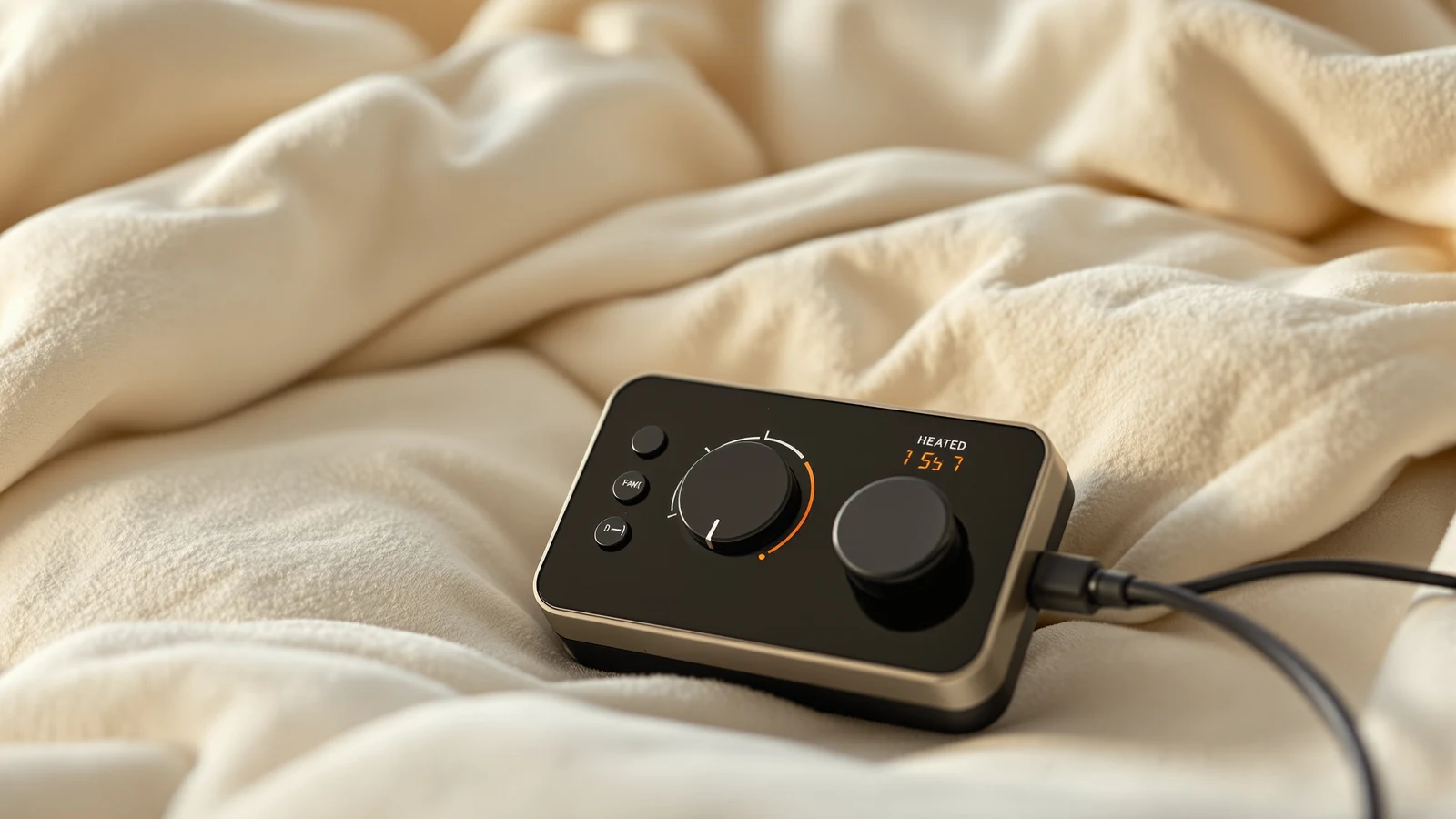
Roundup · Heated Blankets With Simple Controls
The Best Heated Blankets With Simple, No-Fuss Controls
A backlit touchscreen is not an upgrade for everyone. It is a second thing to learn, a second thing that can glitch, and in a dark bedroom it is one more light source you didn't ask for. This guide is about the other end of the category: blankets built around a single dial or a small set of buttons, where there is almost nothing to get wrong.
By Ilane Tall · Updated November 2, 2026 · Research-based.
Quick answer
Fewer controls, fewer ways to get it wrong
A simple-controls heated blanket replaces a menu of settings, modes and a glowing screen with one dial or a short row of buttons: turn it up, turn it down, done. Of the three we cover here, the LaffyLo Electric Heated Blanket (72×84″ full size) is the clearest example — it runs on a dial-and-button controller rather than a backlit digital one, while still publishing ten heat settings, a 1–12 hour timer and ETL-certified overheat protection, so "simple" doesn't mean "stripped of safety features." The JOYFLAME Ultrasoft Throw and the RAYVOICE Pink Throw sit at a lower price with fewer published specifics, which is itself informative about how basic their controls are.
This guide works through what a digital display actually buys you, why fewer controls means fewer failure points, where a simple blanket still needs a real safety feature, who this suits beyond the obvious answer, and when the simpler option is the wrong call. Jump straight to the picks.
Disclosure: this article contains affiliate links. If you buy through one, we may earn a commission at no extra cost to you — see our About page for how we research.
The upsell
What a digital display actually adds, and who it's for
A backlit digital controller does three things a dial doesn't: it shows you exactly which setting you're on without counting notches, it's legible in a dark room without a bedside lamp, and it usually comes bundled with a finer range of steps — twelve levels instead of six, say, or a selectable timer you set to the hour instead of picking from a handful of presets. We've covered that end of the market in how many heat settings a heated blanket actually needs, and the short version is that most people settle into one or two favorite levels within the first week and rarely touch the rest.
That's the case for a display: precision and visibility. The case against it is just as concrete. A screen is a second thing that can fail — a dim backlight, a flickering digit, a button that stops registering taps — on a part you cannot easily repair yourself. It also means a light source stays on, or has to be actively switched off, in a room where you're trying to sleep in the dark. And on a blanket like the LaffyLo, which publishes ten heat settings and a twelve-hour timer window through a plain dial-and-button layout, you get most of the functional range of a digital model without the screen at all. The display is a convenience feature layered on top of the heating function, not a requirement for it.
Who actually wants the digital version: someone who changes settings often enough that counting dial clicks gets old, someone who wants to confirm the exact setting at a glance, or someone buying for a shared bed where two different readouts need to stay distinguishable. If none of that describes you, you're paying for a feature you'll stop noticing within a month — which is the same math we work through in are expensive heated blankets worth it.
Fewer parts, fewer failures
One button or one dial: how little there is to get wrong
Every control a blanket adds is also a control you can mis-set. A programmable timer with a day-of-week schedule is a feature right up until you're trying to figure out, half-asleep, why it switched itself off at 11 p.m. instead of staying on until morning. A twelve-level display is a feature right up until you've nudged it up three notches by accident while pulling the blanket straight. A single dial doesn't have that failure mode: turn it clockwise for warmer, counter-clockwise for cooler, and the only thing left to misunderstand is which direction is which — usually marked right on the dial itself.
The LaffyLo's controller is the clearest case we can point to among our three picks: a dial-and-button layout rather than a backlit digital one, covering ten heat settings and a timer you set from one to twelve hours. That's a wide functional range delivered through a small number of physical actions, which is the actual point of "simple controls" — not fewer capabilities, just fewer steps between you and the one you want. The JOYFLAME throw takes this further on paper: its listing centers on a single headline number, a top heat of 125.6°F reached through what it calls fast, even heating, rather than a published count of stepped levels. A blanket marketed around one temperature figure rather than a ladder of settings is, by definition, asking less of you at the controller.
The RAYVOICE throw is the plainest of the three on paper — its listing is built around size (50×60″) and color rather than a feature list, and it doesn't publish a heat-setting count or timer duration the way the LaffyLo does. That absence of marketing language around "programmable" or "app-connected" is itself a signal of a basic controller, though we'd still tell you to check the current listing photos for the exact control layout before you buy, since that's the only place the manufacturer confirms it precisely.
Not the same thing as "basic"
Where simple controls still need a safety feature underneath
Fewer buttons on the outside should never mean fewer safeguards on the inside, and this is the one place we'd push back on "simpler is always better." An automatic shut-off and overheat protection are not visible controls — you don't set them, you don't see them working — but they're what keeps a blanket left on for hours from becoming a hazard rather than a convenience. Among our three picks, the LaffyLo is the one that states this explicitly: it's ETL certified, lists overheat protection by name, and pairs that with its 1–12 hour timer, so the auto-off isn't something you have to remember to set every single night.
The JOYFLAME and RAYVOICE listings don't name a certification mark or an overheat-protection feature the way the LaffyLo's does. That doesn't mean they lack one — US-market electric blankets are generally built with some form of automatic shut-off as standard — but we don't have that specific confirmation in front of us, so we won't assert it on their behalf. If a certification mark (ETL or UL) and an explicit overheat-protection claim matter to you, which they should on anything you plan to leave running near a mattress or plugged in overnight, check the current listing and the physical tag on the blanket itself before you buy, and treat a published certification as a real point in a product's favor rather than an assumption to make for it.
This is the actual trade-off buried inside "simple controls": you want a blanket where the controls are easy to use correctly, and where the safety behavior doesn't depend on you using them correctly in the first place. A single dial you can't fat-finger into the wrong mode is a genuine safety upgrade over a multi-function remote. A missing overheat-protection claim is not a feature of simplicity; it's just a gap in what the listing tells you.
Beyond the obvious answer
Who this actually suits: not just grandparents
The instinct is to file "simple controls" under gifts for older relatives, and that's a real use case — a large dial with a tactile stop is genuinely easier to use for anyone dealing with reduced grip strength or low vision, and we'd note that as general information rather than medical advice; if dexterity or sensation is a specific concern, that's worth a conversation with a doctor rather than a guide like this one. But that's a narrow read of who benefits.
Think about a guest room or a dorm room, where nobody living there wants to learn a new device's quirks for a blanket they'll use a handful of nights a year — a dial that's self-explanatory on first touch beats a manual nobody will read. Think about anyone who already owns a house full of app-connected, screen-equipped devices and specifically does not want one more thing syncing, updating, or lighting up a bedroom at night; a heated blanket is one of the few remaining appliances that doesn't need to be "smart" to do its one job well. Think about a couch blanket used by whoever's in the room that evening — a houseguest, a kid, a partner who's never touched the thing before — where the controller needs to make sense to a stranger with zero instruction. And if pets share the furniture, the same simplicity applies: see our guide to heated blankets for pet owners for what else changes when a blanket gets used, and occasionally sat on, by an animal.
The throughline isn't age. It's how much attention you're willing to spend on the interface before you get to the part that actually matters, which is being warm.
The picks
Three blankets built around one button or one dial
Ordered from the plainest controller to the most feature-complete one that's still not a digital display. Prices move on Amazon — confirm the live price before buying.
01Plainest controls
RAYVOICE Pink Heated Blanket Electric Throw
For anyone who just wants heat, in pink, with nothing to configure
50×60″ throw · electric heated throw · pink
At $36.99, this is the cheapest of the three and the one with the shortest listing: size, color and the basic fact that it's an electric heated throw. There's no published count of heat settings, no stated timer duration, and no named certification — which means we won't claim any of those on its behalf, and you should check the current Amazon listing and product photos for the exact control layout before buying. What we can say with confidence is the size (50×60″, a single-person sofa throw) and the price, which puts it at the inexpensive end of the category covered in our guide to cheap heated blankets that are still worth buying. If a short feature list and a specific color is what you're after — a dorm room, a gift, a second blanket for a room where you don't want to think about it — this is built for exactly that.
02One headline number
JOYFLAME Ultrasoft Electric Heated Blanket
For people who think in "how hot," not "which of twelve levels"
50×60″ throw · 125.6°F top heat · fast, even heat · ultrasoft fabric
JOYFLAME's listing is built around a single specification rather than a ladder of settings: a top heat of 125.6°F, reached through what the brand calls fast, even heating. That's a meaningfully different pitch than a blanket that leads with "twelve heat levels" — it's one number, and the controller's job is simply to get you there and let you back off if it's too much. At $28.45 it sits between our other two picks on price, and the ultrasoft fabric description points at a plush throw rather than a flannel or sherpa weave. We don't have a published timer duration or certification mark for this one either, so treat the auto-off behavior as something to confirm on the current listing rather than something we're asserting here. If you'd rather know "how hot does this get" than "which of these settings do I want," this is the one built around that question.
03Most capability, simplest controller
LaffyLo Electric Heated Blanket, Full Size
Full bed coverage and a real feature set, without a digital display
72×84″ full size · 10 heat settings · 1–12 h timer · flannel & sherpa · ETL certified · overheat protection · machine washable
This is the pick that proves the point of this whole guide: you don't have to trade capability for a simple controller. At $39.99, the LaffyLo covers a full-size bed at 72×84″ with flannel on one face and sherpa on the other, runs through ten heat settings and a selectable 1–12 hour timer, and is ETL certified with stated overheat protection — and it does all of that through a dial-and-button layout rather than a backlit digital screen. That combination is rare in this price range: most blankets with this many published specs lean on a digital controller to manage them. It's also listed as machine washable once the controller is detached, and for more on what that fabric pairing feels like day to day, see our comparison of flannel, sherpa and faux fur. If you want the fullest feature set of the three without learning a menu, this is the one to buy.
| Model | Best for | Size | Controller | Stated safety feature | Price | Get it |
|---|
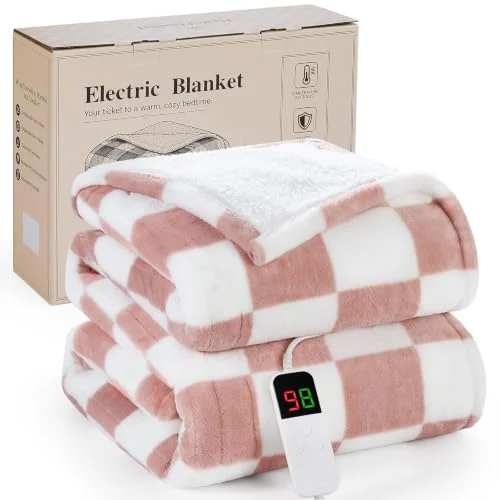 RAYVOICE Pink Throw | Plainest, cheapest | Throw 50×60″ | Not published — check listing | Not published — check listing | $36.99 | Price |
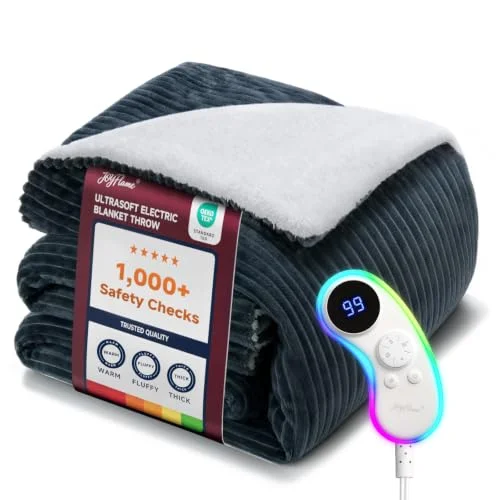 JOYFLAME Ultrasoft Throw | One headline temperature | Throw 50×60″ | Single top-heat spec (125.6°F) | Not published — check listing | $28.45 | Price |
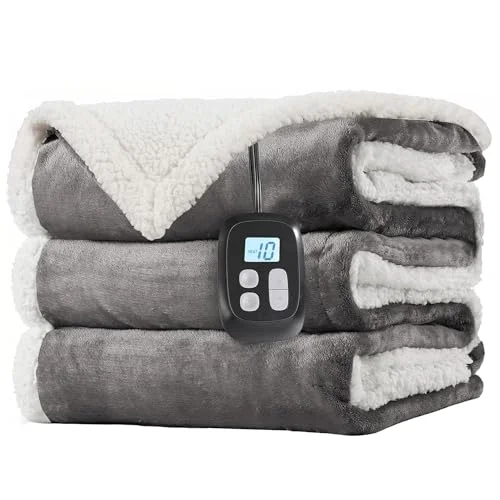 LaffyLo Full Size | Full bed, most capability | Full 72×84″ | Dial & button, 10 settings | ETL certified, overheat protection | $39.99 | Price |
The honest counter-case
When the simpler controller is the worse buy
Simple controls solve a specific problem — too many settings, too much screen, too much to remember — and that problem doesn't apply to everyone. If you share a bed and run a noticeably different temperature than your partner, a single dial sets one heat level for the whole blanket; there's no zone to split, so whoever controls the dial is making the call for both of you. That's a real limitation worth knowing about before you buy, even though none of our three picks here are dual-zone blankets.
If you're genuinely particular about temperature — not "warm enough" but a specific, repeatable level you want to return to night after night — a finer-grained control surface earns its keep. Ten settings or a single top-heat spec give you less precision between "too cool" and "too warm" than a longer ladder of levels would, and for some people that gap is the difference between a blanket they love and one they fiddle with every night. And if you want to schedule the blanket to start warming before you get into bed, or want an exact readout of which level you're on without checking a dial's position, that's explicitly a digital-display feature, and it's a reasonable thing to pay more for rather than something these three picks are built to do.
The honest version of "simple controls" isn't "every blanket should have fewer features." It's "match the control surface to how much you actually plan to adjust it." For a sofa throw that gets set once and left alone, or a full-size blanket where ten settings and a wide timer window already cover what most people use, the simpler controller is the better buy, not a compromise. For a shared bed with two different preferences, or a household that wants precision and scheduling, it's worth paying for the display.
How we picked
Three blankets, chosen for their controllers
We looked specifically for electric blankets and throws whose listings point toward a simpler control surface — a dial-and-button layout instead of a backlit digital one, or a single headline heat spec instead of a long ladder of settings — rather than pulling the most feature-dense options in the category. We kept products with at least a confirmed size and price, and we did not add anything whose only claim was an adjective with no size or spec behind it.
How we compared
Research, not a lab
We're honest about this: we don't physically test these blankets and we don't run a testing lab. We compare published specifications, stated certifications, live pricing and listing language, and where a product's listing doesn't publish a spec — a heat-setting count, a timer duration, a certification mark — we say so rather than filling the gap. Amazon no longer exposes verified star ratings or review counts through its product API, so you will not find rating badges, scores, or paraphrased review sentiment anywhere in this guide.
FAQ
Common questions
Do simple heated blanket controls still have an auto-off timer?
It depends on the specific blanket, and it's a published spec rather than something you can assume. The LaffyLo states a selectable 1–12 hour timer alongside its dial-and-button controller, so a simple interface and a real auto-off aren't mutually exclusive there. The RAYVOICE and JOYFLAME listings we reviewed don't state a timer duration, so if an auto-off window matters to you, confirm it on the current listing before buying rather than assuming it works a particular way.
Is a digital display worth paying more for?
Only if you'll use what it adds: a finer range of heat steps, an exact readout of your current setting, or legibility in a dark room without a lamp. If you tend to pick one comfortable setting and leave it there, a dial or a small set of buttons gets you to the same warmth with less to learn and fewer parts that can glitch. Our guide to whether expensive heated blankets are worth it goes through this trade-off in more detail.
Are single-dial heated blankets safe to leave on overnight?
A simple controller and a safe blanket are two separate questions. What actually matters overnight is automatic shut-off and overheat protection, which are safety features rather than visible controls. The LaffyLo states both explicitly alongside ETL certification. For any blanket, check the listing and the physical tag for a certification mark (ETL or UL) and a stated overheat-protection feature before leaving it running unattended for hours.
Who benefits most from a heated blanket with simple controls?
Not just older users, though a large tactile dial genuinely helps anyone dealing with reduced grip strength or low vision. It also suits guest and dorm rooms where nobody wants to learn a new device for occasional use, households that are deliberately avoiding more screens and smart features, and shared furniture like a couch where whoever's using the blanket that evening needs the controller to make sense without instructions.
Keep reading
Related reading