Best Heated Blankets
Buying Guide · Heat Settings

How Many Heat Settings Does a Heated Blanket Actually Need?

Some blankets offer five heat levels, others twelve. The difference is rarely about getting warmer, and almost always about how finely you can land on the one setting you'll actually use once the novelty of flipping through all of them wears off.

By Ilane Tall · Updated October 30, 2026 · Research-based.

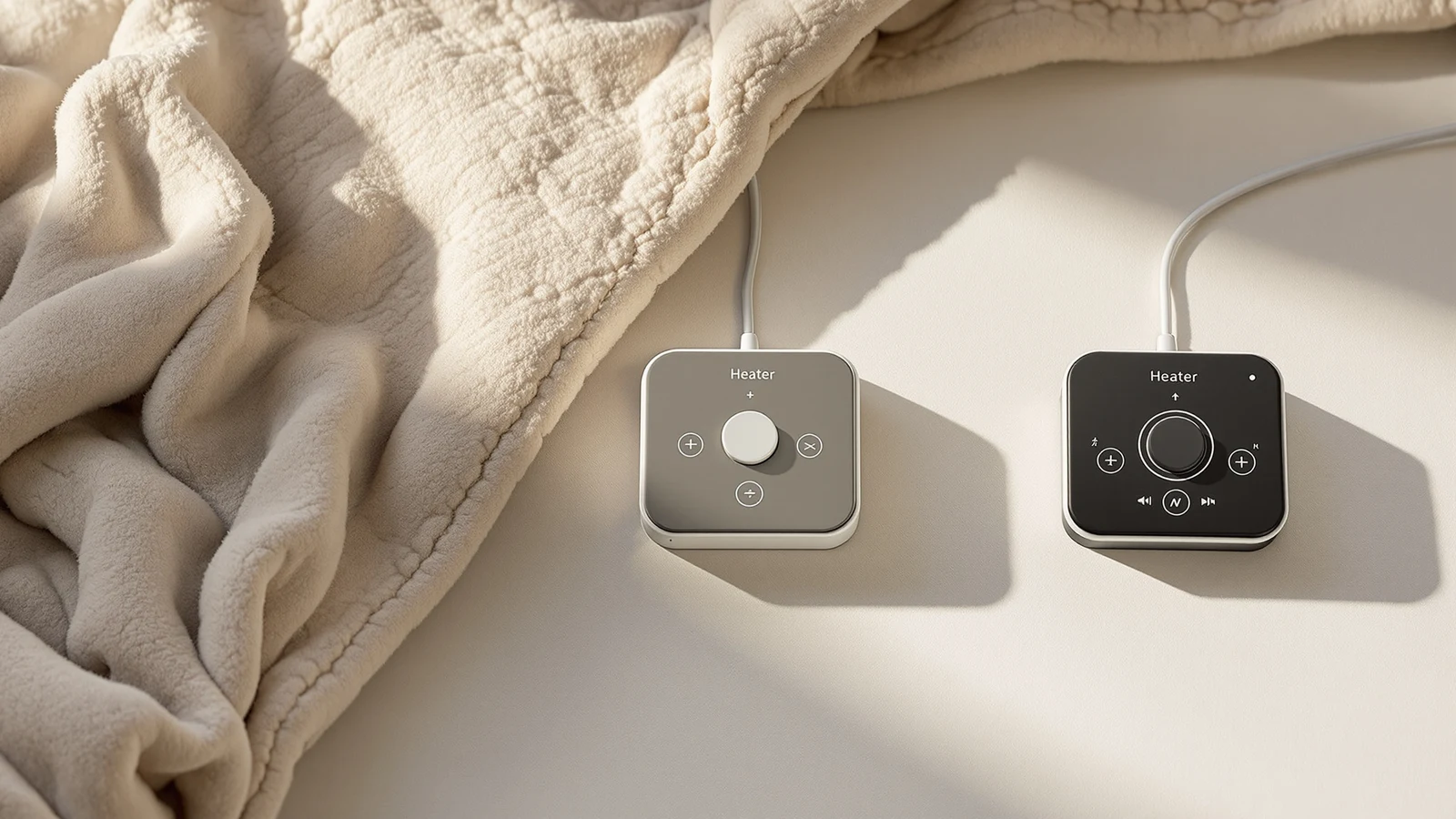
Two heated blanket controllers, one grey and one black, each with a central dial and labeled heat buttons, resting beside a folded cream sherpa throw blanket
Quick answer

More settings sounds like more warmth. It almost never is.

A heat level is a resolution control, not a power control. It decides how many stops sit between "barely on" and "as hot as this blanket goes" — it does not usually change where those two extremes actually are. A five-level blanket and a twelve-level blanket built from similar fabric and wire can run through almost the same temperature range; the twelve-level one just gives you finer steps along the way, so you are more likely to stop on a setting that matches how warm you actually want to be instead of hovering between two that are both slightly wrong. Five levels is the practical floor for this category and is plenty for a single, consistent user. Eight to ten is where most blankets on the market settle, and it is the range most people are happiest with. Twelve is a real improvement in granularity, not just a bigger number on the box — but the gap it closes gets smaller with every extra step, and most people stop noticing it well before the dial runs out.

This guide walks through what a heat level physically changes, who each tier of setting count actually suits, how settings interact with preheat and auto-off timers, three real blankets that sit at five, eight and twelve levels, and what tends to happen to your own habits after the first week of owning any of them. Jump to the picks or to the level you'll actually use.

Disclosure: this article contains affiliate links. If you buy through one, we may earn a commission at no extra cost to you — see our About page for how we research.

The mechanism

What a heat level actually changes versus what the number suggests

The number printed on the box — "5 heat settings," "8 heating levels," "12 heat levels" — describes how many stops the controller has between its lowest and highest output, not how hot the blanket gets at the top or how cool it runs at the bottom. Most electric throws regulate warmth by cycling the heating wire on and off faster or slower rather than by physically changing how much current the wire can carry, so a controller with more steps is dividing roughly the same working range into smaller slices. A blanket with twelve settings is not necessarily capable of running hotter than one with five; it is capable of landing on a temperature closer to the one you actually want, because the gap between adjacent levels is smaller.

This matters because manufacturers almost never publish wattage per level, and none of the three blankets in this guide do. Without that figure, the setting count is the only clue you get about resolution, and resolution is genuinely useful — it is just a different thing from heat output. A five-level blanket that runs from comfortably warm to quite hot in five steps can still feel "right" to someone who always wants roughly the same amount of warmth. A twelve-level blanket covering a similar range in twelve steps mainly helps the person who finds that level 3 is a little cool and level 4 is a little much — the kind of gap that smaller steps are built to close.

The three blankets below make this concrete, because they sit at three different points on the same basic scale while doing the same job: an electric throw blanket you drape over yourself on a sofa or bed. The HOMLYNS Heated Throw Blanket offers five heat settings and a fixed three-hour timer. The Mlivrom Heated Throw Blanket offers eight heating levels and a one-to-nine-hour timer. The waffle-textured Heated Blanket Electric Throw offers twelve heat levels and a one-to-twelve-hour timer. None of the three publish a wattage figure or a temperature range in degrees, which is typical for this price tier — you are reading step count as a proxy for control, the same way we are in this guide.

The floor

Five levels: the floor, and who it is enough for

Five is close to the practical minimum for a heated throw that still counts as adjustable rather than a simple on/off pad. Below five, you tend to find two-setting "low/high" heating pads aimed at a different use case entirely — localized relief rather than whole-body warmth — so five levels is the point where this category of product starts. The HOMLYNS Heated Throw Blanket sits right at that floor: five heat settings and a three-hour timer, priced at $24.98, the least expensive of the three blankets in this guide.

Five settings is genuinely enough for a specific kind of user: someone who already knows roughly how warm they like to be and reaches for the same setting every time, rather than someone who fine-tunes the dial every evening. If you are buying a blanket for a sofa session that rarely runs past a couple of hours, the fixed three-hour auto-off on the HOMLYNS matches that pattern directly — you are not relying on the timer to carry you through the night, so a shorter, simpler timer is not a drawback here the way it would be on a bed blanket. For a reader working from a tight budget, the five-level tier is also where the cheapest heated blankets that are still worth buying tend to cluster, and it is worth checking our picks under $30 if price is the deciding factor before settings count ever comes into it.

Where five levels starts to feel thin is anywhere two people share one blanket and disagree on comfort, or where you are sensitive enough to temperature that the gap between "a little cool" and "a little warm" regularly falls between two of the five stops rather than on one of them. In both cases, the frustration is not that the blanket cannot get warm enough — it almost always can — it is that there is no stop that sits exactly where you want it.

The sweet spot

Eight to ten levels: the range most people settle into

Across the electric blanket and throw category, eight to ten settings is where the bulk of the market lands, and it is a reasonable middle ground: enough resolution that most people can find a stop close to where they want to be, without needing a backlit digital display or a premium price tag to deliver it. The Mlivrom Heated Throw Blanket sits in this band at eight heating levels, priced at $24.99 — almost identical to the five-level HOMLYNS, which makes it a useful comparison: for essentially the same money, you get three more stops to choose between.

The Mlivrom is a 50×60″ flannel throw, ETL certified and machine washable, built around full-body warmth rather than a localized pad. Its timer runs from one to nine hours with auto-off, a noticeably wider window than the HOMLYNS's fixed three hours — one hour covers a short pre-warm before you settle in, nine covers most of an evening and well into the night. That range is worth reading in its own right if auto-off duration matters to you as much as heat-level count does; we cover exactly how shut-off timing is engineered in our guide to heated blanket timers.

Eight levels is the tier to buy if you do not yet know exactly how particular you are about temperature. It gives you enough room to discover whether you are a "set it and forget it" user or someone who wants to nudge the dial by one notch most evenings, without paying the premium that the next tier up tends to carry.

The ceiling

Twelve levels: finer control or a bigger number on the box

The waffle-textured Heated Blanket Electric Throw tops out at twelve heat levels, paired with a one-to-twelve-hour timer, overheat protection, and both ETL and FCC certification — and it costs $27.61, close to double the five- and eight-level blankets above. Twelve levels is a real improvement in resolution over eight: more stops packed into a similar working range means each step represents a smaller jump, which helps if you are the kind of user who finds that "warm enough" and "slightly too warm" are genuinely only one notch apart on a coarser dial.

The catch is diminishing returns. Going from five levels to eight closes a noticeably large gap — you can feel the difference between three stops and five extra ones. Going from eight to twelve closes a smaller gap again, because the same working temperature range is now being divided into even thinner slices, and most people's ability to distinguish between two adjacent slices has limits well before the dial does. In practice, a lot of twelve-level owners still describe themselves as using two or three settings regularly, the same as owners of a five-level blanket — the extra levels mostly exist for the handful of times a precise in-between temperature actually matters.

What the extra money on a twelve-level blanket like this one more reliably buys is not just finer steps — it is the surrounding spec sheet. Overheat protection and dual certification (ETL and FCC here, versus no stated certification on the cheaper HOMLYNS) are the kind of safety-adjacent features that tend to travel with the higher-setting-count tier, not because more heat levels require them, but because they are often bundled into the same premium product line. If you are trying to decide whether that bundle is worth the markup in general, not just for heat-level count, our breakdown of what pricier heated blankets actually add goes through it product by product.

How they interact

How settings interact with preheat and timers

Heat-level count and timer length are sold as separate specifications, but they are usually designed to work together. A number of electric blankets run a short preheat phase at a higher output regardless of which steady-state level you have selected, then drop back to your chosen setting once the fabric has come up to temperature — the idea being that you get fast warmth at the start without having to manually dial up and back down yourself. None of the three blankets in this guide publish a dedicated preheat spec, so if that behavior matters to you specifically, check the individual listing rather than assuming it from the heat-level count; we go through how preheat is actually engineered, and which blankets implement it as a distinct step rather than just "running hot at first," in our guide to the preheat function.

Timer range tends to scale with price and setting count in this category, and the three blankets here illustrate that pattern cleanly: the five-level HOMLYNS has a fixed three-hour auto-off, the eight-level Mlivrom runs one to nine hours, and the twelve-level waffle throw runs one to twelve hours. That is not a coincidence of these three specific products — a wider, selectable timer window is a common feature of the same higher tier that also tends to carry more heat levels, finer certification, and a higher price. If you plan to leave a blanket running most of the night, the auto-off window deserves at least as much attention as the setting count, because a blanket that shuts off after three hours is a sofa blanket regardless of how many heat levels it offers. For the mechanics of how auto-off is timed and why it exists at all, see our timer guide.

The practical takeaway: do not treat heat-level count as a stand-in for how long or how automatically a blanket will behave. They are usually correlated in this market, but they are controlled by different parts of the circuit, and a blanket can in principle offer a wide heat-level range with a short timer, or a narrow range with a long one. Read both specs, not just the one on the front of the listing.
Our picks

The picks: one at each tier

Three electric throw blankets, chosen specifically because they sit at five, eight and twelve heat levels and let the comparison speak for itself.

01Five levels

HOMLYNS Heated Throw Blanket

For one consistent user who wants simple, not granular
5 heat settings · 3-hour timer · throw · grey

The least expensive of the three at $24.98, and the one to buy if you already know you'll use the same setting most evenings. Five stops are enough to move from a light warm-up to a genuinely hot setting without the blanket ever feeling under-powered; what you give up against the other two is the ability to land on a temperature that sits precisely between two of those five stops. The fixed three-hour timer suits a sofa session rather than an all-night bed blanket — plan around that rather than against it.

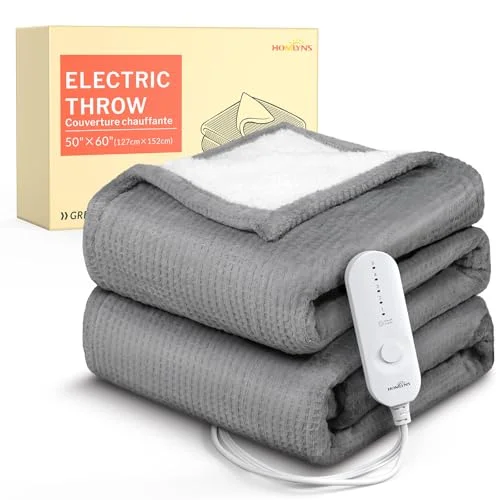
HOMLYNS heated throw blanket in grey with digital controller, folded, next to its retail box
$24.98
5 settings · 3h timerCheck price →
02Eight levels

Mlivrom Heated Throw Blanket

The tier most people end up happiest with
50×60″ · 8 heating levels · 1–9 h timer · flannel · ETL certified · machine washable

At $24.99 this costs almost exactly the same as the five-level HOMLYNS, which makes the extra three heat levels close to a free upgrade in resolution. The flannel construction is built for full-body warmth rather than a single zone, it carries ETL certification, and the one-to-nine-hour timer covers everything from a short pre-bed warm-up to most of a night, well past the HOMLYNS's fixed three hours. If you are not sure yet how particular you are about your exact comfort temperature, this is the tier to start learning on.

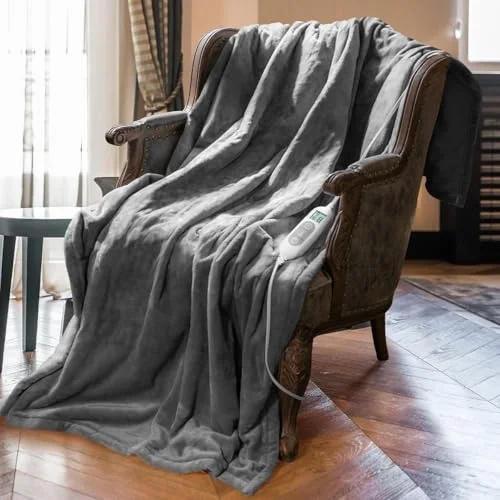
Mlivrom grey flannel heated throw blanket draped over a wingback armchair with its controller clipped to the fabric edge
$24.99
8 levels · 1–9h timerCheck price →
03Twelve levels

Heated Blanket Electric Throw, Waffle, 12 Heat Levels

For the sharpest step-to-step control this guide covers
Single 50×60″ · 12 heat levels · 1–12 h timer · waffle texture · overheat protection · ETL & FCC certified · light grey

At $27.61, close to double the other two, this is the blanket to buy if you have already owned a five- or eight-level model and found yourself wishing for a stop that sat between two existing ones. Twelve heat levels paired with a one-to-twelve-hour selectable timer gives you the widest working window in this guide on both axes, and it is the only one of the three with stated overheat protection and dual ETL and FCC certification. The waffle texture is also a heavier, more structured weave than the flat flannel of the other two, which is worth knowing if you specifically want a throw that already feels substantial before it's plugged in.

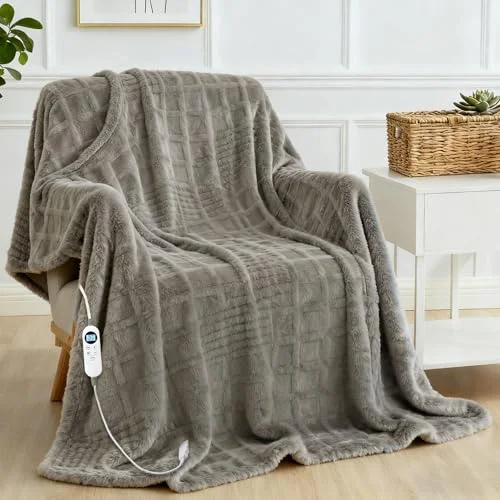
Grey waffle-textured heated throw blanket draped over a chair with its digital controller clipped to the corner
$27.61
12 levels · 1–12h timerCheck price →
ModelHeat settingsTimerCertificationPrice
HOMLYNS Throw53 h, fixed—$24.98Price
Mlivrom Throw81–9 hETL$24.99Price
Waffle Throw, 12-Level121–12 hETL & FCC$27.61Price
What actually happens

The level you will actually use after the first week

Almost everyone who buys a heated blanket spends the first few evenings clicking through every setting it offers, partly out of curiosity and partly to find the ceiling. That exploration phase is where a twelve-level blanket feels most obviously superior to a five-level one — you notice the finer gradations because you are actively comparing adjacent stops against each other. It rarely lasts. Within a week or two, most owners settle into one or two levels they return to by habit: often a higher setting to warm up quickly, then a lower one to hold through the rest of the evening, or a single steady mid-level they stop adjusting altogether.

Once that settling happens, the real test of a blanket's setting count is narrower than it first appears: does it have a stop that sits close enough to your personal comfort zone? A five-level blanket that happens to include a step near where you land will feel just as satisfying day to day as a twelve-level blanket, because you are not toggling through the rest of the range anymore. A twelve-level blanket only pays off long-term if your ideal temperature happens to fall in a gap that a coarser dial can't reach — and you typically cannot know that in advance. It is one of the few specifications in this category where buying slightly more resolution than you think you need is cheap insurance, and buying less is a real risk if you turn out to be a particular user, but neither can be confirmed until you have actually lived with the blanket for a week.

If you are upgrading from a worn-out blanket and already know which of the two patterns describes you — "I always use the same setting" versus "I keep nudging it by one notch" — let that answer the heat-level question before price does. If you don't know yet, the eight-level tier is the safer first purchase: it is priced close to the five-level floor in this guide, and it gives you enough resolution to find out which kind of user you are before committing to the premium that twelve levels tends to carry.

How we picked

Three products, chosen for contrast

Rather than survey every electric blanket on the market, we picked three that sit at distinct points on the heat-level spectrum while otherwise doing the same job — an over-body electric throw, not a mattress pad or a localized pad. Each had to publish a complete specification before we would compare it: a stated heat-level count, auto-off timer behavior, fabric, and any named safety certification. We deliberately chose across the five, eight and twelve-level tiers because the setting count, not the brand or the fabric, is the variable this guide is built to explain.

How we compared

Research, not a lab

We're honest about this: we don't physically test these blankets and we don't run a testing lab. We compare published specifications, stated certifications, and live pricing, and we reason from general, publicly known facts about how resistive heating wire and duty-cycle controllers behave. Amazon no longer exposes verified star ratings or review counts through its product API, so you will not find rating badges, invented scores, or paraphrased review sentiment anywhere in this guide — we simply do not have that data for these specific products.

FAQ

Common questions

Do more heat settings mean a hotter blanket?

Not necessarily. The setting count tells you how finely the controller divides the space between the blanket's lowest and highest output, not how hot that highest output actually is. A five-level blanket and a twelve-level blanket can top out at a similar maximum warmth; the twelve-level one simply gives you more stops along the way, so you are more likely to land on exactly the temperature you want instead of a step above or below it.

Is five heat settings enough for a heated blanket?

For a lot of people, yes. Five is close to the practical floor for this category and works well if you tend to use the same setting every time you reach for the blanket, as with the HOMLYNS Heated Throw Blanket's five settings and three-hour timer. It becomes limiting mainly when two people share one blanket with different comfort preferences, or when your ideal temperature consistently falls between two of the five available stops.

Why do some blankets have 8 settings and others 12 for similar prices?

It varies by product and brand rather than following a strict rule, but in this guide the pattern held: the 8-level Mlivrom throw cost almost the same as the 5-level HOMLYNS, while the 12-level waffle throw cost close to double both. Higher setting counts in this category often arrive bundled with other features — a wider timer range, overheat protection, additional certification — rather than being priced purely on the number of steps alone.

Does the timer length relate to the number of heat settings?

They are controlled separately, but in practice they tend to scale together. Across the three blankets in this guide, the 5-level model has a fixed 3-hour timer, the 8-level model runs 1 to 9 hours, and the 12-level model runs 1 to 12 hours — a pattern common across this market, where a wider heat-level range and a longer selectable auto-off window tend to belong to the same higher product tier. Check both specs individually rather than assuming one from the other.

Keep reading

Related reading