Best Heated Blankets
Roundup · Budget Heated Blankets

Cheap Heated Blankets That Are Still Worth Buying

Below twenty-five dollars, most heated-blanket listings stop publishing anything you can actually check: no heat-level count, no auto-off duration, no certification mark, sometimes not even a brand name you can search for. We looked at three throws sitting right at that floor and read what each one's listing does and doesn't tell you. Two state a safety certification. One doesn't. The cheapest of the three turns out to be the most specific about what's inside it.

By Ilane Tall · Updated October 28, 2026 · Research-based.

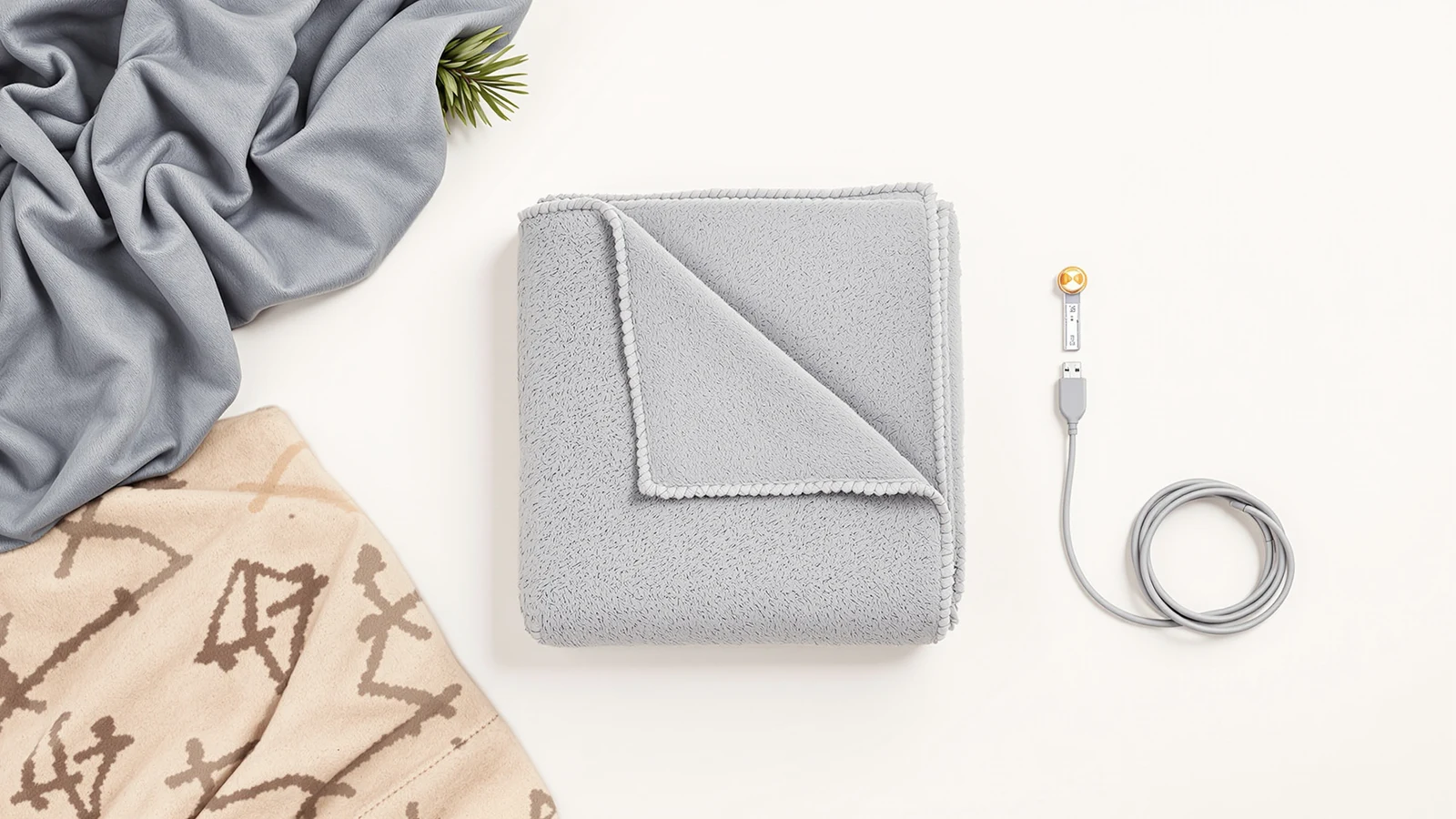
A folded grey heated throw blanket with a small plug-in controller and coiled cord, laid flat on a white surface beside other folded blankets
Quick answer

The cheapest one is also the best documented

At $12.23, the Shodu Electric Blanket Throw (sold under the generic title "Electric Blanket Throw, Fast Heated Blanket Throw") is the one to buy if you want the most checkable spec sheet for the least money: five heat levels across a stated 86–113°F range, a fixed ten-hour auto-off, a named 120-watt power rating, and both ETL and FCC certification claims in the listing. The Mlivrom throw at $25.99 sits in the middle — ETL certified and the only one of the three naming its fabric density (220 gsm) — but it doesn't publish a temperature range. The greenoak Heated Blanket at $26.99 is the most expensive and the most flexible, with ten heat levels and a selectable one-to-eight-hour timer, but its listing is the only one of the three that doesn't state any certification mark at all.

This guide works through what an anonymous listing actually leaves out, the three questions that still get a straight answer at this price, how heat levels and timers differ at the bottom of the market, which certification marks are present, claimed, or simply absent, the three picks themselves, and whether the extra eight dollars between the cheapest and the priciest buys you anything. Jump straight to the picks or to the certification breakdown.

Disclosure: this article contains affiliate links. If you buy through one, we may earn a commission at no extra cost to you — see our About page for how we research. As an Amazon Associate, we earn from qualifying purchases.

The floor of the category

What an anonymous listing isn't telling you

Open the product page for either of the two cheapest throws in this guide and the first thing you'll notice is what's missing from the title. "Electric Blanket Throw, Fast Heated Blanket Throw, Soft Silky Flannel Heating Blanket with 5 Heating Level" is the entire public-facing name of the $12.23 pick — there is no brand word in it anywhere. "Heated Blanket Electric Throw, 50″ x 60″, Heating Blanket with 5 Levels & 10 Hours Auto Off" is the same story at $25.99. Amazon's back-end records a seller name for each — Shodu for the first, Mlivrom for the second — but neither appears in the listing a shopper actually scrolls past. The $26.99 greenoak throw is the outlier: it leads its own title with its brand, a small, verifiable signal that the seller wants to be found again.

That gap matters because a brand name is one of the few things that lets you check a seller's track record outside the one listing in front of you. A title built entirely from keywords ("Fast Heated," "5 Heating Level," "Double-Sided") is optimized to be found by search, not remembered or looked up later. None of this means the product itself is defective; it means the research trail mostly stops at the listing you're already reading, which is why the specifics that are published on that one page carry more weight than usual.

The other thing that disappears at this price is review data. Amazon no longer exposes verified star ratings or review counts through its product API for any of the three throws in this guide, so we have none to show you and we're not going to estimate one. What we do have is each listing's own text, read as closely as a spec sheet rather than as marketing copy — which is what the rest of this guide does.

What's actually checkable

The three questions that still get an answer

Even stripped of a recognizable brand, a listing at this price still answers a handful of concrete questions — just not always the same ones. Three are worth checking before you buy anything down here, because across these three throws, no single product answers all three.

How many heat settings, and what temperature do they reach? All three state a count — five levels on the Shodu and Mlivrom throws, ten on the greenoak. Only two go further and give the actual range in degrees: the Shodu throw and the greenoak throw both state 86–113°F. The Mlivrom listing gives you "gentle warmth to high heat" instead of a number, accurate but not checkable against anything.

How long does it run before shutting off, and can you choose how long? The Shodu and Mlivrom throws both state a fixed ten-hour auto-off — long enough for a full night, with no option to shorten it for a quick nap on the sofa. The greenoak throw is the only one that lets you pick: 1, 2, 4, 6, or 8 hours. If you want the timer to match what you're actually doing, that selectable range is worth more than the extra five heat levels greenoak also offers.

What backs the electrical safety claim, and is it machine washable? This is where the three throws split most clearly, and it gets its own section next, because it's the one most worth reading in full before you add anything to a cart.

Settings and shut-off

Heat levels and timers at the bottom of the market

Heat-level counts look like the easiest number to compare across budget throws, and they're also the easiest to misread. Five levels on the Shodu and Mlivrom throws isn't a lesser version of greenoak's ten — it's a coarser dial across roughly the same temperature window, since the Shodu throw's stated 86–113°F range covers the same ground as greenoak's in half the steps. More settings mean finer control between "barely on" and "too much," not necessarily a hotter blanket. If you tend to pick one setting and leave it, five levels is plenty; if you fidget with the dial through the evening, the extra five on greenoak buys smaller jumps rather than a wider range.

The auto-off split is the more consequential difference. A fixed ten-hour shut-off, which both the Shodu and Mlivrom throws use, is a reasonable default for an all-night blanket and a slightly wasteful one for a forty-minute sofa session. A selectable timer, like greenoak's five presets from one to eight hours, lets you match the shut-off to the plan: one hour for a quick warm-up before bed, eight for something closer to overnight. Our separate guide on how heated-blanket timers actually work goes through why the shut-off duration is often the specification worth reading first, regardless of price tier.

What none of the three throws offer is a backlit or digital controller. All three use the one-button, cycle-through-the-levels design that dominates this end of the market — functional, but something to feel for rather than read in a dark room. That's a real trade-off against the pricier blankets covered in our main heated blankets guide, and it doesn't improve as you move from $12.23 to $26.99 within this trio; all three control the same way.

Present, claimed, or absent

Certification marks: present, claimed or absent

This is the specification that splits these three throws most clearly, and it runs in the opposite direction from price. The $12.23 Shodu throw states both ETL and FCC certification directly in its listing, names the specific safety technology behind it (NTC overheat protection), and publishes a power rating — 120 watts on a standard 120V, 60Hz household outlet. The $25.99 Mlivrom throw states ETL certification and describes flame-retardant, heat-insulating construction with an "intelligent overheat protection system," though it doesn't publish a wattage. The $26.99 greenoak throw, the most expensive of the three, states no certification mark anywhere in its listing — not ETL, not UL, nothing.

That absence doesn't prove the greenoak throw is uncertified; manufacturers sometimes hold a certification without naming it in marketing copy. What it does mean is that we have nothing specific to cite, and an unstated spec stays unstated rather than getting filled in with the benefit of the doubt. If a named safety certification is something you want confirmed before you buy, the Shodu and Mlivrom throws give you that in writing; the greenoak throw asks you to either check with the seller directly or accept the gap. Our guide on whether heated blankets are safe to sleep with covers what ETL and UL marks actually certify, and why "automatic shut-off" alone isn't the same claim as a named certification.

Washability follows a similar pattern. Both the Shodu and Mlivrom listings state "Machine Washable" outright, consistent with the detachable-controller design standard across this category — see our full guide on how to wash a heated blanket without ruining it for the detail that decides it. The greenoak listing doesn't make that claim either way. Fleece-and-sherpa throws are commonly machine washable once the controller unplugs, but "commonly" isn't the same as "stated," so confirm it on the listing page before you buy rather than assuming it from the fabric alone.

The picks

The three worth naming under thirty dollars

Ordered by our recommendation. Prices move constantly on Amazon — confirm the live price before buying.

01Best documented

Electric Blanket Throw (Shodu)

The cheapest of the three, and the most specific about what's inside it
50×60″ throw, blue/white · 5 heat levels, 86–113°F · fixed 10-hour auto-off · ETL & FCC certified

At $12.23 this is the least expensive throw in this guide, and the one we'd point toward first precisely because its listing does the most work for you. Five heat levels are stated with an actual temperature range — 86 to 113°F — rather than a vague "low to high," a 120-watt power rating is named outright, and the safety claim is doubled up: ETL certification and FCC certification, plus a named overheat-protection technology (NTC) rather than just the word "automatic." The double-sided design puts a different color on each face (blue and white here), and it's stated machine washable once the controller is unplugged. The ten-hour auto-off is fixed, not selectable, which is the one place the pricier greenoak throw below gives you more choice. For the price, this is the clearest spec sheet of the three.
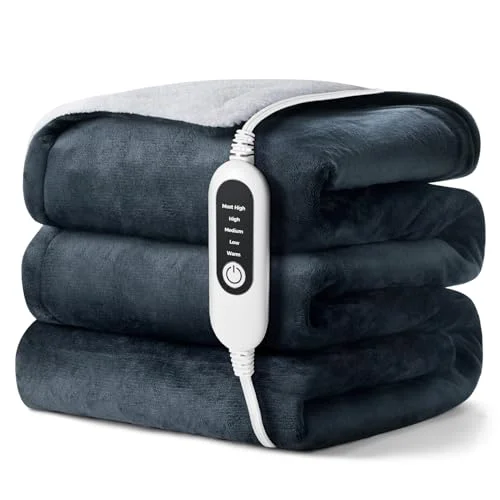
Electric heated blanket throw in blue and white, 50 by 60 inches, ETL and FCC certified
$12.23
Throw · ETL & FCCCheck price →
02Thickest stated fabric

Heated Blanket Electric Throw (Mlivrom)

The middle price, and the only one naming its fabric density
50×60″ throw, rose red/white · 5 heat levels · fixed 10-hour auto-off · ETL certified · 220 gsm double-sided flannel

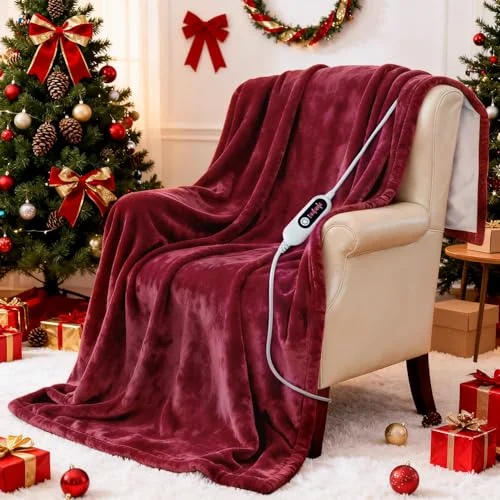
At $25.99, four dollars above the Shodu throw, this is the one listing in the trio that publishes a fabric weight: 220 grams per square meter, double-sided flannel, which is a heavier, denser construction than the thin fleece common at the very bottom of this category and a genuinely useful number since fabric weight is one of the few specs that predicts warmth before the heating element does any work. The listing also states ETL certification and describes flame-retardant, heat-insulating construction with an intelligent overheat-protection system, plus an 8.5-foot power cord — longer than most throws this size, useful if your outlet isn't next to the sofa. What it doesn't give you is a numeric temperature range for its five heat levels, or greenoak's selectable timer; the auto-off here is a fixed ten hours, the same as the Shodu throw.

Heated electric throw blanket in rose red and white, 50 by 60 inches, ETL certified, 220 gsm flannel
$25.99
Throw · 220 gsmCheck price →
03Most flexible, least certified

greenoak Heated Blanket Electric Throw

The only one that lets you choose the timer — and the only one with no stated certification
50×60″ throw, misty grey · 10 heat levels, 86–113°F · selectable 1/2/4/6/8-hour auto-off · fleece & sherpa

At $26.99, this is the most expensive throw in the guide and the only one with a brand name in its own title. It's also the most adjustable: ten heat levels across the same 86–113°F range as the Shodu throw, in finer steps, plus a timer you select rather than one fixed for you — one, two, four, six, or eight hours, matched to whatever you're actually doing. The fleece-and-sherpa fabric is lighter than it looks and the listing leans into gift framing for cold-sensitive buyers. Set against that flexibility is the one gap this whole guide keeps returning to: no certification mark — not ETL, not UL — appears anywhere in the listing, and washability isn't explicitly stated either. Buy this one for the control, not for a documented safety claim the other two actually give you.

greenoak heated electric throw blanket in misty grey, 50 by 60 inches, fleece and sherpa fabric
$26.99
Throw · selectable timerCheck price →
ModelBest forHeat levelsAuto-offCertification statedPriceGet it
Shodu Electric Blanket ThrowBest documented5, 86–113°F10 h, fixedETL & FCC$12.23Price
Mlivrom Heated Electric ThrowThickest stated fabric5, range not stated10 h, fixedETL$25.99Price
greenoak Heated Blanket ThrowMost flexible timer10, 86–113°F1/2/4/6/8 h, selectableNone stated$26.99Price
What the extra few dollars buy

The case for spending $26.99 instead of $12.23 — and what it doesn't buy

The tidy version of a budget roundup says "spend a little more and get a little more." The honest version, once you read these three listings side by side, is messier and more useful: the eight-dollar gap between the Shodu throw and the greenoak throw doesn't track safety documentation at all. It buys five extra heat levels, a selectable timer instead of a fixed one, and a brand name printed on the box — real improvements if you plan to vary how long and how hot you run the blanket from one use to the next. It does not buy a stated certification mark; the cheapest throw in this guide has the most of those, not the most expensive one.

Spend the smaller four-dollar step instead — from $12.23 to $25.99, Shodu to Mlivrom — and you trade a published temperature range for a published fabric weight (220 gsm) and a longer power cord, while keeping ETL certification and the fixed ten-hour auto-off unchanged. Neither step up is strictly "better": each answers a different question more completely while leaving another less complete than the cheapest option did. That's the actual shape of this market at the bottom — price tracks features you can feel (settings, timer flexibility, fabric) more reliably than it tracks features you can't see until something goes wrong (certification, overheat protection).

If you have to pick one axis to prioritize, we'd lean toward documentation: a stated ETL or FCC mark is a claim a seller has to be able to back up if it's ever challenged, where "ten heat levels" is just a count. That's why the $12.23 Shodu throw opens this guide rather than closing it, even though it's the cheapest of the three. If what you actually need is a longer or shorter timer window to match your evening, that reasoning flips, and the extra eight dollars for greenoak's selectable auto-off is the more direct fix.

How we picked

Three throws at or near the $30 floor, chosen for contrast

We looked specifically at heated throws priced between roughly $20 and $30, the band where brand recognition and published detail both tend to thin out fastest. We kept three with a complete, checkable core listing — finished dimensions, a real current price, and at least a heat-level count — and we deliberately chose three that differ on certification and timer design rather than three near-identical options, because that difference is the actual story at this price. We did not pull in any full-size or queen blankets, since mixing bed sizes into a one-person-throw comparison hides the comparison this guide is about.

How we compared

Research, not a lab

We're honest about this: we don't physically test these blankets and we don't run a testing lab. We compare published specifications, stated certifications, live pricing and fabric details drawn directly from each product's own listing, and we say plainly when a specification isn't published rather than filling the gap with a guess. Amazon no longer exposes verified star ratings or review counts through its product API for these products, so you won't find rating badges, paraphrased review sentiment, or invented scores anywhere in this guide.

FAQ

Common questions

What's the real difference between $12.23 and $26.99 at the bottom of this market?

Mostly flexibility, not safety documentation. The $26.99 greenoak throw adds five extra heat levels and a selectable one-to-eight-hour timer over the $12.23 Shodu throw, plus a brand name printed in its own listing title. What it does not add is a stated certification — the cheaper Shodu throw is the one with ETL and FCC certification named explicitly, along with a published wattage and overheat-protection technology. Price tracks features you can adjust more closely than it tracks features you can't see.

What does ETL certification actually mean on a cheap heated blanket?

ETL is a mark from an independent testing laboratory indicating a product has been evaluated against a specific safety standard, similar in purpose to the more widely recognized UL mark. Two of the three throws in this guide — the Shodu throw and the Mlivrom throw — state ETL certification directly in their listings; the Shodu throw also states FCC certification, which covers electromagnetic emissions rather than fire or shock safety. Our guide on whether heated blankets are safe to sleep with covers these marks in more depth.

Is it a problem if a listing doesn't mention any safety certification?

It's not proof of a problem, but it is a real gap. The greenoak throw in this guide, at $26.99, doesn't state ETL, UL, or any other certification anywhere in its listing, even though it's the most expensive of the three. That could mean the certification exists and simply wasn't written into the marketing copy, or it could mean there isn't one to cite. Either way, we don't have anything specific to point to for that product, so we say so rather than assuming the best case.

Can these budget throws run all night?

Two of them, yes, within their stated limits. The Shodu and Mlivrom throws both have a fixed ten-hour auto-off, long enough to cover a full night's sleep before shutting off on their own. The greenoak throw tops out at an eight-hour selectable setting, which is close but slightly short of a full night for some sleep schedules; you'd need to reselect the timer if you want it running again after that.

Keep reading

Related reading