Roundup · Heated Blankets for Pet Owners
The Best Heated Blankets for Pet Owners
A heated blanket that lives on a couch a dog sleeps on gets washed on a completely different schedule than one that only ever touches human skin — and shedding fur, muddy paws and the occasional claw test parts of the construction a typical buying guide never has to mention. We looked at three built to take a weekly wash cycle without the wires or the fabric failing first.
By Ilane Tall · Updated November 1, 2026 · Research-based.
Quick answer
Buy for the wash cycle, not just the warmth
If you want one blanket that does the whole job, the Bedsure Heated Blanket Electric Throw at $43.68 is the one to buy: it is the only one of the three whose listing spells out a full control set — a preheat function, six heat levels and six timer presets running up to ten hours, an eight-hour auto-off, and ETL certification — which matters more once a blanket is going through a machine every week rather than every month. If you'd rather keep two in rotation so one is never out of commission in the wash, the GOTCOZY Heated Blanket at $31.44 is the one to buy as the spare. The Texciting Heated Blanket at $28.48 is the cheapest ETL-certified entry point if you just want to find out whether a pet and a heated blanket get along before spending more.
This guide works through why pet hair changes the actual wash schedule, the one spec — a detachable cord — that matters more here than anywhere else in this category, which fabrics hold up to that schedule without matting, where claws do the real damage, the three picks themselves, and what still has to happen between wash days. Jump straight to the picks or to what to do between washes.
Disclosure: this article contains affiliate links. If you buy through one, we may earn a commission at no extra cost to you — see our About page for how we research. As an Amazon Associate, we earn from qualifying purchases.
The real wash cycle
Why pet hair changes how often this actually gets washed
A heated blanket used only by people gets washed on the same loose schedule as any other throw — whenever it visibly needs it, which in practice can stretch to a month or more. Add a dog or cat that treats the same blanket as a bed, and that schedule collapses. Fur works into a knit or woven surface in a way that a quick shake doesn't undo, dander builds up fast enough to matter to anyone with allergies in the house, and a blanket that smells faintly of wet dog after a rainy walk is not one most people leave folded on the sofa until next month. The realistic cadence for a shared blanket like this is roughly once a week, sometimes more if the household has more than one animal or a dog that is still shedding its undercoat.
That change in frequency is the whole reason this guide exists as its own category rather than just pointing you at a general roundup. A blanket that's only asked to survive twelve wash cycles a year is a very different engineering problem than one asked to survive fifty, and the parts that fail first under repeated washing — the cord connection, the fabric nap, the edge binding — are exactly the parts a buyer comparing on heat settings and price alone tends to overlook.
It's also worth being honest about what washing does and doesn't fix. A wash removes loose fur and surface odor; it does nothing for fur that has worked its way into the weave over weeks of use, which is a fabric question as much as a laundry one. We get into which fabrics resist that in the section below, and if replacing a blanket more often than you'd like turns out to be the real cost of pet ownership, our guide to cheap heated blankets that are still worth buying is worth reading before you assume the expensive option is automatically the cheaper one over a year of weekly washes.
The one spec to check
The detachable cord is the spec that matters most here
Every electric blanket in this category is built the same way at its core: a soft layer with a heating wire running through it, connected to a controller box through a cord that has to come off before the blanket goes anywhere near water. For a household that washes once a month, forgetting to check whether that cord detaches is a minor inconvenience you discover once. For a household washing weekly because of a pet, it's a question you're answering every single time, which makes it the single specification worth confirming on the product listing or in the product images before you buy — more than heat-setting count, more than size. A controller that doesn't fully separate from the blanket turns a five-minute wash-day routine into a weekly argument with yourself about whether it's really safe to run the whole thing through the machine.
None of the three listings in this guide spell out the detachment mechanism in the product title, so we won't claim one does something the manufacturer hasn't stated — check the listing photos and the product description for your specific size and color before buying, and treat "controller unplugs from the blanket" as the deciding feature rather than an assumption. What we can say from the published titles: the Bedsure pick names a full control set — preheat function, six heat and six timer settings up to ten hours, and an eight-hour auto-off — and a blanket with that much electronics built into the controller end is exactly the kind where confirming the plug-apart design matters most. If automatic shut-off timing and preheat behavior are features you want explained before you buy anything in this category, our guide to what the preheat function actually does covers how that cycle works independent of any specific product.
Never submerge or machine-wash the controller itself, regardless of how the cord detaches — that rule doesn't change just because the blanket is washed more often than most.
The fabric itself
Fabric that survives a weekly wash without matting
As a general textile matter, the fabrics used across this category respond very differently to repeated machine washing. A deep-pile sherpa or faux-fur surface is warm and soft when new, but that same loft is what mats down fastest under regular agitation — the fibers compress and tangle together, and a once-weekly wash accelerates that timeline considerably compared to the once-a-month cycle most sherpa throws are designed around. A tighter, flatter weave like flannel or a ribbed knit has less loft to lose in the first place, which is generally why it holds its texture longer under frequent washing even though it won't feel as plush straight out of the package. Our full breakdown in flannel vs sherpa vs faux fur goes deeper into how each one behaves unplugged and over time, and it's worth reading before you default to the plushest-looking option in a pet household.
None of the three products in this guide names a specific weave or pile type in its listing title beyond general descriptors — the Texciting blanket is described simply as a "Soft Electric Blanket," the GOTCOZY as a "Cozy Warm Electric Throw," and the Bedsure as a "Thick Striped Fast Heating Electric Blanket." We won't assign a fabric category to any of them that the listing doesn't state outright; what the Bedsure's title does confirm is a thicker, striped construction, which as a general rule tends to hold its shape under repeated washing better than a thin single-layer throw, independent of the exact material underneath.
If you can't find a fabric type stated anywhere on a listing you're considering, that's useful information on its own — it means you're buying on price and stated electronics rather than on a textile claim, and it's worth weighing that gap against how often the blanket will actually be in the wash.
Construction
Edges and seams: where claws do the most damage
As a matter of general construction, the edge of any blanket is where it fails first around a pet, for a simple mechanical reason: a cat kneading before settling in, or a dog pawing a blanket into a pile, concentrates repeated stress on the binding and the seam rather than the flat body of the fabric. A loose or unfinished edge gives a claw something to catch on; a bound or serged edge spreads that same stress across stitching designed to take it. This is true of any blanket, heated or not, but it carries more weight here because a torn seam near the perimeter of an electric blanket is also where the heating wire's edge routing tends to run, which is a reason to be more careful about inspecting a worn edge on a heated throw than on a plain one.
None of the three listings in this guide details its specific edge or binding construction, so we're not going to claim one holds up to claws better than another on specifics we don't have. What's worth doing instead, for any heated blanket a pet will share, is checking the listing's photos for a clearly bound or stitched edge before buying, and inspecting that same edge for fraying every time it comes out of the dryer — a loose thread caught early is a repair; caught late, it's a reason to retire the blanket. If the blanket in question is also going to cover a bed a pet sleeps on rather than just a sofa, our guide to what size heated blanket you actually need is worth a look too, since a properly sized blanket that doesn't hang off the mattress edge gives claws less loose fabric to find in the first place.
Our picks
Three built for a wash cycle that happens every week
All three are 50×60″ throws. Ordered by our recommendation. Prices move constantly on Amazon — confirm the live price before buying.
01Best overall
Bedsure Heated Blanket Electric Throw
The most complete control set of the three, for the household that only wants to buy once
50×60″ throw · preheat function · 6 heat & 6 timer settings, up to 10h · 8h auto-off · ETL certified · white, thick striped fabric
This is the pick with the most published detail to evaluate, which matters when a blanket is going into the wash far more often than the category average. Its listing names a preheat function, six heat levels paired with six timer presets running up to ten hours, and an automatic eight-hour shut-off, all backed by ETL certification. The "thick striped" description in its title points to a sturdier, more structured fabric than a single-layer throw, which as a general rule gives a blanket more to work with across repeated wash-and-dry cycles before it starts looking tired. At $43.68 it's the most expensive of the three, and the extra is buying the fullest electronics package here — worth it if this is going to be the one blanket doing the job, rather than one of a rotating pair.
02Best for a wash-day spare
GOTCOZY Heated Blanket
The second blanket that means one is always clean while the other dries
50×60″ · Rose · electric throw
Washing weekly means a blanket spends a meaningful chunk of its life in a machine or on a drying rack rather than on the sofa, and the simplest fix for that is owning two instead of one. At $31.44, the GOTCOZY is priced to make that rotation affordable without feeling like a second full-price purchase, and buying it in a different color from your primary blanket — this one ships in rose — makes it trivial to tell at a glance which one is due for a wash and which one just came out of the dryer. Its listing doesn't publish a heat-setting count or a stated certification the way the Bedsure pick does, so we're not asserting either; what you're buying here is simply a second unit sized the same as a standard throw, bought specifically to keep the rotation going.
03Lowest price, still certified
Texciting Heated Blanket
The cheapest way to find out if a heated blanket and a pet get along
50×60″ · ETL certified · Grey · soft electric blanket
If you're not yet sure a heated blanket will survive being a pet's favorite spot at all, this is the lowest-risk way to find out. At $28.48 it undercuts both other picks here, and it still carries ETL certification, which is the safety mark worth having on anything left running near a sleeping animal regardless of price. The listing describes it simply as a "Soft Electric Blanket" in grey without further fabric or control detail, so treat it as a straightforward, no-frills throw rather than one with the stated feature depth of the Bedsure pick. It's the one to buy first if the real question in your house is whether the blanket survives six months of a cat sleeping on it, not which model has the most settings.
| Model | Best for | Size | What's published | Price | |
|---|
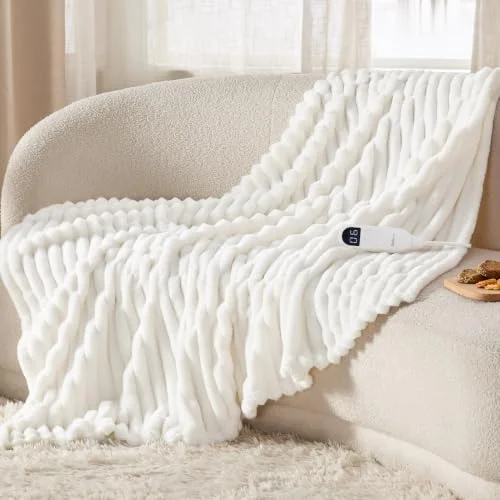 Bedsure Electric Throw | Most complete feature set | 50×60″ | Preheat · 6 heat & 6 timer · 8h auto-off · ETL | $43.68 | Price |
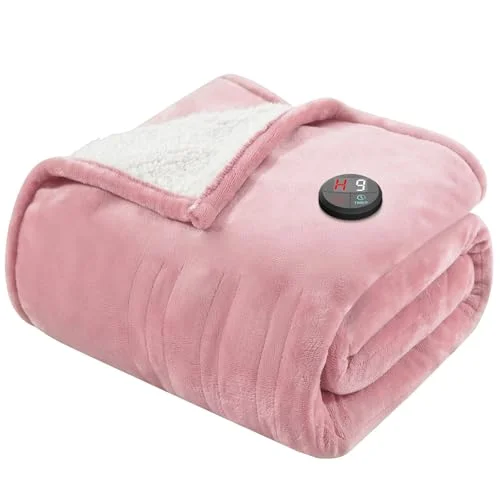 GOTCOZY Heated Blanket | A wash-day spare | 50×60″ | Size & color stated; controls not published | $31.44 | Price |
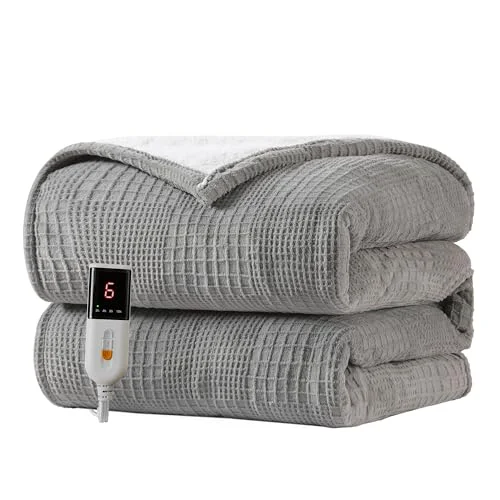 Texciting Heated Blanket | Lowest price, still ETL | 50×60″ | ETL certified; controls not published | $28.48 | Price |
Upkeep, between wash days
What still needs to happen between washes
A weekly wash handles fur and odor, but it isn't the only maintenance a shared blanket needs, and most of what's left is quick. A lint roller or the upholstery attachment on a vacuum, run over the surface between wash days, pulls out the loose fur a wash alone would otherwise just redistribute through the drum. For households with puppies or kittens still working out what's a chew toy and what isn't, a quick check of the full cord length — not just the point where it meets the controller — before every use catches fraying before it becomes a hazard rather than after. Any blanket with a nicked or exposed cord should be retired rather than patched; that's a general safety rule for electric blankets regardless of why the cord got damaged.
Spot-cleaning matters more here too. An accident that happens between scheduled wash days doesn't need to wait for the next full cycle — blot it, let the area air dry completely with the controller unplugged, and treat it as a reason to move the next full wash up rather than down. And if a blanket is starting to look genuinely tired well before a year is out — matted patches, a faded color, a cord that's stiffened — that's a normal consequence of washing on a pet-household schedule rather than a sign you bought the wrong one. Our guide to cheap heated blankets that are still worth buying is a reasonable next stop if replacing one every season or two turns out to be the realistic rhythm in your house.
How we picked
Three throws, chosen for a harder wash cycle
We looked specifically at 50×60″ electric throws with a current, checkable Amazon listing, then narrowed to three that cover the real range a pet-owning buyer actually faces: the most feature-complete option available, an affordable second unit worth buying purely to keep a rotation going, and the cheapest certified entry point. We did not estimate a fabric type, a cord-detachment design, or an edge construction for any product whose listing doesn't state one — where a spec isn't published, this guide says so rather than guessing.
How we compared
Research, not a lab
We're honest about this: we don't physically test these blankets and we don't run a testing lab — and we definitely haven't put a cat on any of them for six months to find out what happens. We compare published specifications, stated certifications, live pricing and listing descriptions, and we say plainly when a spec isn't published rather than filling the gap with a guess. Amazon no longer exposes verified star ratings or review counts through its product API, and we have no review data for these specific products, so you won't find rating badges, paraphrased review sentiment, or invented scores anywhere in this guide.
FAQ
Common questions
How often should I wash a heated blanket if I have pets?
Roughly once a week for a blanket an animal regularly sleeps on, compared with once a month or less for a blanket used only by people. Fur and dander build up faster than most people expect, and a household with more than one pet, or a dog still shedding its undercoat, may land on the more frequent end of that range.
Why does the cord need to detach for washing?
The fabric and heating wire are built to survive a gentle wash cycle; the controller's electronics are not. The cord has to fully separate from the blanket before either goes into a machine, and you should never submerge or wash the controller itself. For a blanket washed weekly rather than monthly, confirming this detachment design on the listing before buying matters more than almost any other spec.
Will a heated blanket survive my dog's claws?
As a general construction matter, the edge and seam are where claws cause the most damage, since kneading and pawing concentrate repeated stress there rather than on the flat body of the fabric. A clearly bound or stitched edge, checked in the listing photos before buying and inspected for fraying after every wash, is the practical way to catch wear before it becomes a tear.
What fabric holds up best to pet hair and frequent washing?
As a general rule, a flatter weave like flannel or a ribbed knit tends to hold its texture longer under repeated washing than a deep-pile sherpa or faux fur, which mats down faster once it's agitated weekly instead of monthly. Not every listing states its exact fabric, and where one doesn't, it's worth weighing that gap against how often the blanket will actually be in the wash.
Keep reading
Related reading