Best Heated Blankets
Roundup · Heated Throws With a Short Auto-Off

The Best Heated Throws With a Short 3-to-4-Hour Auto-Off

Most electric throws default to eight or ten hours before they shut themselves off, on the assumption that you'll fall asleep under one. A smaller group is built around a shorter window instead — three or four hours, enough for a nap or a couch session but not a full night. Three that take that approach, what the shorter window actually buys you, and when you should buy the longer timer instead.

By Ilane Tall · Updated November 25, 2026 · Research-based.

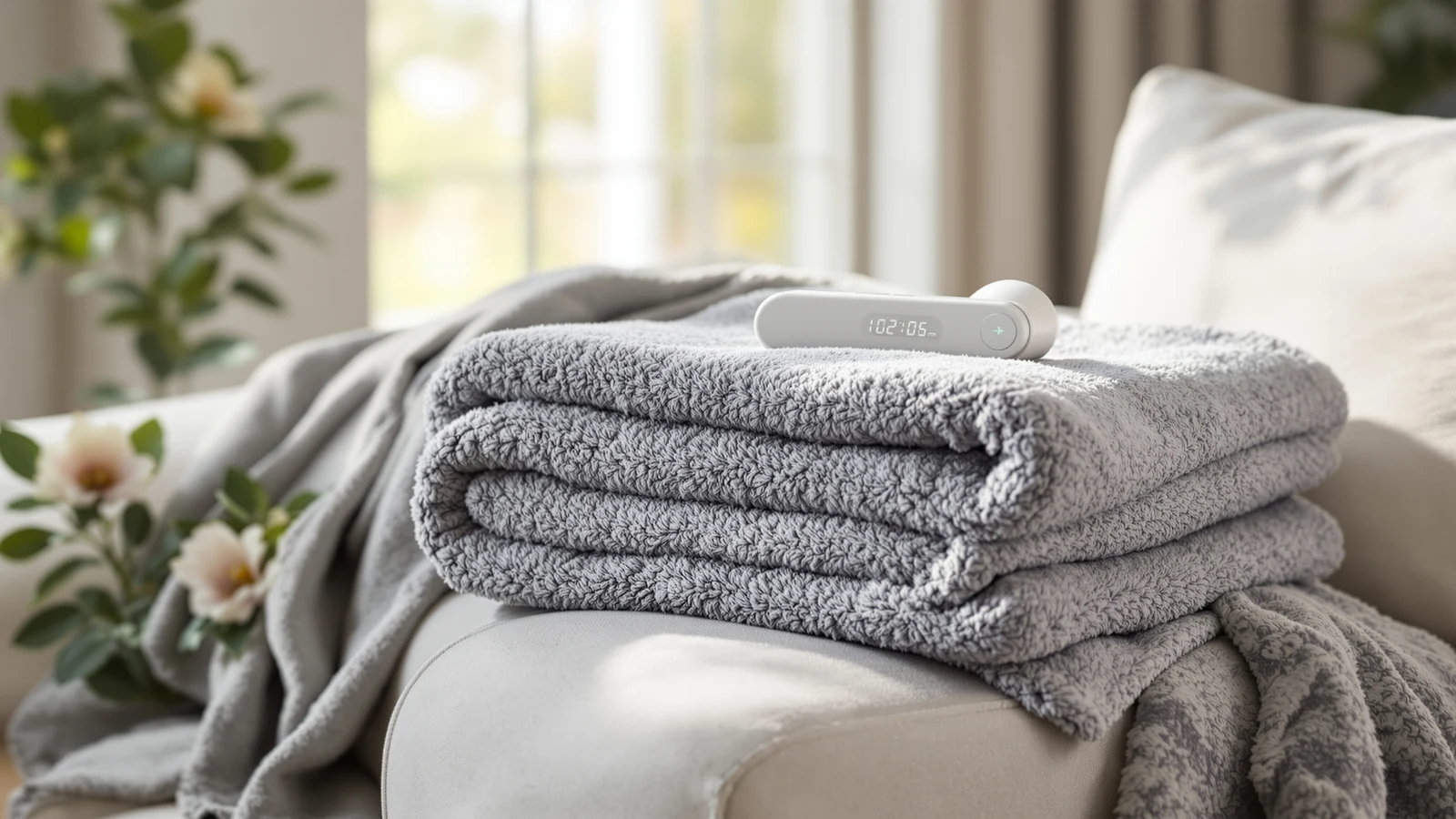
Folded grey heated throw blanket on a sofa arm with its slim digital timer controller showing a short countdown display
Quick answer

Short is the point here, not the compromise

All three of these throws shut themselves off well before a typical electric blanket would, and all three cost less than $30. The VENTIMI Heated Throw Blanket at $25.64 cuts off the fastest, at three hours, with five heat settings running up to 115°F. The ESTINGO Heated Throw Blanket at $26.99 and the Tefici Heated Blanket Throw at $29.99 both stop at four hours, but split on control: ESTINGO runs five heat levels across a stated 86–122°F range, while Tefici offers only three settings between 95°F and 113°F. None of the three is meant to run all night — that's a different shopping list, and we cover it near the end.

This guide covers why a short auto-off is a deliberate design choice rather than a stripped-down feature, what three and four hours actually cover, why the heat-level counts split 5-5-3 instead of matching, why all three land under $30 regardless of timer length, the three picks, and when you should buy a longer-timer blanket instead. Jump straight to the picks or to when you want the longer timer.

Disclosure: this article contains affiliate links. If you buy through one, we may earn a commission at no extra cost to you — see our About page for how we research. As an Amazon Associate, we earn from qualifying purchases.

The design choice

Why a short auto-off is a feature, not a limitation

It's easy to read a three-hour cutoff as a corner cut on a budget blanket, but that's not what's actually happening with any of the three throws here. All three still carry overheat protection, and two of the three name a specific safety certification — VENTIMI and ESTINGO are both ETL certified, and Tefici carries both ETL and FCC certification. A manufacturer that was simply stripping cost out of the electronics wouldn't still be paying for independent safety testing on a throw priced under $30. The short window is a use-case decision, not a shortcut.

The use case is specific: a nap, an evening on the couch, a reading session before you actually get into bed. In every one of those moments, a blanket that keeps running after you've gotten up, dozed off past the point you meant to, or simply forgotten about it isn't doing you any favors — it's just drawing power into an empty room or an already-warm body. A shorter auto-off removes that decision from you automatically, the same way a kettle or a space heater with a timer does.

It also changes the anxiety most people have about leaving any electric blanket plugged in. A throw that forces itself off after three or four hours is one you can leave running while you doze on the sofa without the nagging thought that it's still on somewhere in the house hours later. That's a genuinely different psychological trade than a ten-hour throw offers, and it's the entire reason this shorter category exists alongside the longer-timer one rather than being replaced by it.

The window

Three and four hours: what that covers, and what it doesn't

Three hours, VENTIMI's window, comfortably covers an afternoon nap, a couple of sitcom episodes, or the stretch between getting home from work and starting dinner. It's short enough that you're unlikely to still be using the blanket when it shuts off unexpectedly mid-task — by the three-hour mark, whatever you sat down to do is usually finished. Four hours, where both ESTINGO and Tefici land, stretches that further: a full movie plus the trailers and the time it takes to settle in, or an entire evening from dinner cleanup to the point you'd normally head to bed anyway.

What neither window covers is a full night of sleep. Eight hours is the low end of what most adults need, and even the longer of these two timers, Tefici and ESTINGO's four hours, runs out well before a typical bedtime-to-morning stretch. If you fall asleep under one of these three throws at 10 p.m. expecting to wake up warm at 6 a.m., you'll spend most of that night under a blanket that's no longer heating — still a blanket, just not an electric one anymore for the back half of the night.

That's a real limitation if you're shopping for a bed blanket, and not a flaw if you're shopping for a sofa throw. The honest way to think about the three-to-four-hour window is as a ceiling on a single sitting, not a floor on how long you can own the blanket before it needs replacing. Used for naps and evenings, all three will run their full cycle most times you reach for them; used as an overnight bed blanket, all three will leave you cold well before sunrise.

Control

Heat levels across the three: five, five, and three

Two of these three throws give you the same number of heat settings, and the third gives you noticeably fewer. VENTIMI and ESTINGO each run five heat levels, with VENTIMI topping out at a stated 115°F and ESTINGO spanning a wider published range of 86°F to 122°F. Tefici, despite costing the most of the three at $29.99, offers only three heat settings across a narrower 95°F-to-113°F band. More settings generally means finer gradation between "barely on" and "too much" — a question we work through in more detail in our look at whether a 20-heat-level queen blanket actually buys more control, which reaches a similar conclusion from the opposite direction: extra levels help, but only up to a point.

What's notable here is that all three throws publish an actual temperature range in degrees Fahrenheit rather than leaving you to guess what "level 3" means on an unlabeled dial. That's a more specific disclosure than most throws at this price make, and it's the same habit we flag as uncommon in our piece on the one heated blanket that states its actual temperature — except here it's the norm across all three picks rather than the exception across an entire catalogue.

Price and heat-level count don't track each other in this group, which is worth noting before you assume the priciest option is also the most capable one. Tefici is the most expensive of the three and has the fewest settings; the two cheaper throws both offer five. We've seen this same pattern elsewhere in the category — Eydna's cheapest two queen blankets carry more heat levels than its pricier third, and Eastsora sells two throws that both claim twelve levels regardless of fabric differences between them. Heat-level count is a spec you have to check on each listing individually; it isn't something price reliably predicts.

The price

Why all three land under $30, and it isn't because of the timer

It would be a reasonable guess that a shorter auto-off is cheaper to build, and that's where some of the under-$30 pricing comes from — but it's a minor piece of it. A three-hour timer and a twelve-hour timer run on essentially the same category of control chip; the cost difference between them is close to nothing. What actually sets the price on a heated throw is the fabric weight, the panel size, and whether the brand has paid for independent certification, and none of those three things changes meaningfully because the auto-off is shorter.

All three of these are single-person throw-sized blankets rather than bed-size blankets, which is the bigger reason they land where they do. A throw this size uses roughly a third of the heating wire and fabric of a queen blanket, and that difference in material is what separates a $25–$30 throw from a $60–$90 queen blanket on this site's home page — not the length of the timer attached to either one. None of these three describe a quilted or heavily layered construction either; they're flannel-and-sherpa builds, which is a cheaper fabric approach than the quilted mattress-pad-style construction some brands charge more for, a trade-off we weigh directly in our look at whether quilted heated blankets are worth the extra money.

The practical upshot is that you're not paying a premium or getting a discount specifically for a short auto-off window — you're paying throw-size prices for a throw-size product, and the shutoff length is a separate design decision layered on top. That also makes all three reasonable picks if you're buying for someone else rather than yourself; see our guide to the best heated blankets to give as a gift for how a sub-$30 throw compares to pricier options as a gift specifically.

Our picks

Three throws built for a shorter sitting, ordered by auto-off length

All three are 50×60-inch-class throws under $30, not bed blankets. Prices move constantly on Amazon — confirm the live price before buying.

01Shortest window, lowest price

VENTIMI Heated Throw Blanket, Grey

A three-hour cutoff built for one sitting, not an evening
Throw · 5 heat settings, up to 115°F · 3-hour auto shut-off · ETL certified · flannel & sherpa

At $25.64, this is the cheapest of the three and also the one with the shortest timer: a flat three-hour auto shut-off, the tightest window in this guide. Five heat settings run up to a stated 115°F, and the listing states it reaches that top temperature within about 45 minutes of switching on, which matters more on a short timer than a long one — you want the warmth early in a three-hour window, not late in it. It's built from flannel and sherpa, ETL certified, and includes overheat protection. The trade-off against the two longer-timer picks below is straightforward: three hours is enough for a nap or a short couch session, but it's the one to skip if you tend to settle in for a full evening.
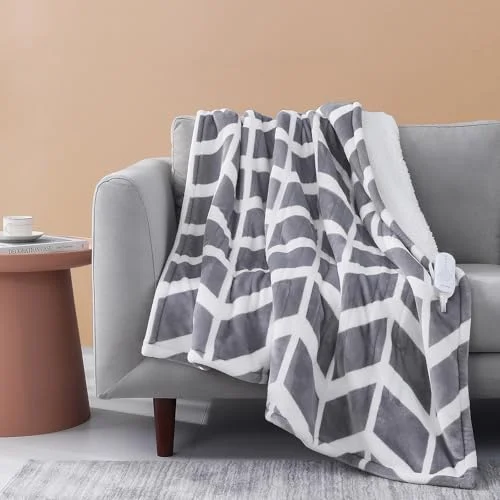
VENTIMI grey and white chevron-pattern heated throw blanket draped over a sofa with its controller clipped to the edge
$25.64
Throw · 3-hour auto-offCheck price →
02Widest temperature range

ESTINGO Heated Throw Blanket, Cool Gray

Four hours, five levels, and the widest stated range of the three
Throw 50×60″ · 5 heating levels, 86–122°F · 4-hour auto shut-off · 200gsm flannel / 200gsm sherpa · ETL certified for bedding

At $26.99, ESTINGO's throw adds an extra hour of run time over VENTIMI — a four-hour auto shut-off — while matching it on heat-level count at five. What separates it is range: a stated 86°F-to-122°F spread, the widest of the three picks here, which gives you more room between a barely-there low setting and a genuinely hot top one. The fabric is built as 200 gsm flannel on one face and 200 gsm sherpa on the other, an evenly matched double-sided construction rather than a thin layer on one side. It's ETL certified specifically for bedding use. The same brand also sells queen-size blankets with different auto-off lengths, which our comparison of ESTINGO's four queen blankets covers if a throw turns out to be the wrong size for what you need.

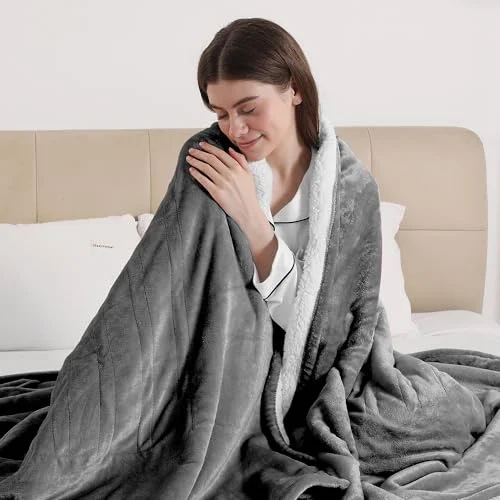
ESTINGO cool gray heated throw blanket wrapped around a woman sitting on a bed
$26.99
Throw · 4-hour auto-offCheck price →
03Simplest controls

Tefici Heated Blanket Throw

Fewer settings, double-layer flannel, same four-hour cutoff
Throw 50×60″ · 3 heat settings, 95–113°F · 4-hour auto shut-off · ETL & FCC certified · 2-layer flannel

At $29.99, this is the most expensive of the three picks, and it's the one with the fewest controls: three heat settings across a narrower 95°F-to-113°F range, against five on each of the other two. What it adds instead is a double layer of flannel rather than a flannel-and-sherpa pairing, which the listing describes as softer and better at holding warmth than a single sherpa layer. It carries both ETL and FCC certification with stated overheat protection, and the same four-hour auto shut-off as the ESTINGO pick above. If you'd rather turn a dial between three clearly different settings than fine-tune across five closer ones, the simpler control layout here is a legitimate reason to pick it over a throw with more settings at a lower price.

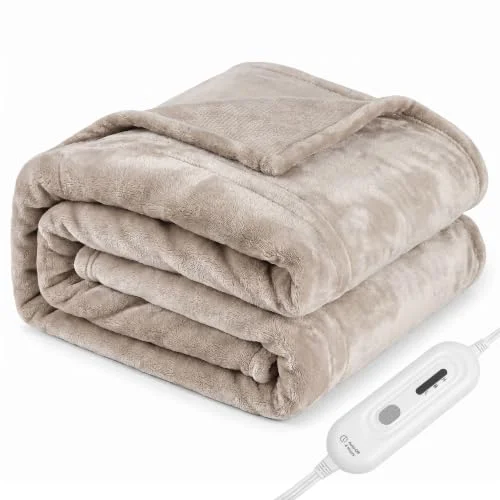
Tefici camel-colored heated throw blanket folded with its white cord controller resting on top
$29.99
Throw · 4-hour auto-offCheck price →
ModelBest forHeat settingsAuto-offPrice
VENTIMI ThrowShortest sitting, lowest price5 (up to 115°F)3 h, fixed$25.64Price
ESTINGO ThrowWidest temperature range5 (86–122°F)4 h, fixed$26.99Price
Tefici ThrowSimpler 3-setting control3 (95–113°F)4 h, fixed$29.99Price
The other case

When you actually want the longer timer instead

None of these three throws are the right buy if what you actually want is warmth from the moment you get into bed until the moment you wake up. A three-or-four-hour cutoff solves a very different problem than an all-night one, and if your cold spot is a bed rather than a sofa, a short-timer throw will leave you reaching for extra blankets well before morning. That's the scenario where a blanket with a selectable auto-off running to ten or twelve hours — like the top pick on our main guide to the six best heated blankets — is the correct purchase, not a better version of the three throws here.

It's also the better call if you share a bed and want each side independently controlled through the night, which is a feature built into dual-zone and multi-setting bed blankets rather than single-zone throws like these three. ESTINGO itself sells queen-size blankets aimed at exactly that longer, bed-focused use case, and our comparison of its four queen blankets is worth reading if you like this brand's build quality but need a bed-size blanket with a different timer profile than its throw.

And if you're buying for someone else rather than for yourself, the right timer length depends entirely on how they'll use it — a short-timer throw for a sofa-and-nap habit, a long-timer blanket for someone who wants it running while they sleep. Our guide to the best heated blankets to give as a gift walks through that distinction in more detail, since guessing wrong on auto-off length is one of the more common reasons a gifted heated blanket ends up unused.

How we picked

Three throws, chosen for their short auto-off

We looked specifically for 50×60-inch-class heated throws with a stated auto shut-off of four hours or less, a current checkable Amazon listing under a real ASIN, and a complete published specification: heat-setting count, temperature range where stated, fabric construction and any named safety certification. VENTIMI, ESTINGO and Tefici were chosen because their timers span the exact window this guide is about — three hours and two different four-hour implementations — while differing meaningfully on heat-level count and fabric. We did not estimate a heat-setting count or a temperature range for any product whose listing doesn't state one.

How we compared

Research, not a lab

We're honest about this: we don't physically test these blankets and we don't run a testing lab. We compare published specifications, stated safety certifications, live pricing and fabric construction, and we anchor every claim about auto-off behavior and heat settings in the manufacturer's own listing copy rather than an assumption. Amazon no longer exposes verified star ratings or review counts through its product API, and we have no review data for these three specific products, so you won't find rating badges, scores, or paraphrased review sentiment anywhere in this guide.

FAQ

Common questions

Why would I want a heated throw that shuts off after only three or four hours?

A shorter auto-off matches how a lot of people actually use a throw: a nap, a movie, an evening on the couch, rather than a full night of sleep. It also means you can leave the blanket running without worrying it's still on hours after you've gotten up or dozed off, since it forces itself off rather than relying on you to remember. All three throws in this guide still carry overheat protection and, in two cases, a named safety certification, so the short window is a use-case decision rather than a stripped-down safety feature.

Which of these three has the most heat settings?

VENTIMI and ESTINGO each offer five heat settings, while Tefici offers three. ESTINGO's stated range is the widest of the three at 86°F to 122°F, VENTIMI tops out at a stated 115°F, and Tefici runs a narrower 95°F-to-113°F band across its three settings. Tefici is also the most expensive of the three, so price does not track heat-level count in this group.

Can I leave any of these three running overnight?

No — all three are built around a three-to-four-hour window, well short of a typical eight-hour night of sleep. If you fall asleep under one expecting it to keep running until morning, it will shut off partway through the night and you'll spend the rest of it under a blanket that's no longer heating. For overnight bed use, look for a blanket with a selectable auto-off running to ten or twelve hours instead, like the top pick on our main heated blanket guide.

Are these three safe to use given how short the timer is?

The short timer isn't a safety compromise — VENTIMI and ESTINGO are both ETL certified, and Tefici carries both ETL and FCC certification, with overheat protection stated on all three. The standard precautions still apply regardless of timer length: don't fold or tightly tuck the blanket while it's running, keep liquids away from the controller, and unplug the controller before washing. Automatic shut-off, whether it arrives after three hours or ten, is a safety feature either way.

Keep reading

Related reading