Best Heated Blankets
Honest Take · Heat Levels vs. Degrees

The One Heated Blanket That States Its Actual Temperature

Open ten heated-blanket listings and nine of them will tell you it runs on a scale of one to six, or one to ten, or one to twenty, and nothing else. The tenth will simply print a number in degrees Fahrenheit on the product title itself. That gap is worth sitting with for a minute, because it changes what "level 5" is actually a claim about.

By Ilane Tall · Updated November 23, 2026 · Research-based.

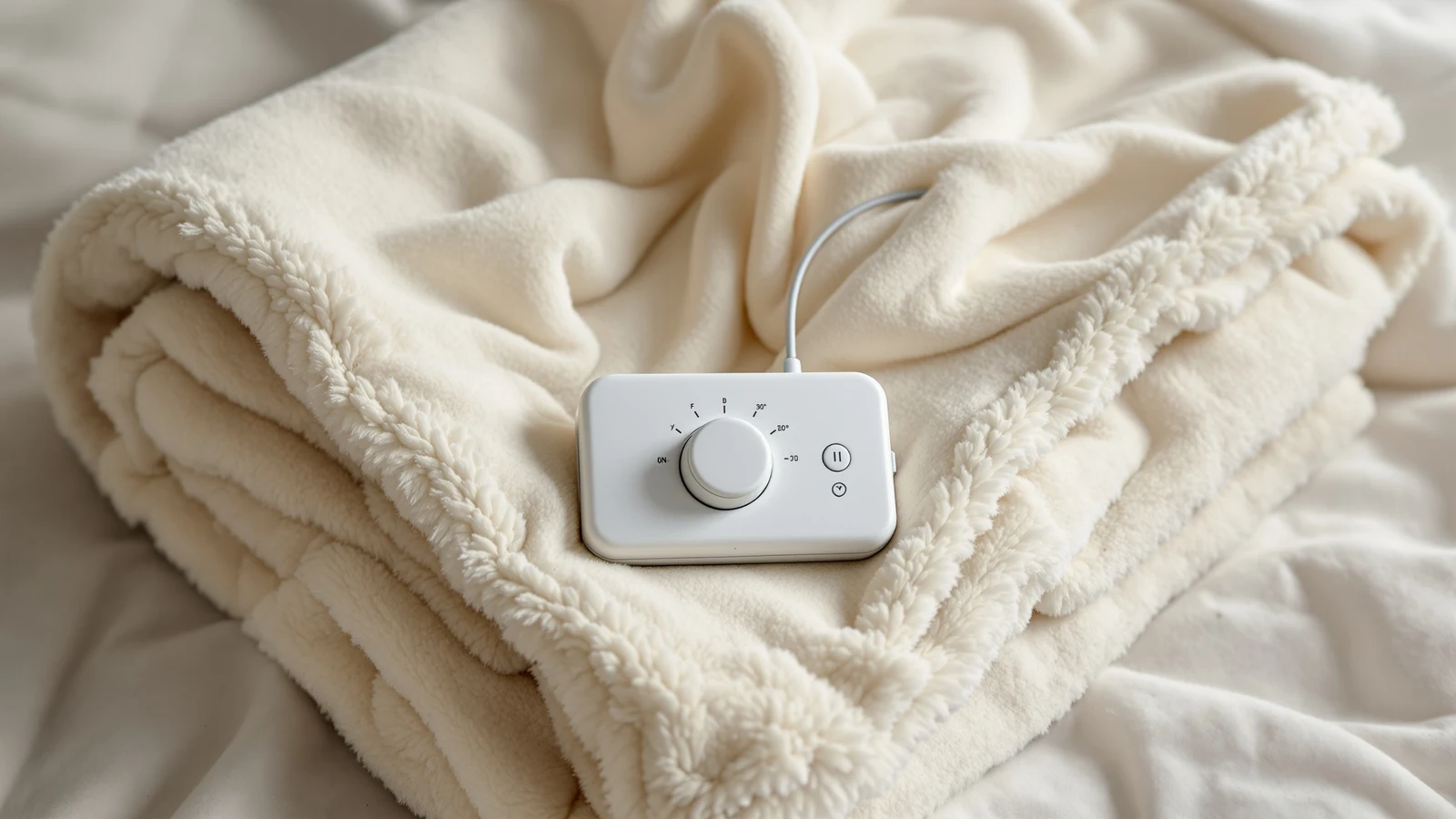
Close-up of a heated blanket controller next to a thermometer icon suggesting an actual temperature reading rather than an abstract heat level
Quick answer

One listing names a number; the rest name a dial position

Of the heated throws we researched for this category, almost every one describes its heat output as a count of settings — "5 heating levels," "9 heat settings" — with no indication of what any single level produces in degrees. The JOYFLAME Ultrasoft Electric Heated Blanket Throw is the exception: its listing states 125.6°F outright, as a fast, even maximum heat, right in the product title. That single data point is useful less for what it tells you about the JOYFLAME and more for what it implies about everything else — namely, that "level 5" on a different throw is a number nobody is required to publish, and most don't.

Below: why almost nobody states a temperature, what a level number is actually standing in for, why the JOYFLAME is the exception rather than the rule, and our picks among the three throws in this comparison — including the two that only give you a level count. Jump straight to the picks or to how to read a heat-level claim.

Disclosure: this article contains affiliate links. If you buy through one, we may earn a commission at no extra cost to you — see our About page for how we research.

The pattern

Why almost no listing states a temperature, and what they say instead

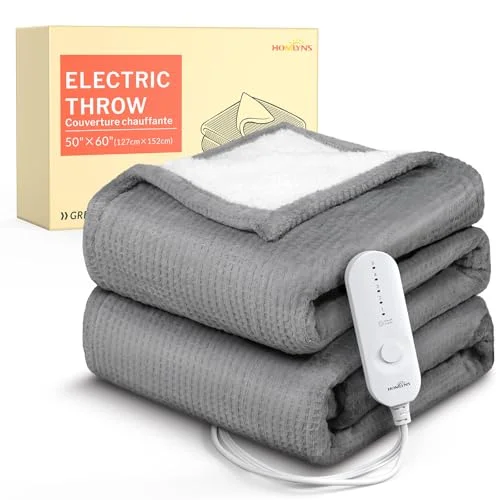
Search "heated blanket" on Amazon and the specification that shows up on nearly every listing is a heat-level count: 5 settings, 6 settings, 9 settings, sometimes 20 on a premium dual-zone blanket. What almost none of them tell you is what any of those settings actually produce against your skin, measured in degrees. The Electric Blanket Throw we cover below is typical of the category: its title leads with "5 Heating Level" and nowhere in the listing is a Fahrenheit figure attached to any of the five. The HOMLYNS Heated Throw Blanket follows the same convention — 5 heat settings, stated plainly, with no temperature attached to any of them.

This is not unusual for the category; it is the convention. A heat-level number is a relative scale internal to that one product — level 3 on a 5-level throw and level 3 on a 9-level throw are not the same output, and there is no published arithmetic that lets you convert one to the other. What a level count does communicate, reliably, is granularity: a 9-setting throw lets you step between low and high in smaller increments than a 5-setting one, which matters if you find that "level 2" is too cold and "level 3" is already too warm. It just doesn't tell you where either number sits on an actual thermometer.

The language manufacturers reach for instead is almost always comparative rather than absolute: "fast heating," "even heat distribution," "warms quickly." The Electric Blanket Throw's listing itself leans on exactly this — "Fast Heated Blanket Throw" is in the product name, doing the job a temperature figure would otherwise do. It is a real claim about speed, not a substitute for one about degrees, but it is the kind of claim that reads like more information than it is.

The exception

The one blanket that does: 125.6°F, printed on the listing itself

The JOYFLAME Ultrasoft Electric Heated Blanket Throw breaks from the convention in its own product title: "125.6°F Fast Even Heat." That is a maximum temperature, stated as a specific number rather than an abstract setting position, and it is the only one of the three throws in this comparison that does it. Whatever else is true about the JOYFLAME — and we don't have its full settings breakdown beyond what the listing states — that single figure is a different kind of claim than "level 5," because it is falsifiable in a way a level number is not. You can hold a thermometer to it and check; you cannot hold a thermometer to "level 5" and learn anything, because level 5 was never a claim about a number in the first place.

It is worth being precise about what 125.6°F does and doesn't tell a buyer. It is described as the throw's maximum, fast, even heat — not necessarily the temperature you'd run it at every night, and not a figure we can independently verify beyond what JOYFLAME states on the listing. We're not able to tell you how that maximum was measured, over what surface, or after how long. What it does do is give you one real number to anchor a comparison against, which the other two throws in this piece simply don't offer. That is a meaningfully different kind of transparency than a level count, even with those caveats attached.

There's also a plain, practical reason 125.6°F is a usable number and not just a marketing flourish: it sits well under the threshold where skin contact becomes a burn risk over any sustained period, and well above the point where a blanket would feel merely "warm" rather than "hot." Stating it costs JOYFLAME nothing in terms of making the product look dangerous — if anything, a specific number reads as more carefully engineered than a vague "heats fast," which is probably part of why it's unusual to see it stated at all rather than assumed to be a liability.

The translation problem

What a "level 5" on another throw might actually correspond to

Here is the honest limitation: we cannot tell you what level 5 on the Electric Blanket Throw or level 5 on the HOMLYNS corresponds to in degrees, because neither listing publishes that conversion, and we don't invent specs that aren't stated. What we can say, from the general engineering of this product category, is how a level system is built. A heated throw's heating element is a resistive wire run through the fabric in a grid, and the "level" dial doesn't move a thermostat set-point the way a home heating system does — it adjusts how much of the time the element is powered within each cycle, a technique commonly called duty-cycling. A higher level means the wire is on for a larger share of each cycle, which raises the average temperature at the fabric surface, but the actual peak temperature the wire reaches at any given level is a function of that specific throw's wire gauge, wattage, and control firmware — none of which is shared across brands, or even necessarily across two throws from the same brand.

That is precisely why the JOYFLAME's 125.6°F figure doesn't translate into "level 5 on the Electric Blanket Throw is roughly X degrees." The five levels on the Electric Blanket Throw could top out well below 125.6°F, well above it, or land close to it — the listing simply doesn't say, and five settings spread across an unstated range could mean each step is a large jump or a small one. The same is true of the HOMLYNS's five settings. A 5-level throw and a 9-level throw both described only by their level count are not directly comparable on heat intensity at all; the level count tells you about control granularity within one product, not about where that product's output sits relative to another.

This is the quiet cost of the level-only convention: it lets two throws that run very differently hot both describe themselves the same way. "5 heating levels" is true of a throw that tops out mild and true of a throw that tops out genuinely hot, and a shopper comparing listings side by side has no way to tell which is which without a stated temperature — which is exactly the piece of information the JOYFLAME's listing supplies and the other two don't.

The incentive

Why manufacturers likely avoid the number even when they could state it

Every heated blanket sold in the US has a maximum surface temperature, because the electronics inside are engineered to a specific wattage and the heating wire has physical limits. That number exists for every one of these products whether or not the listing says so — the absence of a stated figure is not evidence that no number was measured, only that it wasn't published. So the question worth asking is why a brand would measure a temperature internally, as part of basic product safety engineering, and then choose not to put it on the listing the way JOYFLAME does.

Part of the answer is almost certainly that a level count is simpler marketing copy than a temperature. "5 Heating Level" fits cleanly into a product title alongside size and fabric type; a Fahrenheit figure invites a direct side-by-side comparison with every competing listing that does publish one, which is a comparison most brands would rather not invite if their own number isn't especially flattering. A level count, by contrast, can't be directly benchmarked against a competitor's level count at all — which, perversely, makes it the safer number to publish precisely because it resists comparison.

There's also a liability angle worth naming plainly, as general information rather than a claim about any specific brand's reasoning: the word "hot," attached to a specific degree figure, sits closer to a safety claim than "warms quickly" does. A level number lets a brand describe intensity without making a statement that could later be measured and disputed. We don't have internal documentation from any of these manufacturers explaining their labeling choices, so this is informed inference about the category's incentives, not a claim about what any one brand decided or why — but it's consistent with the fact that stating a temperature, as JOYFLAME does, remains the exception rather than the norm across a category where every product has one.

The picks

The three throws in this comparison

Ordered by how much of the heat specification each one actually discloses — from a stated number in degrees down to a level count alone.

01States a temperature

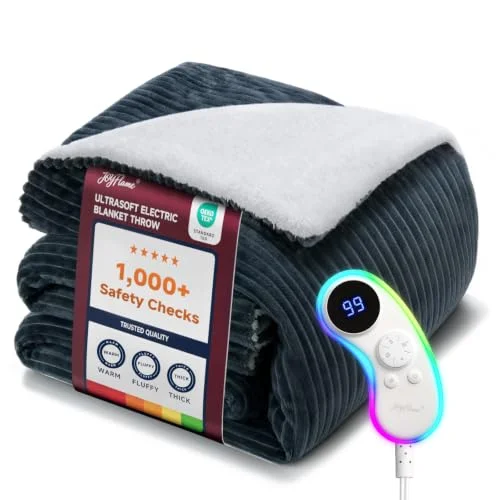
JOYFLAME Ultrasoft Electric Heated Blanket Throw

The one that tells you the number instead of the level
Throw 50″×60″ · 125.6°F fast, even heat

This is the throw this entire article is about: the only one of the three where the listing states an actual maximum temperature, 125.6°F, rather than an unqualified level count. "Fast even heat" is the other half of the claim — a description of how quickly and uniformly that maximum is reached across the fabric, which is a real, checkable property even without independent testing on our end. At $28.45 for a 50×60″ throw, it sits in the middle of this comparison's pricing, between the Electric Blanket Throw and the HOMLYNS. We don't have a published heat-level count for the JOYFLAME beyond the stated maximum, so we're not able to tell you how many steps lead up to 125.6°F — only that the top of the range is a number you can actually hold against a thermometer, which neither of the other two throws here offers.

JOYFLAME Ultrasoft Electric Heated Blanket Throw, 50 by 60 inch, stated maximum 125.6 degrees Fahrenheit
$28.45
Throw · 125.6°FCheck price →
02Level count, mid-range

HOMLYNS Heated Throw Blanket

Five settings and a timer, no stated temperature
Throw · 5 heat settings · 3-hour timer · grey

The HOMLYNS states five heat settings and a 3-hour timer, and that is the specification in full as far as heat output is concerned — there is no Fahrenheit figure attached to any of the five levels. The 3-hour timer is itself a useful, concrete spec in a category where auto-off duration varies widely; it tells you plainly that this is built around a defined session rather than an all-night run. At $24.98 it is the least expensive of the three throws here. If what matters most to you is knowing exactly how hot the top setting gets, the HOMLYNS's listing simply doesn't answer that question, and we're not going to guess an answer it doesn't publish.

HOMLYNS Heated Throw Blanket in grey with 5 heat settings and 3 hour timer
$24.98
Throw · 5 settingsCheck price →
03Level count, budget

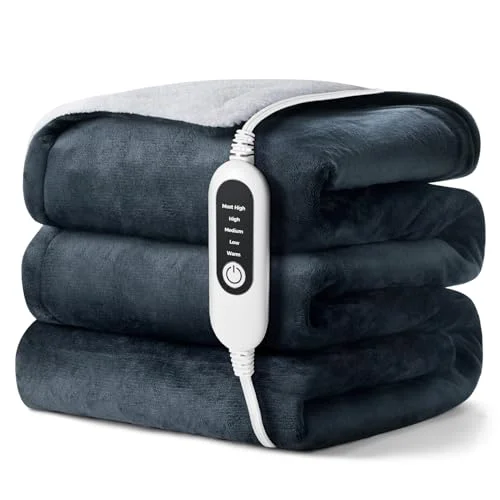
Electric Blanket Throw, Fast Heated Blanket Throw

Five levels, double-sided fabric, no stated temperature
50″×60″ · 5 heating levels · double-sided flannel · ETL certified · machine washable

At $12.23 this is the least expensive throw in the comparison, and its specification is the category's convention in its purest form: five heating levels, and the rest of the listing's heat-related language is about speed ("fast") rather than degrees. It is double-sided, soft silky flannel on both faces, ETL certified, and stated as machine washable. None of that tells you what level 3 or level 5 feels like on your skin in absolute terms — only that there are five discrete steps to choose from, which is the same information every budget throw in this category tends to offer, and nothing more.

Electric Blanket Throw, double-sided soft flannel heated throw blanket with 5 heating levels
$12.23
Throw · 5 levelsCheck price →
ModelHeat spec disclosedSizePrice
JOYFLAME Ultrasoft ThrowMaximum stated: 125.6°F50×60″$28.45Price
HOMLYNS Heated Throw5 settings, no temperatureThrow$24.98Price
Electric Blanket Throw5 levels, no temperature50×60″$12.23Price
The takeaway

Reading a heat-level claim with this in mind

None of this makes a level-only listing a bad product — the HOMLYNS and the Electric Blanket Throw are both ordinary, functional throws within the normal conventions of this category, and the absence of a Fahrenheit figure is not itself a red flag on either one. What it means, practically, is that a level count is a within-product comparison tool and not a between-product one. "5 heat settings" tells you that you'll have five steps to choose from on that specific blanket; it does not tell you whether step 5 on that blanket runs hotter or cooler than step 5 on a different blanket with the same count.

If a stated temperature matters to your decision — say, because you're shopping for someone with reduced heat sensitivity, or you simply want a number you can reason about rather than a position on an unlabeled dial — the JOYFLAME's 125.6°F is the one piece of comparable, published data in this trio, and it's worth treating that disclosure itself as a point in its favor, independent of whether 125.6°F happens to be the number you'd personally pick as ideal. For anyone with a health condition that makes skin sensitivity to heat a real concern, that is general information to weigh, not medical advice, and it is worth discussing a specific setting with a doctor rather than inferring safety from a marketing claim either way.

And for the two throws that only publish a level count: the honest response is not to assume a number, but to treat the count as what it actually is — a statement about how many steps are available, not about where any of them land in degrees. If that distinction matters enough to change your purchase, the practical move is to look specifically for a listing that states a figure, the way JOYFLAME's does, rather than inferring one from adjectives like "fast" or "intense" that aren't attached to a number at all.
How we picked

Three throws, chosen for the contrast in disclosure

We pulled three heated throws from our catalogue specifically to illustrate a labeling pattern we noticed across the category: one that states a maximum temperature in its listing, and two that state only a heat-level count with no temperature attached. We did not screen out the level-only throws for lacking that figure — the absence of a published temperature is the norm in this category, not the exception, and both are otherwise ordinary, complete listings with a stated heat-level count, fabric, and certification where applicable. We did not independently measure any of these throws' surface temperatures; every figure here is the one the listing itself publishes.

How we compared

Research, not a lab

We're honest about this: we don't physically test these blankets and we don't run a testing lab. We compare published specifications, stated certifications, and live pricing, and we reason from general, publicly documented facts about how resistive heating elements and duty-cycle controls work in this product category. Amazon no longer exposes verified star ratings or review counts through its product API for most listings, so you will not find rating badges, invented scores, or paraphrased review sentiment anywhere in this guide — we simply do not have that data for these specific products.

FAQ

Common questions

Why don't most heated blankets state a temperature in Fahrenheit?

Most listings in this category describe heat only as a level count — "5 heating levels," "9 heat settings" — with no degree figure attached to any step. Every blanket has a real maximum temperature by virtue of its wattage and wiring, whether or not the listing says so; the absence of a published number simply means the brand chose not to disclose it. A level count also resists direct comparison with a competitor's level count, which may make it a more comfortable number to publish than a temperature that invites a side-by-side check.

Does the JOYFLAME's 125.6°F mean it runs hotter than throws that only list heat levels?

Not necessarily. 125.6°F is JOYFLAME's stated maximum, fast, even heat — a real, specific figure. But the Electric Blanket Throw and the HOMLYNS don't publish a comparable temperature at all, so there's no published number to measure the JOYFLAME against. Their five heat levels could top out below, at, or above 125.6°F; the listings simply don't say, which is exactly the gap this article is about.

Can I figure out what "level 5" corresponds to in degrees on an unlabeled throw?

Not reliably, and not from the listing alone. A heat level typically reflects how much of each duty cycle the heating wire is powered, and the actual temperature that produces depends on that specific product's wire gauge, wattage, and firmware — details that aren't shared across brands or even always across models from the same brand. Two throws with the same level count are not guaranteed to run equally hot at any given level.

Is a stated temperature safer than a level count?

Not inherently — both the JOYFLAME and the level-only throws here are ETL-certified or otherwise built to standard safety practice where stated. A published temperature doesn't make a blanket safer; it makes the heat claim easier to evaluate and compare. If heat sensitivity is a genuine health concern for the person using the blanket, that's worth discussing with a doctor regardless of which labeling convention the product uses — this is general information, not medical advice.

Keep reading

Related reading