Honest Take · Heat-Level Counts
This Queen Blanket Claims 20 Heat Levels: Does That Mean More Control?
A queen heated blanket in our database advertises twenty heat levels, split across two independent controllers, one per sleeper. That's roughly double the count most queen blankets stop at, and several times the six levels on the cheapest throws. Before treating twenty as simply "more control than ten," it's worth asking what a heat level actually is on this kind of product, how many of them a dial or a button can meaningfully land on, and whether the number on the box is describing the thing you actually feel.
By Ilane Tall · Updated November 20, 2026 · Research-based.
Quick answer
More levels, but the real upgrade is the two zones
Twenty heat levels sounds like twenty distinct temperatures you can dial between, but on the kind of resistive heating wire these blankets use, the output between two adjacent levels out of twenty is a small enough difference that most people cannot reliably feel it blind. What a higher count buys you with more confidence is finer rounding — you can land closer to the exact warmth you want instead of jumping between coarse six-level steps — plus a digital display that's easier to read and repeat than a mechanical dial. On the queen blanket we looked at here, the number that actually changes how it's used in a shared bed isn't twenty; it's that there are two of those twenty-level controllers, one per side, so each sleeper sets their own number independently.
Below: what twenty levels can and can't deliver on a dimmer-style heating element, why a digital display makes a high count easier to sell than a dial ever could, what 6, 10 and 20 actually translate to in practice, the independent dual-zone question that matters more than the count, our picks among the three blankets we compared, and the level count that's genuinely worth paying attention to when you're reading a listing. Jump to the picks or to the number that actually matters.
Disclosure: this article contains affiliate links. If you buy through one, we may earn a commission at no extra cost to you — see our About page for how we research.
The box versus the dial
Twenty on the box, and what a controller can actually land on
"Twenty heat levels" is a specific, countable claim, and on the queen blanket we're looking at here — a dual-controller model listed with twenty adjustable heat levels per side and a 12.5 ft controller cord — it describes twenty discrete button presses on a digital unit, not twenty positions on a rotating dial. That distinction matters more than it sounds like it should. A dial has to be turned by hand and stopped somewhere, and the more notches you cram onto a small rotating wheel, the harder it is to land precisely on one rather than sliding past it in the dark. A button-stepped digital controller doesn't have that problem: each press moves exactly one level, every time, regardless of how many total levels exist. Twenty levels on a dial would be a nuisance. Twenty levels on buttons is just twenty button presses from "off" to "maximum."
That's also why the two lower-count blankets we're comparing against both use buttons rather than dials. The COZYTY throw offers six heat settings on its digital controller, and the CAROMIO queen blanket offers ten on its LCD dual controller — neither asks you to twist a knob and guess. The mechanism, not the count, is what decides whether a high number is actually usable. If you ever shop a model that advertises a high level count on a twist dial rather than a keypad, that's worth noticing: the number may be real, but landing on a specific one of twenty rotational positions by feel, especially under a blanket in a dark room, is a different task than tapping a button labeled "+1" twenty times.
None of this means twenty buttons equals twenty meaningfully different experiences once you're lying under the blanket. It means the hardware can register twenty distinct instructions reliably. Whether your skin can tell level 14 from level 15 is a separate question, and it's the one the next two sections work through.
What makes the number sellable
Digital displays are why high heat-level counts are easy to sell
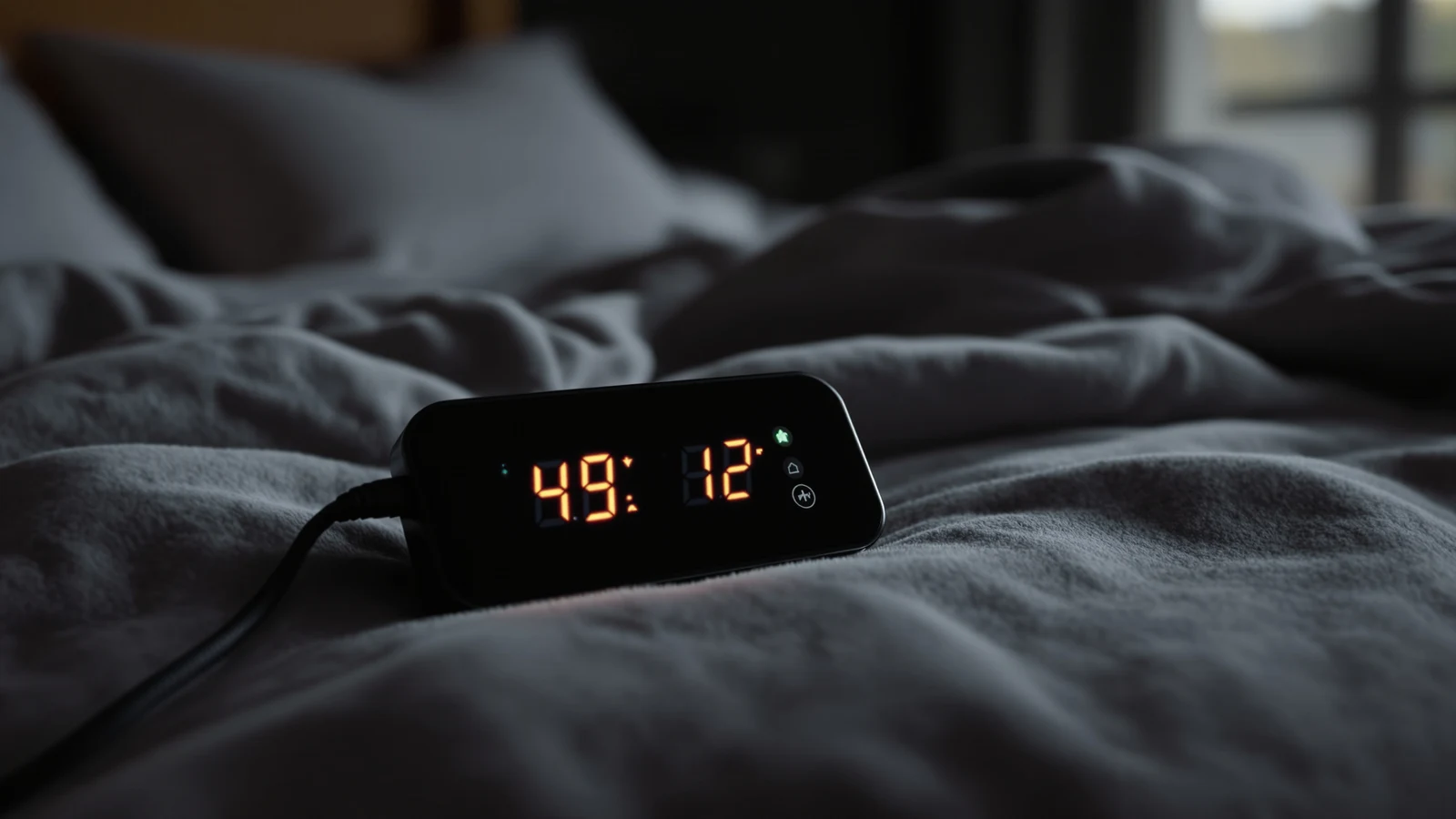
A mechanical dial with six printed notches looks, at a glance, like a blanket with six options. A digital display that counts up from "1" to "20" as you hold a button looks like twenty options, and it looks that way immediately, before you've read a single spec line. That's the real function of the digital controller in this category: it turns an abstract heat-settings number into something you watch happen on a screen, one step per press, which makes a larger number feel earned rather than arbitrary. The CAROMIO queen blanket's LCD dual controller displays its ten settings the same way; the COZYTY throw's digital controller does the same for six. The display itself doesn't change how much heat comes out of the wire — it changes how legible and countable the number feels to a shopper comparing listings.
This is also, mechanically, why high counts have become easy to advertise in the first place. Older mechanical blankets used a rotary dial wired directly to a handful of resistor taps, and adding more taps meant more physical switch positions — a real manufacturing cost with real limits. A digital controller instead drives the heating wire electronically, commonly through pulse-width modulation, where the "level" is really just how large a fraction of each second the element is switched on. Going from six software-defined levels to twenty is a firmware and labeling decision far more than a hardware one. That's not a criticism of the twenty-level blanket specifically — the dual-zone system genuinely requires two of these controllers, which is real added hardware — but it does explain why the level count on the box can rise faster than the number of heat outputs you can actually distinguish once you're using it.
None of that makes a digital, numbered display pointless. Being able to glance down and confirm "level 8," then set the same number again next week without guessing, is a genuine usability win over a dial with no numbers printed on it at all. The honest version of the pitch is: the display buys you repeatability and a readable number in the dark, not twenty genuinely distinguishable temperatures.
The arithmetic
What 6, 10 and 20 levels actually translate to on a dimmer-style element
Here's the arithmetic, with the assumption stated plainly: treat each blanket's heating wire as a simple dimmer running from 0% output at the lowest usable setting to 100% at the highest, divided evenly across its stated number of levels. On the COZYTY throw's six settings, each step is roughly a sixth of the full range — about 17 percentage points of output per press. On the CAROMIO queen blanket's ten settings, each step narrows to about 10 percentage points. On the twenty-level dual-zone blanket, each step is roughly 5 percentage points of the full range. Going from six levels to ten roughly halves the size of each step. Going from ten to twenty halves it again.
That halving matters because human skin isn't equally sensitive at every step size. Perceiving a difference in warmth against skin generally requires a noticeably larger change than the eye needs to tell two shades of gray apart, and a 5-percentage-point step in heating output, especially once a blanket has already warmed you for several minutes and your skin has adapted, is a plausible candidate for a change most people won't reliably notice blind. A 17-percentage-point step, by contrast, is large enough that most people would call it "clearly warmer" without needing a display to confirm it changed. In practical terms: a six-level blanket is more likely to feel like six genuinely different temperatures than a twenty-level blanket is to feel like twenty.
The practical upside of finer steps isn't that you can feel every one of them individually — it's rounding error. With six levels, the setting you actually want might sit between two steps, and you're stuck picking whichever side is closer, off by up to half a step's worth of heat. With twenty levels, that same gap between what you want and what's available shrinks to a quarter of the size. You're less likely to feel "stuck between levels 3 and 4" the way you might on a coarser blanket. That's a real, usable benefit of a higher count — it just isn't the same claim as "twenty distinguishable temperatures," and the two get conflated in marketing copy more often than the spec sheet admits.
The feature that actually changes the bed
Independent dual control: two zones, twenty levels each
The twenty-level queen blanket we're comparing here is listed with dual controllers providing independent warmth for each side of the bed, each running its own full twenty-level range off a 12.5 ft controller cord, with auto shutoff built in. That's the detail that matters more than the raw count. A single shared controller on a queen bed means one person's idea of "warm enough" is imposed on whoever else is under the blanket — a nightly negotiation that has nothing to do with how many heat settings exist, because there's only one setting being applied to two people. Splitting the blanket into two independently controlled zones removes that negotiation entirely: each side gets its own number, chosen by the person lying on it, changeable without touching the other side's setting at all.
This is also where a higher level count earns more of its keep than it does on a single-zone throw. Two people with genuinely different cold tolerances are more likely, between them, to land on two different fine-grained settings that both feel right than either one is to need a specific one of twenty levels alone. Coarser steps on a shared single-zone blanket already force a compromise between two people; adding independence removes that compromise, and having more steps available on each independent side gives each person more chances to find their own comfortable number rather than rounding to whichever of six shared options is closest.
It's worth being precise about what this does and doesn't solve. Dual-zone control fixes the "we disagree on warmth" problem. It does not, by itself, fix the "can I feel the difference between level 14 and level 15" problem discussed above — that's a property of the heating element and the step size, not of how many independent zones exist. A dual-zone blanket with six levels per side would still solve the shared-bed negotiation; it just wouldn't let either person fine-tune as precisely once they'd found their preferred zone. On this particular product, you get both: the independence and the finer steps, which is a reasonable case for the twenty-level framing specifically on a queen bed built for two, in a way it isn't on a single-person throw.
Our picks
The picks, by what you're actually solving for
None of these are wrong choices — they answer three different questions. One person on a couch, one queen bed with a single sleeper, or a queen bed shared by two people who disagree on warmth.
01Best for a shared queen bed
Queen Heated Blanket With Independent Dual Controllers
When the real problem is two people, not one thermostat
Queen 84×90″ · 20 heat levels per side · two independent controllers · 12.5 ft controller cord · soft fleece · auto shutoff
At $64.99, this is the most expensive of the three, and the reason to pay more is the dual-zone system, not the level count on its own. Each side of the bed gets its own controller and its own full run of twenty heat levels, so two people with different cold tolerances each dial in their own number without touching the other side's setting — the shared-bed negotiation a single-controller blanket forces onto two people simply doesn't happen here. The 12.5 ft controller cord gives real slack to route each cord to its own nightstand, and auto shutoff covers the standard safety expectation for anything left running overnight. The honest caveat: the twenty-level count buys finer rounding more than twenty felt temperatures, as the sections above explain. Buy this because you need two independently adjustable sides, not because the number twenty is bigger than ten.
02Best queen for one sleeper
CAROMIO Heated Blanket Queen, LCD Dual Controller
A queen blanket with finer steps than six, without paying for a second zone you won't use
Queen 84×90″ · 10 heat levels · LCD dual controller · waffle weave, 240 GSM velvet & 200 GSM sherpa · 1–12 h timer · ETL certified
At $53.99, this sits between a basic throw and the dual-zone pick above, and ten levels is a genuinely useful middle ground: enough steps to round closer to your preferred warmth than a six-level throw allows, without the twenty-level blanket's finer steps that are harder to tell apart anyway. It's listed with a waffle-weave construction — 240 GSM velvet on one face, 200 GSM sherpa on the other — and an LCD controller that displays the active level and a 1–12 hour timer rather than a fixed window. It carries ETL certification. If you want queen-size coverage for one person, or a couple who both run the same setting anyway, the single controller here is simpler to manage than negotiating two, and you're not paying for independence you won't use.
03Best for one person, not a bed
COZYTY Heated Blanket Throw, Digital Display
The cheapest way to confirm whether level count matters to you at all
50×70″ throw · 6 heat settings · digital display controller · 1–4 h timer · 4 h auto shutoff · flannel & sherpa · ETL & FCC certified
At $28.28, six settings on a digital display is the coarsest of the three, and by the arithmetic above, the biggest and most reliably noticeable steps of any blanket here — which is arguably a feature, not a limitation, for a throw you're adjusting quickly on a couch. It carries ETL and FCC certification with built-in overheat protection and a 4-hour auto shutoff, and a 1–4 hour timer suited to an evening rather than overnight bed use. This is the pick if you want to test, cheaply, whether a heated throw earns a permanent spot in your routine before spending on a queen blanket with ten or twenty levels you may never fully use on a sofa.
| Model | Best for | Size | Heat levels | Controller | Price | |
|---|
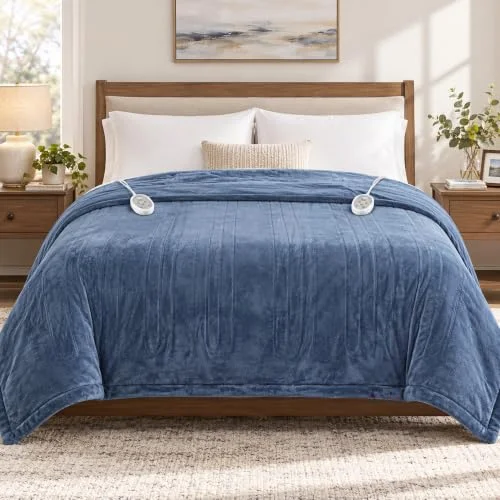 Dual-Controller Queen | Shared bed, two sleepers | Queen 84×90″ | 20 per side | Two independent | $64.99 | Price |
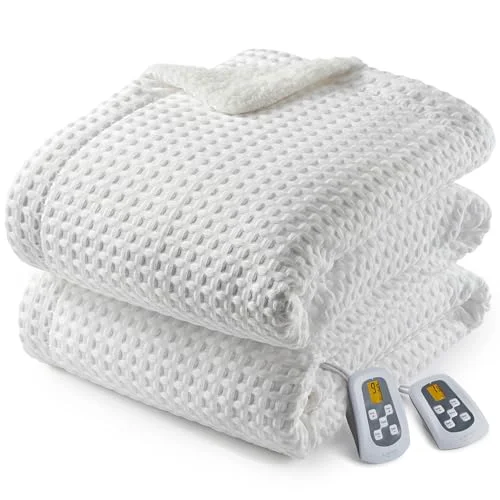 CAROMIO Queen | Queen bed, one sleeper | Queen 84×90″ | 10 | LCD dual controller | $53.99 | Price |
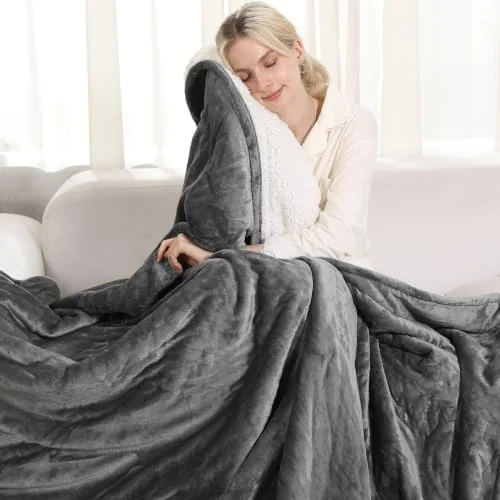 COZYTY Throw | Couch, one person | 50×70″ throw | 6 | Digital display | $28.28 | Price |
The takeaway
The level count that's actually worth paying attention to
If you read only one number off a heated-blanket listing, it probably shouldn't be the heat-level count by itself. Once a blanket clears roughly ten levels on a digital controller, each additional step is doing less and less work in terms of what you can actually feel, for the arithmetic reasons laid out above — the gap between level 10 and level 11 out of twenty is a quarter of the gap between level 3 and level 4 out of six. Past that point, a higher count is mostly buying finer rounding and a bigger number on the box, not a meaningfully warmer or more controllable blanket than a well-built ten-level model.
The spec worth reading closely instead is whether the controller count matches how many people will use the blanket. A single sleeper on a queen bed gets essentially everything a higher level count can offer from a ten-level single controller like the CAROMIO's, and doesn't need to pay for a second zone sitting idle. Two people sharing a queen bed get more real benefit from splitting into two independently controlled zones than from either person having access to twenty levels alone on one shared dial — the negotiation a single controller forces is a bigger source of nightly friction than a coarse step size ever is. If you're shopping queen blankets more broadly and the auto-off window matters as much as the heat settings do, our guide to heated blankets with a full 12-hour auto-off covers that spec in the same kind of detail.
It's also worth treating a high heat-level count the same way we've treated other inflated-sounding specs in this category. We ran into a similar pattern comparing four nearly identical ESTINGO queen listings, where the headline numbers matched across every SKU and the real difference was elsewhere in the listing. A heat-level count is a real, checkable spec — it isn't fabricated the way a review score would be — but a bigger number on a digital controller doesn't automatically mean a bigger difference in how the blanket feels against your skin. Read it alongside the controller count, the auto-off window, and the fabric before deciding it's the number that should decide your purchase.
How we picked
Three controllers, three different level counts
We picked three blankets specifically for contrast in stated heat-level count and controller design: a six-level throw with a digital display, a ten-level queen blanket with an LCD dual controller, and a twenty-level-per-side queen blanket with two fully independent controllers. Each had to publish a complete specification — finished dimensions, exact heat-level count, controller type, auto-off behaviour, fabric and any stated certification — before we'd compare it. We did not pull in blankets whose listings only claimed an adjective like "multiple heat settings" without a number, because the whole point of this piece is comparing specific counts against each other.
How we compared
Research, not a lab
We're honest about this: we don't physically test these blankets and we don't run a testing lab. The dimmer-style step-size arithmetic in this guide is a stated model built from each product's published level count, not a measurement taken off a physical unit, and we say so plainly rather than presenting it as a lab finding. We compare published specifications, stated certifications and live pricing, and we anchor every claim in those sources plus general facts about how resistive heating elements and digital controllers are built. Amazon no longer exposes verified star ratings or review counts through its product API, so you will not find rating badges, scores, or paraphrased review sentiment anywhere in this guide.
FAQ
Common questions
Can you actually feel the difference between adjacent heat levels on a twenty-level blanket?
Probably not reliably, between two levels right next to each other. Modeling the heating wire as an even dimmer, each of twenty levels represents roughly a 5-percentage-point step in output, a small enough change that it's a plausible candidate to fall below what human skin can distinguish blind, especially after the blanket has already been warming you for a few minutes. Wider gaps — level 5 versus level 15, say — are far easier to notice than adjacent ones.
So is a higher heat-level count pointless?
Not pointless, just narrower in what it buys than the number implies. More levels mean finer rounding — you land closer to your exact preferred warmth instead of jumping between coarse steps — and a digital display makes the active level easy to read and repeat. What it doesn't reliably mean is twenty distinguishable temperatures you can tell apart one by one. Past roughly ten levels, each additional step does less and less work.
What matters more on a shared queen bed: the level count or the controller count?
The controller count. A single shared controller on a queen bed imposes one person's idea of "warm enough" on whoever else is under the blanket, regardless of how many heat levels exist. Splitting into two independently controlled zones, each with its own full range of levels, removes that nightly negotiation entirely — which is a bigger improvement for two people than either person having access to a higher number alone on one shared dial.
Is a mechanical dial with a high level count as usable as a digital controller with the same count?
Generally no. A rotary dial has to be turned and stopped by feel, and the more levels crammed onto one dial, the harder it is to land precisely on a specific one, especially in a dark room. A digital, button-stepped controller moves exactly one level per press regardless of the total count, which is why high level counts in this category are almost always paired with digital displays rather than dials.
Keep reading
Related reading