Best Heated Blankets
Honest Take · Box-Quilted Heated Blankets

Are Quilted Heated Blankets Worth the Extra Money?

Most heated blankets are a flat panel of flannel or sherpa with a heating wire run through it. A smaller group is box-quilted — stitched into a grid of pockets like a comforter, with a layer of fill between the two fabric faces. The marketing calls this "comforter-like warmth." We priced two box-quilted queen blankets against a flat queen blanket that costs about the same, to see what the stitching actually buys.

By Ilane Tall · Updated November 18, 2026 · Research-based.

A box-quilted ivory heated blanket folded on a bed next to a flat grey electric blanket, showing the stitched grid pattern of the quilted fabric
Quick answer

Sometimes — but the quilting itself is not what you're paying for

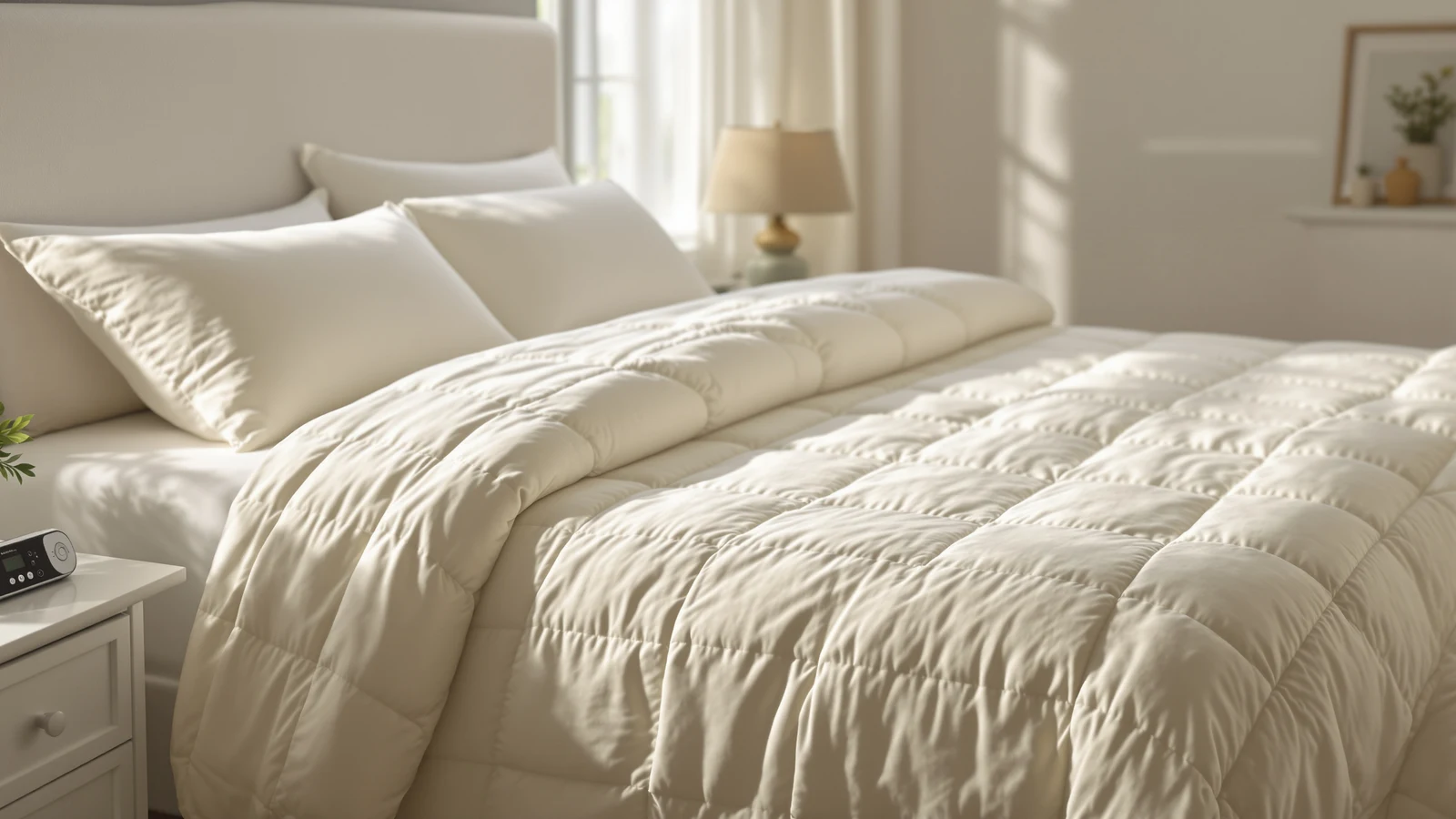
Box-quilting adds a layer of fill between two fabric faces, stitched into a grid so the fill doesn't shift into one corner of the blanket. That genuinely makes a heated blanket heavier and drapes closer to a comforter than a throw. What it does not reliably predict is price: of the two quilted queen blankets we compared here, one costs less than a flat, non-quilted queen blanket of the same size, and the other costs nearly $35 more. The quilting is a real construction difference. The price gap between quilted blankets is driven by brand, the auto-off range, and certification claims — not by the stitching pattern alone.

This guide works through what box-quilted means on an electric blanket, whether "comforter-like warmth" is measurable or just copywriting, what the quilting adds in weight and drape, how the quilted options price against a flat queen at similar money, our picks among the three, and who is better off skipping the quilting and buying a flat sherpa throw instead.

Disclosure: this article contains affiliate links. If you buy through one, we may earn a commission at no extra cost to you — see our About page for how we research.

The construction

What "box-quilted" actually means on a heated blanket

A standard heated blanket is a single flat textile layer — flannel, microplush, or a sherpa-and-plush pairing — with a heating wire sewn through the weave in a loose grid. It has thickness, but it is the thickness of one fabric, and nothing stops the whole panel from folding flat as a sheet. Box-quilting changes the build: a layer of fill sits between a top fabric and a backing fabric, and the whole assembly is stitched down at regular intervals into a grid of small boxes, the same technique used on a quilted comforter or a mattress topper. The stitching lines are there for a structural reason, not decoration — without them, the fill inside would migrate toward the lowest point of the blanket every time it was folded or shaken, leaving thin patches and thick clumps instead of an even layer.

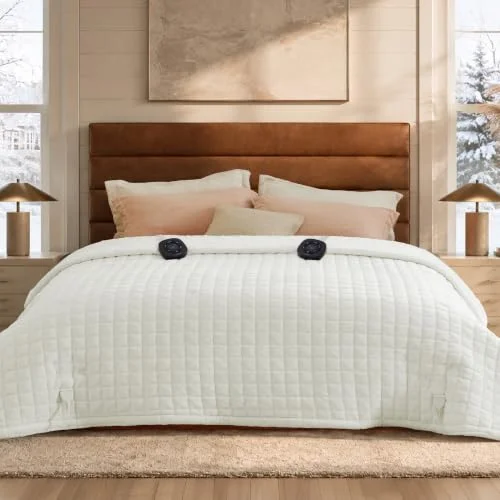
Of the three products in this comparison, two use this construction. The Bedsure Luxury Quilted Heated Blanket is explicitly box quilted at 84×90 inches and is marketed around "comforter-like warmth." The KOOWEIBED Heated Blanket is listed as premium quilted at the same 84×90-inch queen size, with the same dual-control and preheat layout. The ESTINGO Heated Blanket, also a queen at 84×90 inches, is not described as quilted — it is the flat-panel build most electric blankets use, which is exactly why it works as the comparison point here.

Quilting also changes where the heating wire sits relative to you. On a flat blanket, the wire sits in roughly the same plane as the fabric, against whatever is pressed on top of it. On a quilted blanket, the wire typically runs through or alongside the fill, with padding on both sides rather than a thin fabric skin. None of the three listings publish wire placement as a measurable spec, so that is a structural inference from the build type rather than a tested claim. For a side-by-side look at how one quilted brand sizes its own range, see our guide to Bedsure's heated blankets at every size.

The marketing claim

Comforter-like warmth: real difference or marketing language

"Comforter-like warmth" is the Bedsure listing's own phrase, and it is doing two jobs at once: describing a real physical property, and selling a $84.78 blanket against $30 throws that use the same word "warm" with nothing to back it up. The real part is straightforward thermodynamics. A fill layer, even a thin one, traps a pocket of still air the way a comforter's down or synthetic fill does — and still air is a poor conductor of heat, which is precisely why it insulates. A flat heated blanket has no equivalent air pocket of its own; whatever insulating value it has comes from the fabric weight and whatever is layered on top of it in use, such as a duvet or a second blanket.

What the claim does not mean is that the quilted blanket runs hotter. All three blankets in this comparison are dual control with heat settings in a similar range — the Bedsure and KOOWEIBED both list 10 heat settings, and the ESTINGO lists 5 — and heat output is set by the wire and the controller, not by the fill. The quilting changes how the heat is held near the body once the element produces it, not how much heat the element can produce. A comforter feels warm partly because it is not actively heated at all; the fill alone is doing the insulating. A quilted heated blanket gets both: the fill's passive insulation, plus an active element adding heat on top of it. That combination is the honest version of "comforter-like" — it is a legitimate construction difference, but it describes drape and heat retention, not a higher ceiling on temperature.

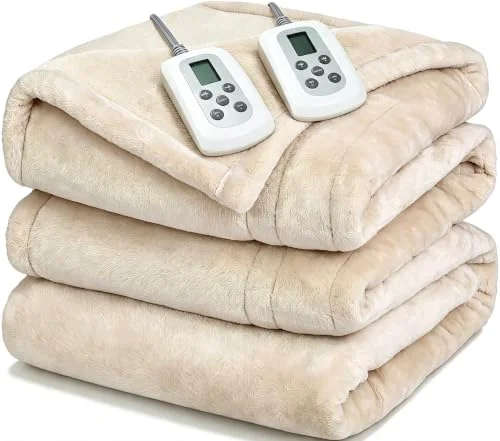
The KOOWEIBED listing makes a narrower, more checkable version of the same pitch: "premium quilted" alongside a preheat function and a stated memory function that returns to your last setting. Preheat and memory are control-layer features, not quilting-layer ones — a flat blanket can have both, and the ESTINGO in this set does not list either, which is a real functional gap unrelated to the quilting itself. Separating the fabric claim from the electronics claim matters here, because a shopper comparing listings by price alone could easily credit the stitching for features that actually come from the controller board.

On the bed

Weight and drape: what quilting adds to a made bed

None of the three listings here publish a blanket weight in ounces or pounds, so we won't invent one — but the construction itself tells you which direction the weight moves. A flat flannel or microplush panel is one layer of fabric plus a thin wire grid; a box-quilted blanket is two fabric faces plus a fill layer plus the same wire grid, which is unavoidably more material in the same 84×90-inch footprint. That extra material is also why a quilted blanket holds its shape on a made bed rather than collapsing flat the way a single-layer throw does when you fold it back. If you've ever smoothed a flat heated blanket over a comforter and watched it slide or bunch at the foot of the bed, the quilted build's added body is the direct fix for that — the stitched boxes keep it from folding into a shapeless sheet.

The trade-off runs the other way at laundry time. All three blankets are listed as machine washable once the controller is unplugged, the baseline for the category and not something quilting changes. What quilting does change is dry time: a fill layer holds moisture the way any quilted bedding does, so a box-quilted queen takes meaningfully longer to dry than a flat flannel one of the same size, and a standard home dryer may need more than one cycle to get a thick fill layer fully dry. If you wash a heated blanket often, that extra dry time is a real cost of the quilted build. Our guide on storing a heated blanket for summer covers how to fold a quilted blanket for storage without creasing the wire, which matters more here than on a flat panel because the fill adds bulk that wants to crease at the same lines every time.

Drape on the bed itself is the upside. A flat blanket under a duvet behaves like an extra sheet — thin and easy to lose track of in the layers. A quilted blanket has enough structure to sit as its own visible layer, closer to how a quilt or a light comforter sits, which is part of why the Bedsure listing leans on "comforter-like" rather than "blanket-like." If you want a heated layer that functions as the top layer of a made bed rather than something hidden under a duvet, the quilted build does that job better by construction.

The arithmetic

Price-matched against a plain queen blanket at the same cost

Here is the comparison that actually answers the question in this guide's title. All three blankets are queen size at 84×90 inches, so size is held constant and price differences come down to construction and features. The KOOWEIBED, which is premium quilted, lists at $52.99. The ESTINGO, which is a flat, non-quilted panel, lists at $55.99 — seven dollars more than the quilted option, despite having half the heat settings (5 versus KOOWEIBED's 10) and no listed preheat or memory function. By this specific pair, quilting is not the premium feature here; it is the cheaper blanket.

The Bedsure Luxury Quilted blanket breaks that pattern: at $84.78 it costs $35 more than ESTINGO's flat panel and $42 more than KOOWEIBED's quilted one, while sharing nearly the same feature list as KOOWEIBED — 10 heat settings, dual control, preheat, and a memory function. Both are quilted queens with the same control layout; the $42 gap between them is not explained by the stitching, since both blankets have it. What differs on paper is the auto-off range — Bedsure states 1 to 10 hours against KOOWEIBED's unspecified auto-off beyond "fast heating" — and brand positioning, with Bedsure's ivory colorway and "comforter-like warmth" phrasing aimed squarely at a bedroom-centerpiece buyer rather than a budget one.

The honest takeaway: quilting, by itself, is not a reliable price signal in this category. It can land you a cheaper blanket, as with KOOWEIBED against ESTINGO, or a much pricier one with largely the same feature set, as with Bedsure against KOOWEIBED. If a listing uses the word "quilted" to justify a higher price, check what else moved — heat settings, auto-off range, certification claims — before assuming the stitching is what you're paying the premium for. For a similar lesson from a different angle, our comparison of Westinghouse's three heated throws found the same thing: three products from one brand, same core function, and the price spread tracked fabric and fine print rather than the headline feature.
ModelConstructionSizeHeat settingsAuto-offPrice
KOOWEIBED Heated BlanketPremium quiltedQueen 84×90″10Not specified$52.99Price
ESTINGO Heated BlanketFlat panel, not quiltedQueen 84×90″510 h$55.99Price
Bedsure Luxury QuiltedBox quiltedQueen 84×90″101–10 h$84.78Price
Our picks

The picks among the three

All three are queen-size electric blankets at 84×90 inches. Ordered by the job each is actually best suited to.

01Best quilted value

KOOWEIBED Heated Blanket, Queen

Box-style construction without the box-quilted price
Queen 84×90″ · 10 heat settings · dual control · preheat & memory function · premium quilted · machine washable

This is the pick that undercuts the entire premise that quilting costs extra. At $52.99 it is the cheapest of the three despite being the one listed as premium quilted, and it carries the same 10 heat settings, dual control, preheat, and memory function as the $84.78 Bedsure below — meaning the two quilted blankets here are functionally close on paper, at a $42 difference in price. What KOOWEIBED does not publish is a specific auto-off window; the listing emphasizes fast heating and the preheat step rather than a stated hours-to-shutoff range, which is the one spec we'd want confirmed on the listing before buying if an unattended overnight auto-off matters to you.

KOOWEIBED premium quilted heated blanket, queen size
$52.99
Queen · quiltedCheck price →
02The flat comparison

ESTINGO Heated Blanket, Queen

The plain panel this whole comparison is measured against
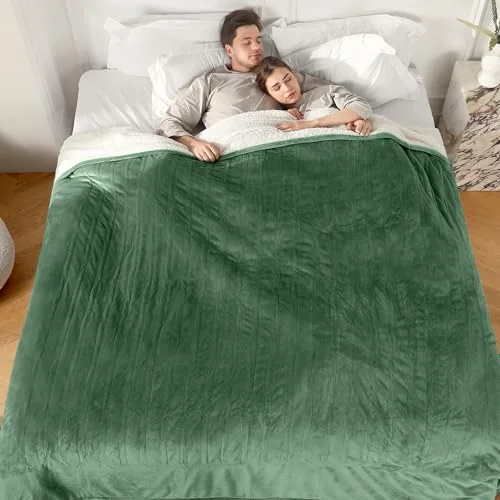
Queen 84×90″ · 5 heating levels · dual control · 10-hour auto off · ETL certified · hunter green

ESTINGO is the one blanket here that is not quilted, and at $55.99 it is also the most expensive of the three for the plainest feature set — half the heat settings of either quilted option and no stated preheat or memory function. What it does have, and the others don't list, is a clearly stated 10-hour auto-off and ETL certification named directly in the title. If a specific, published auto-off window and a named safety certification matter more to you than quilted drape or a wider heat-setting range, that is a legitimate reason to pick the flat blanket here over either quilted one, even at the higher price.

ESTINGO heated electric blanket, queen size, hunter green
$55.99
Queen · flat panelCheck price →
03Best for the comforter look

Bedsure Luxury Quilted Heated Blanket, Queen

When you want the blanket to double as the bed's top layer
Queen 84×90″ · 10 heat settings · dual control · 1–10 h auto off · preheat & memory function · box quilted · ivory

At $84.78 this is the most expensive blanket in the comparison, and the case for it is specific rather than general: it is the only one of the three with a published auto-off range (1 to 10 hours) on top of the full feature set KOOWEIBED also offers, and its ivory box-quilted construction is built to sit as the visible top layer of a made bed rather than hide under a duvet. If your goal is a heated blanket that looks and drapes like a quilted comforter and you want the shutoff window stated rather than implied, that combination is what the extra cost over KOOWEIBED buys. If you mainly want quilted construction at the lowest price, KOOWEIBED above does that with nearly the same spec sheet for less.

Bedsure Luxury Quilted heated blanket in ivory, queen size, box quilted
$84.78
Queen · box quiltedCheck price →
The other option

Who should just buy the flat sherpa version instead

None of this makes quilting the right answer for every heated-blanket purchase, and a flat flannel or sherpa blanket is still the better buy for several common cases. The clearest one is portability: a quilted queen's added bulk, the same structure that makes it drape like a comforter, works against it the moment you want to fold it over the arm of a sofa or carry it between rooms. A flat throw folds flatter and packs smaller, which is exactly the use case our guide to heated throws for a cold home office is built around — a blanket that has to move with you through a workday, not sit permanently on one bed.

Budget is the second case. Queen-size quilted blankets here run from $52.99 to $84.78; a flat throw at 50×60 inches is routinely $30 to $40 less than even the cheaper quilted queen, because it's a smaller blanket built with less material regardless of quilting. If you're not sure a heated blanket earns a permanent spot in your routine, the lower commitment of a flat throw is the more sensible first purchase.

Dry time is the third. A fill layer holds moisture longer than a single fabric panel, so anyone who washes their blanket often will find a flat sherpa or flannel throw meaningfully faster to launder and dry than a quilted queen. And if color matters more than construction, the quilted options here are limited to ivory and hunter green; a flat throw opens up far more choice, the premise behind our roundup of heated throw blankets in a color other than grey. Quilting is a real upgrade in drape and heat retention, but it's an upgrade to a specific use case — a bed you want looking finished — not a universal improvement over a flat blanket.

How we picked

Two quilted, one flat, same size

We chose three queen-size electric blankets at the same 84×90-inch footprint specifically to isolate construction from size: two listed as box-quilted or premium quilted, and one flat panel at a comparable price, so the quilting itself explains any gap in feel or function. Each had to publish a complete specification — finished dimensions, heat-setting count, auto-off behaviour where stated, construction type, and any named certification — before we would compare it.

How we compared

Research, not a lab

We're honest about this: we don't physically test these blankets and we don't run a testing lab. We compare published specifications, stated certifications, live pricing, and construction type, and we anchor every claim in those sources plus general facts about how fill, quilting, and heating elements behave. Amazon no longer exposes verified star ratings or review counts through its product API, so you will not find rating badges, scores, or paraphrased review sentiment anywhere in this guide — we simply do not have that data for these specific products.

FAQ

Common questions

Is a quilted heated blanket actually warmer than a flat one?

Not in the sense of a higher maximum temperature — heat output comes from the wire and the controller, and all three blankets here run comparable heat-setting ranges. What quilting adds is a fill layer that traps still air the way a comforter's fill does, which helps retain heat near the body once the element produces it. That's a real difference in warmth retention and drape, not a difference in how hot the blanket can get.

Does quilting always cost more?

No. In this comparison, the premium-quilted KOOWEIBED lists at $52.99, which is seven dollars less than the flat, non-quilted ESTINGO at $55.99. The box-quilted Bedsure Luxury blanket, at $84.78, is the expensive outlier — and it costs roughly $42 more than KOOWEIBED despite both being quilted queens with nearly identical feature lists. The price gap tracks brand positioning and auto-off specifics more than the stitching itself.

Does a quilted heated blanket take longer to wash and dry?

Yes, typically. All three blankets here are machine washable once the controller is unplugged, which is standard for the category. But a quilted blanket's fill layer holds moisture longer than a single fabric panel, so it takes noticeably longer to dry — sometimes more than one dryer cycle — compared with a flat flannel or sherpa throw of a similar size.

Should I buy a quilted queen blanket or a flat throw?

That depends on where and how you'll use it. A quilted queen is built to sit as a bed's top layer and stays on one bed; a flat throw at 50×60 inches is lighter, cheaper by $30 to $40, dries faster, and moves easily between a sofa, a chair, and a home office. If portability or budget matters more than how the blanket looks on a made bed, the flat throw is the better buy regardless of quilting.

Keep reading

Related reading