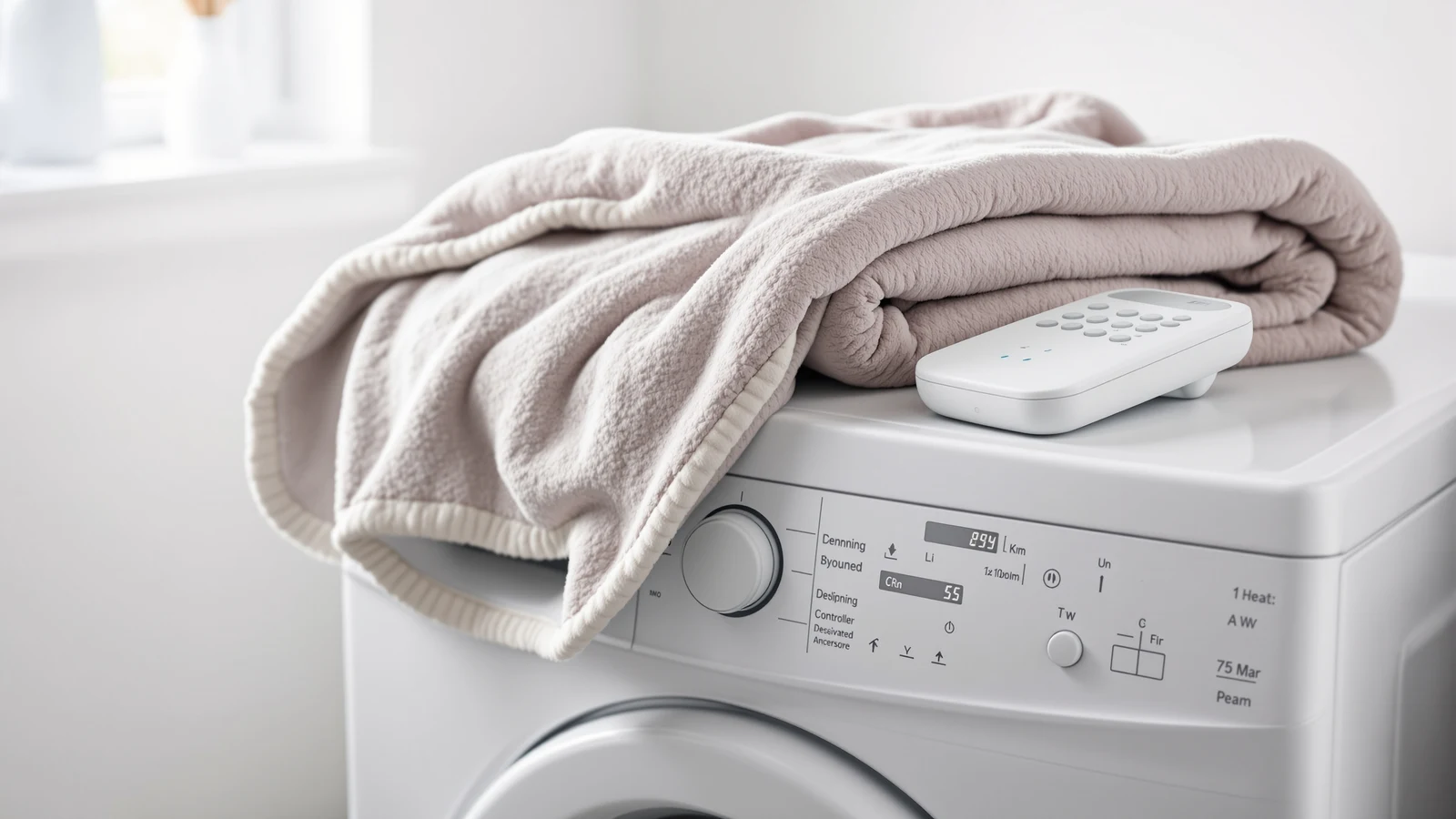
Detach the controller, then wash it like any other blanket
Nearly every electric blanket and heated throw on the market today is machine washable, and the thing that makes it so is a cord that fully detaches where it meets the fabric, separating the controller from the blanket body before anything goes near water. Confirm that detail on the specific listing before you buy, because it is the one spec that decides whether a blanket can be washed at all rather than something you have to spot-clean forever. Once the controller is off, wash cold or warm on a gentle cycle, skip the bleach and fabric softener, and dry on low heat or air-dry — slowly if the blanket is a thick sherpa or faux fur, since that pile holds water far longer than a flat flannel weave.
This guide walks through why the detachable cord matters more than any other spec, exactly what to do before the blanket goes in the machine, which cycle and products to use and avoid, why some fabrics take a full day to dry, how to fold or roll one for off-season storage without damaging the internal wire, and what a scorched patch or a frayed cord actually means. Jump straight to the drying times or to the storage fold that causes damage if that is what brought you here.
Disclosure: this article contains affiliate links. If you buy through one, we may earn a commission at no extra cost to you — see our About page for how we research.
The detachable cord is the specification that decides everything
Every electric blanket is really two products wired together: a soft fabric layer with a heating element run through it, and a separate controller that regulates heat level and timing. The entire category of "machine washable heated blanket" exists because, on most current models, those two pieces come apart completely at a plug-style connector near one edge of the blanket. Pull that connector apart, and you have a textile blanket on one side and an electronic controller on the other — one of which can go in a washing machine, and one of which absolutely cannot.
This is why the detachable cord is worth confirming before anything else on a listing, ahead of heat-setting counts or fabric names. The Electric Heated Blanket Throw, 50×60″, soft sherpa faux fur (ASIN B0H7178NCJ, $27.19) states "Machine Washable" directly in its own title alongside its ten heat settings and one-to-eight-hour timer, which is about as unambiguous as a listing gets: the manufacturer is telling you, in the product name itself, that the cord detaches and the blanket is built to survive a wash cycle.
Not every listing is that explicit. The Bedsure Heated Blanket Throw with Preheat Function (ASIN B0BZR6YBHK, $35.12, soft flannel, 50×60″) and the HaloRest Heated Throw Blanket (ASIN B0FMQQDHP8, $56.98, faux fur, 50×60″) describe their fabric, their settings, and their size, but neither title uses the words "machine washable." That does not mean either one is not washable — detachable-cord construction is the near-universal standard across this category, and separable controllers show up on the vast majority of current electric blankets and throws. It means the detail is not stated in the data we have for those two specific listings, so before buying either one, check the product listing or included manual for the washing instructions and for confirmation that the controller unplugs from the blanket, rather than assuming it based on what a similar-looking throw states.
The practical habit worth building is simple: before you ever add a new heated blanket to the wash, find the connector. It is almost always a plastic plug-and-socket joint a few inches from where the cord meets the fabric, distinct from the wall plug at the other end of the cord. If you cannot find a point where the cord separates into two independent pieces, treat the blanket as not machine washable until the listing or manual tells you otherwise, and consider spot-cleaning instead.
Before the machine: unplug, detach, set the controller aside
The sequence matters more than it seems like it should. First, unplug the blanket's cord from the wall outlet entirely — not just switch the controller off, but remove the plug, so there is no chance of the element drawing current while you are handling it. Switches and dials can be bumped by accident during handling, and a blanket that is merely switched off but still connected to power is not the same as one that is fully disconnected.
Second, find the connector between the controller and the blanket body — the detachable joint discussed above — and separate the two pieces completely. On most throws this is a simple plug that pulls straight apart with a firm, steady tug; it is not designed to need force, and if it feels like it is fighting you, stop and look for a release clip or tab rather than yanking on the fabric side of the connection. Set the controller down somewhere dry, away from the laundry area entirely, so it cannot end up in the machine by accident or get splashed while you load the drum.
While the blanket is laid out and the connector is exposed, this is also the moment to run a quick visual check along the full length of the cord and across the fabric for anything unusual — a cracked section of cord, a discolored patch, a spot that feels stiff or lumpy under the fabric. None of that should stop you from washing a blanket that otherwise looks fine, but if you do spot something, read the section further down on what a scorched patch or a frayed cord actually means before you plug the blanket back in again.
Once the controller is set aside, treat the blanket itself as you would any other heavy textile item going into a wash: shake it out to remove loose debris, check for pet hair or crumbs caught in the pile, and close any hook-and-loop fasteners or snaps the blanket uses to stay anchored to a mattress, so they do not catch on the fabric during the spin cycle.
Cycle, temperature and what not to use
Once the controller is off and set aside, the wash itself is unremarkable: cold or warm water, on a gentle or delicate cycle, with a mild detergent and nothing else added. The heating wire woven through the fabric is designed to flex with the material, but it is not designed for the mechanical stress of a high-speed spin or an aggressive heavy-duty cycle, so stick to the lowest agitation setting your machine offers. A front-loading machine without a center agitator is generally gentler on a blanket this size than a top-loader with a tall post in the middle of the drum.
Skip the bleach entirely. Beyond the obvious risk to color, bleach breaks down the insulation that keeps the heating wire's grid pattern electrically isolated from the fabric around it over repeated washes, which is not a trade worth making for brighter whites. Skip fabric softener too: it coats fibers with a residue that can mat down pile fabrics like the sherpa and faux fur throws in this category, and over time it can affect how evenly a thick pile dries and breathes, which matters more on a blanket that already has an electrical reason to dry fully before its next use.
Dry cleaning is also off the list for the same reason as bleach: the solvents used in professional dry cleaning are harsher on wire insulation than a standard detergent and water, and most heated-blanket manufacturers explicitly exclude dry cleaning from their care instructions for exactly this reason. Do not wring the blanket by hand to remove excess water either; let the washing machine's spin cycle do that work at its lowest setting, and let gravity and air do the rest afterward.
Wash the blanket on its own or with a small load of similarly soft, zipper-free items. A heated blanket's surface area and the fine wire grid underneath make it a poor match for a load that includes anything with hooks, zippers, or stiff embellishments that could snag the fabric and, in the worst case, pull at the wire itself.
Drying: why sherpa and faux fur are the slow ones
Fabric construction decides drying time far more than anything you do in the dryer. The Bedsure throw's soft flannel construction is a relatively flat, tightly woven fabric: water moves through it and off it quickly, so a low-heat tumble dry or a few hours of air-drying flat is usually enough to get it fully dry, because there is not much depth to the material for moisture to hide in.
Sherpa and faux fur are a different story, and two of the three blankets referenced in this guide are built from exactly that kind of deep pile. The sherpa faux fur throw (B0H7178NCJ) and the HaloRest faux fur throw (B0FMQQDHP8) both have a thick, high-loft surface specifically because that pile is what makes them feel warm even before the element switches on — the same density of fiber that traps body heat also traps water deep against the base of the pile, well below what a quick squeeze or a glance at the surface will tell you. It is entirely normal for a heavy sherpa or faux fur throw to still feel damp at the root of the pile the better part of a day after it comes out of the wash, even though the outer surface looks and feels dry within an hour or two.
The safest approach for any of these fabrics is a low-heat tumble cycle, if the care label allows one, followed by air-drying flat or draped over a drying rack rather than on a single hook or hanger, which can stretch the fabric unevenly and crease it right along the wire grid. Shake the blanket out and reposition it on the rack every hour or two during air-drying; this redistributes the pile and lets trapped moisture reach the surface instead of sitting against the same compressed patch the whole time. Never use a high-heat dryer setting on any of these blankets — heat that aggressive is harder on both the fabric and the wire than the washing step itself. And do not plug the controller back in and use the blanket again until it is completely dry all the way through, not just dry to the touch on top; running current through a heating element inside damp fabric is not something any of these listings' instructions account for.
Storage between seasons, and the fold that damages wires
The heating wire inside any of these blankets is laid out in a repeating grid pattern across the full surface, meant to lie flat. Fold the same blanket into the same quarter-folds every spring, store it that way for months, and unfold it again every autumn, and you are putting mechanical stress on the exact same lines in the wire grid year after year. A single fold does no visible harm; the same crease repeated across several seasons is a slow way to fatigue and eventually crack a wire that was never designed to be bent sharply in one place over and over.
The simplest fix is to roll the blanket loosely rather than fold it into tight squares. A loose roll distributes any bend gradually along the whole length of the material instead of concentrating it at a handful of sharp lines, and it is a better default for the sherpa and faux fur throws here, too, since a tight fold compresses their pile in a way a loose roll does not. If you prefer to fold a blanket for space reasons, vary where the folds fall from one season to the next, and keep the fold itself loose rather than pressed flat.
Where you store it matters almost as much as how. A breathable cotton storage bag or a bin with some airflow is better than a fully sealed, compressed vacuum bag: compression under vacuum or under the weight of other stored items for months at a time can set a permanent crease in both the fabric and the wire beneath it, the same risk as repeated tight folding, just applied constantly instead of twice a year. Keep stored blankets out of damp basements or hot attics where humidity swings are extreme, since moisture trapped against a rolled or folded blanket for months is a separate problem from the drying question above, and avoid stacking anything heavy directly on top of where a blanket is stored.
What a scorched patch or a frayed cord means
A heated blanket is not a product category built around repair. The wire is woven into the fabric itself and the controller is a sealed unit, so there is no realistic at-home fix for either one if something has actually failed. That makes the decision simpler than it is for most laundry items: if you see or feel one of a short list of warning signs, the answer is to retire the blanket, not to keep using it and see whether it gets worse.
A scorched, discolored, or melted patch anywhere on the fabric means the heating element has overheated at that spot at some point, whether or not the blanket still seems to work normally elsewhere. A frayed, cracked, or visibly worn section of cord anywhere along its length, including right at the connector you have been detaching before every wash, means the insulation protecting that wire has broken down and should not be trusted with household current again. And a hard ridge or lump felt under the fabric that was not there when the blanket was new can mean the internal wire has kinked, which is exactly the kind of damage a repeated tight fold or a crushed storage position can eventually cause.
None of these are things to monitor for a few more uses. They are reasons to stop using the blanket that day, unplug it, and not plug it back in. If you want a fuller walkthrough of what the automatic shut-off and certification marks on a heated blanket do and do not guard against, our safety guide covers that in more depth; this section is specifically about the laundry-and-storage side of the same question, since a damaged cord discovered mid-wash is one of the more common ways people actually notice it.
Three throws, three different fabrics to wash and dry
Not a ranked roundup — just the products named throughout this guide, chosen specifically to contrast a flat flannel weave against two deep-pile fabrics.
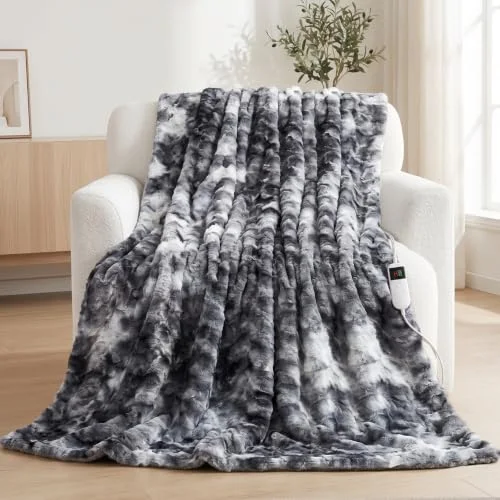
Sherpa Faux Fur Heated Throw
50×60″ · 10 heat settings · 1–8 h timer with overheat protection · states "Machine Washable" in its own listing title.
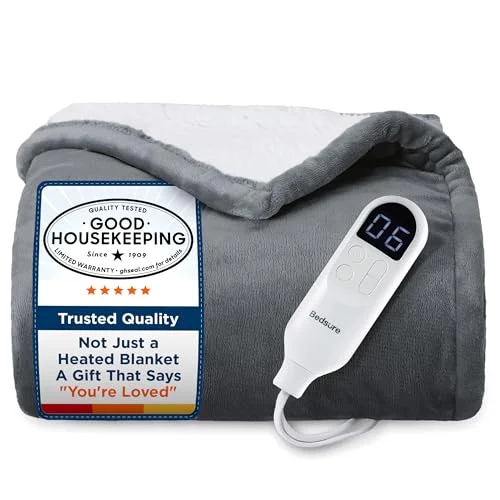
Bedsure Flannel Throw with Preheat
50×60″, grey · preheat function · 6 heat settings · 6 time settings up to 10 h · flat flannel weave, the quickest of the three to dry.
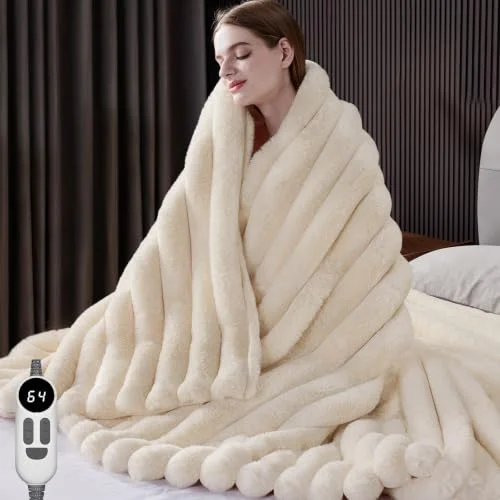
HaloRest Faux Fur Heated Throw
50×60″ · faux fur construction · deep pile that holds water longer than a flat weave — confirm wash instructions on the listing before buying.
Three fabrics, chosen for contrast
We picked these three throws specifically because they span the fabric types that behave differently in the wash: a sherpa faux fur throw whose own listing states it is machine washable, a soft flannel throw built around a preheat function, and a faux fur throw priced and built for a heavier, plusher feel. We only state a "machine washable" claim where a product's own listing says so; where it does not, we say that plainly and point you to the listing rather than assuming the category norm applies to that specific model.
Research, not a lab
We're honest about this: we don't physically test these blankets and we don't run a testing lab. We compare published specifications, stated care instructions, and general facts about how woven fabrics, pile fabrics, and heating-wire grids behave in a wash and a dryer. Amazon no longer exposes verified star ratings or review counts through its product API, so you will not find rating badges, scores, or paraphrased review sentiment anywhere in this guide — we simply do not have that data for these specific products.
Common questions
Can I put my heated blanket in the washing machine?
Almost always yes, as long as the controller fully detaches from the blanket at a connector near the edge of the fabric — that detachable cord is the specification to confirm on the listing before you buy, because it is what makes the difference between a genuinely washable blanket and one you can only spot-clean. Once the controller is unplugged from the wall and detached from the cord, the fabric and wire are built to survive a gentle machine cycle.
What temperature and cycle should I use to wash a heated blanket?
Cold or warm water on a gentle or delicate cycle, with a mild detergent and nothing else. Skip bleach, which breaks down the insulation around the heating wire over repeated washes, and skip fabric softener, which coats fibers and can mat down pile fabrics like sherpa and faux fur. Dry cleaning is also off the list, since its solvents are harder on wire insulation than ordinary detergent and water.
Why does my sherpa or faux fur heated throw take so long to dry?
Deep pile fabrics like sherpa and faux fur hold water well below the surface, against the base of the pile, which is the same density of fiber that makes them feel warm even before you plug them in. A flat flannel throw can dry in a few hours, while a thick sherpa or faux fur throw can still be damp at the root of the pile the better part of a day later, even though the surface feels dry much sooner.
What's the right way to fold a heated blanket for off-season storage?
Roll it loosely rather than folding it into tight, repeated squares. The heating wire runs in a flat grid pattern through the fabric, and the same sharp crease repeated in the same place every season can fatigue and eventually damage the wire underneath it. A loose roll spreads any bend across the whole blanket instead of concentrating it at a few fixed fold lines, and it is gentler on sherpa or faux fur pile than a tight fold as well.