Best Heated Blankets
Comparison · Reversible vs. Single-Sided Heated Throws

Reversible Flannel-and-Sherpa Heated Throws: What the Second Side Is For

One throw in our catalogue is built with two fabrics bonded to the same heating wire — flannel on one face, sherpa on the other. Two more are ordinary single-sided flannel throws at a similar size and price. Flipping a reversible blanket changes what touches your skin; it does not touch the heat setting, the timer, or the auto-off, which all live in the one wire layer both faces share. Here is what the second side actually buys you, and when the plain single-sided throw is the better call.

By Ilane Tall · Updated November 8, 2026 · Research-based.

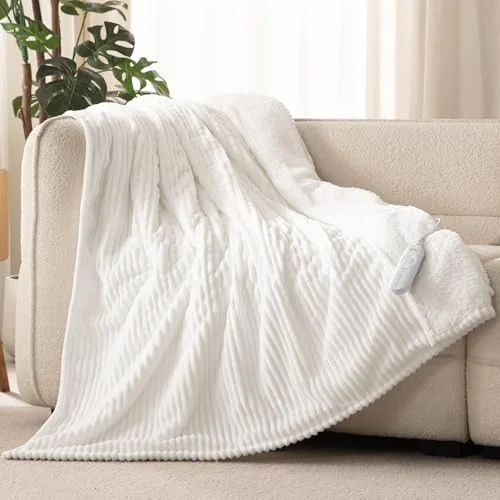
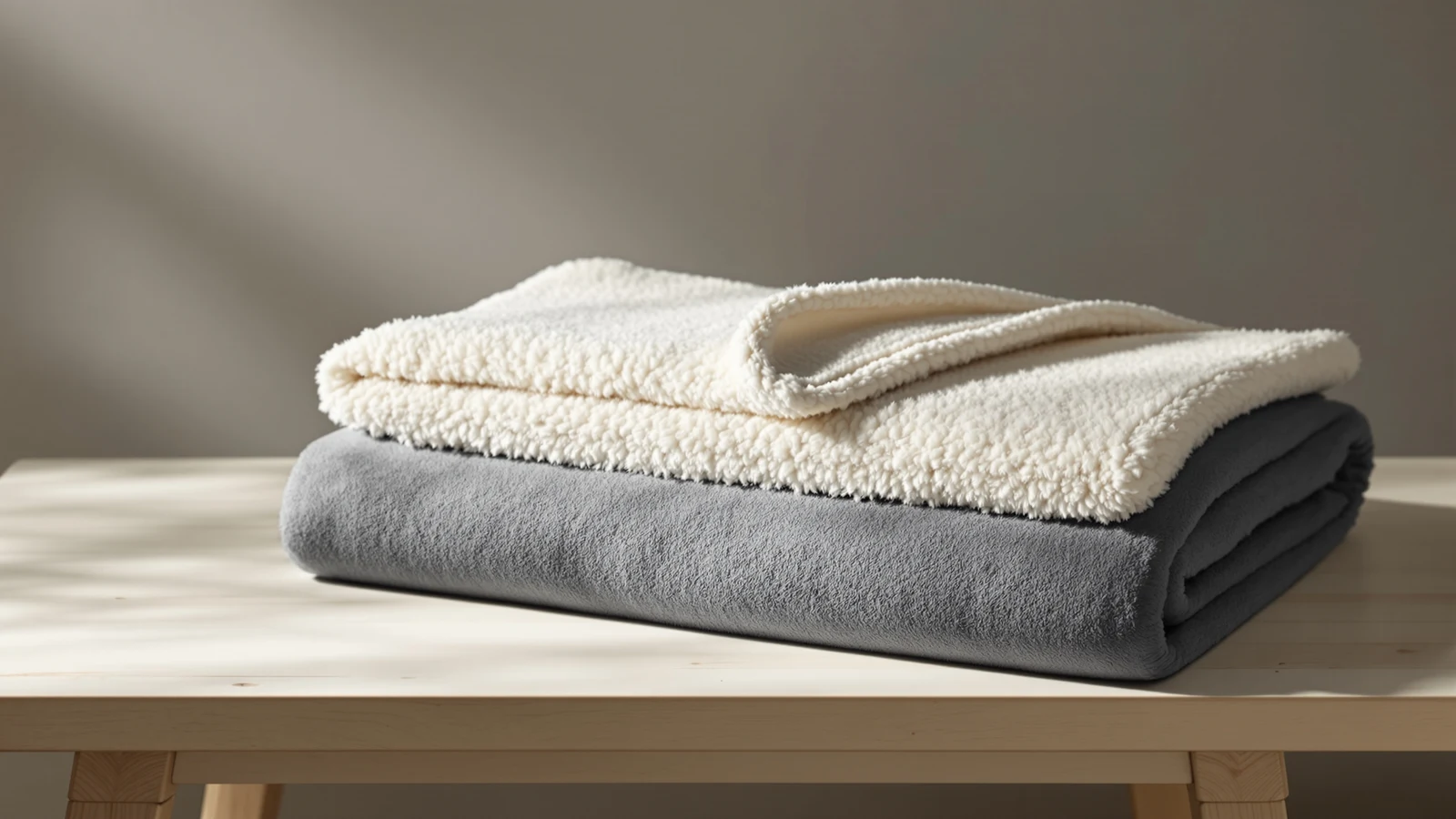
A reversible heated throw blanket shown half-folded to reveal smooth flannel on one side and thick sherpa pile on the other, resting on a sofa arm
Quick answer

A different face, not a different blanket

The Cozorbt throw in this comparison is reversible because two fabrics — flannel and sherpa — are bonded to a single heating-wire layer sandwiched between them, not because it is two blankets stitched back to back. Flipping it changes which fabric touches your skin; it does not change the heat level, the timer, or the auto-off, because all three live in the wire layer both faces share. Measured against two single-sided flannel throws at a similar size, the reversible model also happens to have more heat settings (ten, against six on the Westinghouse and five on the Reaks) and a longer auto-off (eight hours, against three on the Reaks) — though that is a separate spec decision from the fabric one, and the cheaper Reaks is the better buy if you already know you will never flip anything.

This guide works through what reversible actually means mechanically, when flipping is worth doing, how the heat-level counts and auto-off windows compare across the three, our picks, and the simpler single-sided buy if two fabrics were never the point. Jump straight to the picks or to the simpler single-sided case.

Disclosure: this article contains affiliate links. If you buy through one, we may earn a commission at no extra cost to you — see our About page for how we research.

The construction

What reversible actually means, physically

Every electric throw in this category is built the same basic way: a layer of fabric with a thin heating wire run through it in a grid, connected to a controller that sets how much current reaches that wire. A single-sided throw like the Reaks or the Westinghouse has one piece of fabric doing that job — flannel, in both cases — with the wire woven into the one layer you can see and touch. A reversible throw like the Cozorbt Flannel & Sherpa Reversible Throw (50×60″, ASIN B0F93QKD5J) is built with the same wire grid, but it sits between two fabric faces bonded to it rather than under one: flannel quilted to one side of the heating layer, sherpa to the other. The wire does not know which face is up. It heats both at once, which is the detail that actually matters here.

That construction rules out a misconception worth clearing up before anything else: a reversible heated throw is not two blankets stitched together with a gap between them, and it is not one side "on" while the other waits its turn. There is one heating element, shared by both faces, running at whatever level the controller is set to regardless of which side is currently against your skin. Flip the Cozorbt from flannel to sherpa mid-evening and the heat setting you had chosen stays exactly where you left it — you have changed the texture under your hand, not the wattage reaching the wire.

That also explains why the spec sheet lists heat settings, timer settings and auto-off exactly once rather than twice, one set per face. Ten heat settings, twelve timer settings and an eight-hour auto-off described for the Cozorbt apply identically whichever side is facing out. The only things that change with a flip are texture, drape and how the blanket looks folded over the back of a sofa — which, for most people deciding whether reversible is worth the premium over a single-sided throw, is the actual question, not a hidden second set of electronics.

Living with it

When you would actually flip it

Sherpa pile is thicker than flannel and holds more air inside its loops, which means it feels warmer the instant you touch it, before the heating wire has done anything at all — the same reason a faux-fur or sherpa throw in our other comparisons reads as "warm" even unplugged. On a genuinely cold night, most people reach for the sherpa face of the Cozorbt first for exactly that reason: it is the side that needs the least help from the element to feel comfortable. Flannel, by contrast, is lighter and less insulating on its own, which makes it the better choice on a mild evening when you want the heat from the wire without the blanket itself trapping extra warmth on top of it.

Mood and texture preference matter just as much as temperature. The Cozorbt ships in one color, Light Brown, on both faces, so flipping it does not change how the room looks — it changes how the blanket feels in your hands, smooth and brushed on the flannel side, deep-pile and shaggy on the sherpa side. Some people simply prefer one texture to the other and never flip it at all, which is a legitimate way to use a reversible throw and not a failure to get your money's worth — you are still getting whichever face you like better, at a price close to the single-sided options.

The least glamorous reason to flip it is the most common one in practice: whichever side is dirty. Sherpa's deeper pile holds onto pet hair and lint more stubbornly than flannel does, which is worth knowing if the throw lives somewhere a cat or dog naps — our guide to heated blankets for pet owners covers which fabrics shed hair back out in a wash. If one face is overdue for a wash and the other is clean, flipping it buys another evening of use before the blanket goes into the machine — controller unplugged first, as with any of these three.

The dial

Heat levels: ten versus six versus five

The Cozorbt publishes ten heat settings plus twelve separate timer settings, which is an unusually fine-grained control scheme for a $26.99 throw — most blankets at this price settle for the usual six steps. Ten settings mean more room between "barely warm" and "too much," which matters more than it sounds like it should once you are trying to find the one level that holds steady through a two-hour movie without you reaching for the dial again. The twelve timer settings are a separate control from the heat level entirely: they decide how long the blanket runs before the auto-off cuts in, not how hot it gets while it's running.

The Westinghouse sits in the middle at six heat levels, the more common count across this category and the one most single-sided flannel throws settle on. Six settings is enough to go from a low simmer to a genuinely hot setting without the gaps feeling too wide, and it is simpler to operate in practice — there are fewer button presses between where you are and where you want to be. If a longer list of numbers on a dial sounds like more decision-making than you want from a blanket, our guide to heated blankets with simple controls covers throws built around exactly that preference.

The Reaks has the fewest at five heat levels, the simplest control scheme of the three and also the cheapest blanket here at $26.99. Fewer settings is not automatically a downside: a five-step dial is faster to learn, has less room for a setting to feel ambiguous, and is arguably the right amount of choice for a throw that mostly gets used at one or two levels anyway, winter after winter. The real trade-off with the Reaks is not the heat count — it's the auto-off, which is the next spec worth reading closely.

The safety cutoff

Auto-off: eight hours against three, and what it says about intended use

The Cozorbt's auto-off is set to eight hours, paired with those twelve separate timer settings that let you choose a shorter window if you want one. Eight hours is long enough to cover a full evening on the sofa and run well into a night's sleep if you fall asleep under it, which is the design intent behind an auto-off that long: the manufacturer is building for the realistic case of someone not getting back up to turn it off. Combined with the ETL certification Cozorbt states for this model, an eight-hour window reads as a blanket engineered with overnight, not just evening, use in mind.

The Reaks cuts out after three hours, a fraction of that window, and the difference is a statement about intended use rather than a weakness in the blanket. A three-hour auto-off fits an active evening — reading, a couple of episodes, dinner on the sofa — and it is a specification that assumes someone is awake and using the blanket, not one built around the possibility of falling asleep under it for the night. If you want a throw to run while you are dozing off, the Reaks is the wrong one of these three to buy for that specific habit, regardless of how its five heat levels compare.

The Westinghouse's listing does not publish an auto-off duration at all, which means we won't guess at one here — check the current listing directly before assuming it behaves like either of the other two. What we can say from the published specification is six heat levels and soft flannel construction in Charcoal; shut-off timing and certification are gaps in the public spec, not a feature we can compare. That gap is itself useful information: it is the one of the three where you cannot plan around the auto-off window without reading the listing yourself.

Our picks

The picks: one reversible, two single-sided

All three are 50×60″ throws at a similar price point. The difference is fabric construction, heat-level count and how long each is built to run unattended.

01Best for flipping

Cozorbt Flannel & Sherpa Reversible Throw

The one to buy if two textures from one blanket is the point
50×60″ · 10 heat settings · 12 timer settings · 8 h auto-shut-off · ETL certified · reversible flannel & sherpa · Light Brown

This is the only one of the three built as two fabrics bonded to a shared heating layer, and it backs that construction up with the most capable control scheme here: ten heat settings instead of the usual six, twelve separate timer settings, and an eight-hour auto-off long enough to run through a whole evening or into early sleep. ETL certification is stated on the listing, and it is machine washable like the other two once the controller is unplugged. At $26.99 it costs almost exactly the same as the cheapest single-sided throw in this comparison, which is the real case for buying it: you are getting a second texture and a noticeably longer feature list for a price difference measured in cents, not dollars.
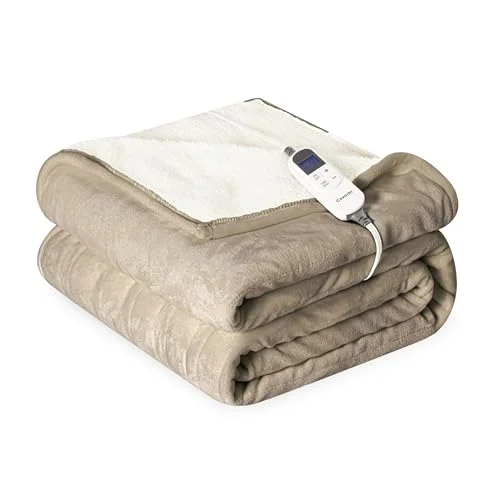
Cozorbt reversible flannel and sherpa heated throw blanket in light brown, 50 by 60 inches
$24.79
Throw · reversibleCheck price →
02Middle ground

Westinghouse Soft Flannel Throw

More heat levels than the cheapest option, one fabric face
Throw 50×60″ · 6 heat levels · soft flannel · Charcoal

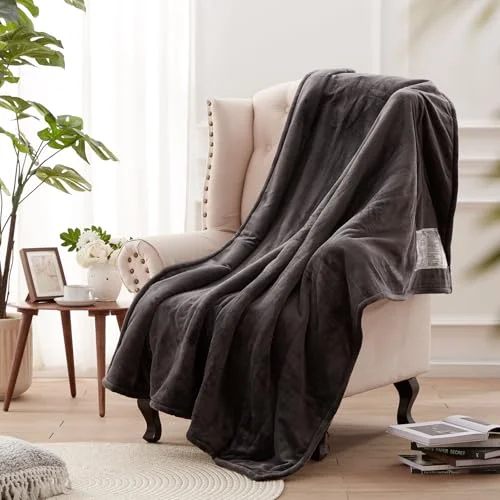
The Westinghouse sits between the other two on heat-level count — six settings, more than the Reaks' five and fewer than the Cozorbt's ten — on a single flannel face in Charcoal rather than the reversible pair. It is also the most expensive of the three at $33.62, which is a harder number to justify given that its published specification does not include an auto-off duration the way both other throws' do; that is a gap in the listing rather than a feature either way, and worth checking directly before you buy if an overnight auto-off window matters to your routine. The case for it over the Reaks is simply the extra heat level and the moderate step up in control range that six settings over five practically means.

Westinghouse soft flannel heated throw blanket in charcoal, 50 by 60 inches
$33.62
Throw · single-sidedCheck price →
03Simplest, cheapest

Reaks Heated Throw Blanket

For an evening on the sofa, not an overnight habit
50×60″ · 5 heat levels · 3 h auto-off · White

At $26.99 the Reaks is the least expensive throw in this comparison, and its specification reads like it was built for a specific, narrower use: five heat levels is the fewest of the three, and a three-hour auto-off is a fraction of the Cozorbt's eight. Neither is a flaw so much as a design decision aimed at an active evening on the sofa rather than overnight use — fewer settings to think about, a shorter window that assumes you are awake and using it. If you already know you will never flip anything, never want more than a handful of heat levels, and mostly use a throw for a couple of hours at a time, this is the simpler buy; see the next section for the fuller case.

Reaks heated throw blanket in white, 50 by 60 inches
$26.99
Throw · single-sidedCheck price →
ModelConstructionHeat settingsAuto-offPrice
Cozorbt Flannel & SherpaReversible, 2 faces108 h$24.79Price
Westinghouse FlannelSingle-sided6Not published$33.62Price
Reaks ThrowSingle-sided53 h$26.99Price
The alternative

The simpler buy if you will never flip it anyway

Reversibility is only worth paying for if you expect to use both faces. If you already know you prefer flannel, or already know you prefer sherpa, and cannot picture a scenario where you deliberately flip the blanket over, the second fabric face on the Cozorbt is not doing anything for you — a feature you own but don't use, like a dual-zone controller on a blanket you never share. In that specific case the Reaks is the more honest buy: $26.99, the lowest price of the three, and five heat levels that are enough for a sofa throw.

The trade-off is the auto-off, and it is worth repeating rather than glossing over: three hours is built for active use, not for falling asleep under it. If your pattern is a couple of hours in the evening and then putting the throw away, that window is a non-issue and the Reaks is simply the cheapest, simplest way to get a heated throw. If you tend to doze off under the blanket, the Reaks' three-hour window will cut out mid-nap more often than the Cozorbt's eight-hour one would — a real reason to spend the extra fifty-five cents on the reversible model even if you never flip it.

This is also the size to reconsider if a throw was never quite the right scope for your use case. All three products here are the same 50×60″ footprint, built for one person on a sofa or a chair rather than a shared bed; our guide to heated blanket sizing walks through when a throw is the right call and when a full-size or queen blanket solves the actual problem better, and our queen roundup under $60 covers that next size up if bed coverage, not sofa coverage, is what you are actually shopping for.

How we picked

Three throws, chosen to isolate one variable

We picked these three specifically because they let the fabric-construction question stand on its own: one reversible flannel-and-sherpa throw and two single-sided flannel throws, all three at the same 50×60″ size and within about nine dollars of each other. Each had to publish a complete specification — finished dimensions, heat-level count, fabric, and whatever auto-off or certification information the listing states — before we would compare it. Where a listing is silent on a spec, as the Westinghouse is on auto-off duration, we say so rather than filling the gap with a guess.

How we compared

Research, not a lab

We're honest about this: we don't physically test these blankets and we don't run a testing lab. We compare published specifications, stated certifications, live pricing and fabric construction, and we anchor every claim in those sources plus general, verifiable facts about how sherpa and flannel behave as fabrics. Amazon no longer exposes verified star ratings or review counts through its product API for these listings, so this guide does not include rating badges, scores, or paraphrased review sentiment of any kind — we simply do not have that data for these specific products.

FAQ

Common questions

Does flipping a reversible heated throw change how warm it gets?

No. The heating wire sits in a single layer shared by both fabric faces, so the heat level, timer and auto-off stay exactly where you set them regardless of which side is facing out. What changes when you flip it is texture and how much the fabric itself insulates before the element does any work — a thicker pile like sherpa feels warmer on contact than flannel does, independent of the heat setting.

Is a reversible heated throw actually two blankets stitched together?

No, and that is a common misreading of the word "reversible" in this category. A reversible throw like the Cozorbt is one heating-wire layer with two fabric faces bonded to it, not two separate blankets joined at the edges. There is one controller, one wire grid, and one set of heat and timer settings that apply no matter which face is up.

Should I buy the reversible one or a single-sided throw?

If you expect to use both fabric faces — sherpa on cold nights, flannel on mild ones, or just whichever side needs a wash — the reversible throw gets you two textures and, in this comparison, more heat settings and a longer auto-off for almost the same price as the cheapest single-sided option. If you already know you will only ever use one texture and mostly want a short, simple sofa session, the cheaper single-sided throw with fewer settings and a shorter auto-off is the more honest buy.

Why does one throw's auto-off cut off after three hours and another after eight?

It reflects a different assumption about how the blanket will be used. A shorter auto-off, like three hours, is built around active use — someone awake on the sofa for an evening — while a longer one, like eight hours, is built to tolerate someone falling asleep under it. Neither is objectively better; the right one depends on whether you use a throw actively or tend to doze off under it.

Keep reading

Related reading