Best Heated Blankets
Honest Take · The Running-Cost Question

What a Heated Blanket Actually Costs to Run

Search for this question and you will get a confident number in the first paragraph. What you will not get is where that number came from, because the listing it is based on does not say how many watts the blanket draws. We are not going to pretend we have information nobody publishes. Instead, here is the one assumption we use, where it comes from, and the arithmetic in full — so you can redo it with your own electricity rate instead of taking anyone's word for the answer.

By Ilane Tall · Updated October 19, 2026 · Research-based.

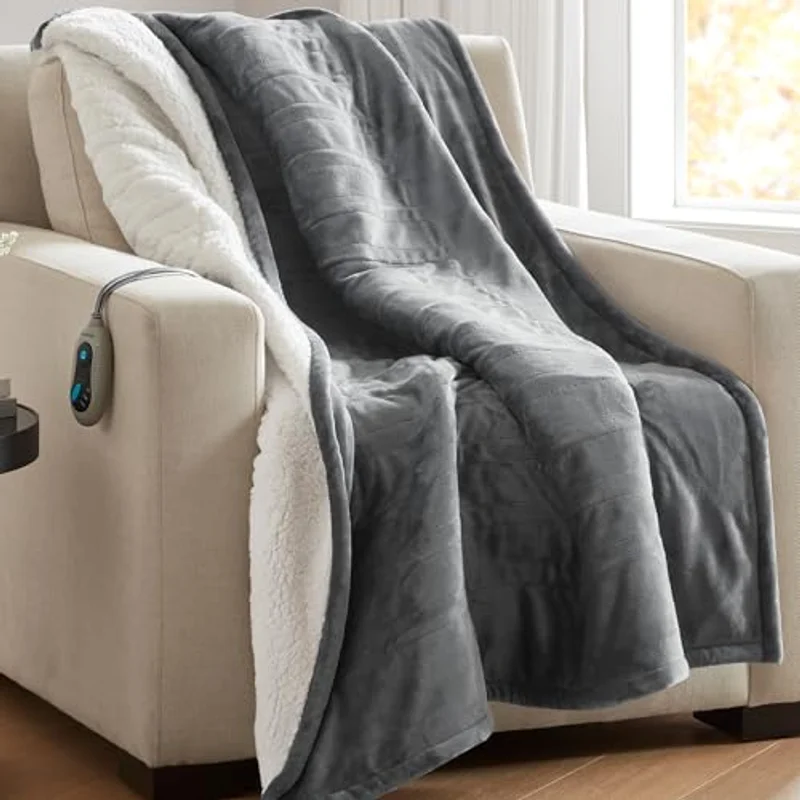
A grey flannel heated throw blanket folded over a sofa arm next to its controller, used to illustrate the real electricity cost of running a heated blanket
Quick answer

Cents per evening, not dollars — if the assumption holds

Assume a 50×60″ throw draws about 100 watts on a mid setting and runs for eight hours. That is 0.8 kWh. At roughly 17 cents per kilowatt-hour, close to the U.S. residential average, the evening costs about 14 cents. A queen-size bed blanket covers roughly twice the surface and typically lands at something close to double that, call it a quarter to thirty cents. Every number in that paragraph is built on an assumed wattage, because none of the three throws we researched for this piece — or almost any blanket on the market — publishes one. The arithmetic is simple. The honesty is in saying so before you read it.

Jump straight to the step-by-step math, to the thermostat comparison, or to three throws we checked the math against.

Disclosure: this article contains affiliate links. If you buy through one, we may earn a commission at no extra cost to you — see our About page for how we research.

The missing spec

Why no listing tells you the wattage

Open the product page for almost any heated throw or electric blanket on Amazon and you will find the dimensions, the fabric, the number of heat settings, sometimes a certification mark. You will not find a wattage rating, and that is close to universal across the category. We went looking for it across the throws we cover on this site, including the three in this piece, and none state a power draw in watts anywhere in the title, bullet points, or description.

Part of the reason is that a heated blanket's power draw is not a fixed number the way a space heater's is. The heating wire cycles on and off under thermostatic control to hold a target warmth, so the instantaneous draw depends on the setting, the room temperature, and where in the cycle the element happens to be. A single "watts" figure on the box would really be an average under some unstated test condition, which is likely part of why so few brands bother printing one.

The other part is simpler: nobody asks for it at the point of sale. Shoppers compare heat settings, size, and auto-off duration, because those specs decide whether a blanket suits a sofa or a shared bed. Running cost is a second-order question that surfaces after the purchase, usually the first time a winter electricity bill looks different than expected — so the spec that would answer it never had commercial pressure to appear on the listing in the first place.

That gap is exactly why so many "cost to run a heated blanket" articles elsewhere read the way they do: confident number, no stated assumption, no way to check it against your own rate or usage. We think the more useful version states the assumption first, so you can tell when it does not apply to you.
In the open

The assumption we use, and where it comes from

We assume a 50×60″ throw draws roughly 100 watts on a mid heat setting. That figure is not pulled from any single product's spec sheet — it is a round, middle-of-the-road number for resistive-wire electric throws generally, the kind of figure that shows up repeatedly in buying guides for this product type when a range is given at all. We apply it the same way across every throw we cover, regardless of price or brand, because inventing a precise number for a listing that never published one would be a more specific-sounding claim with no more evidence behind it.

On the rate side, we use roughly 17 cents per kilowatt-hour, close to the recent U.S. average residential price reported by the Energy Information Administration. It is a national blended average, not your rate — utility prices range roughly from 10 cents to well above 30 depending on state and season, so this number sets a sense of scale, not a bill you can hold us to.

For hours of use, we assume eight hours: an evening on the sofa running into part of the night, or an overnight on a bed blanket with a long auto-off window. It is a round number chosen so the arithmetic is easy to redo, not a claim about how long you personally run yours.

Each of those three numbers is a stated assumption, not a measurement on any specific product. Swap in your own rate and your own typical hours, and the formula in the next section still works — only the final figure changes.

Show the work

Cents per evening: the arithmetic, step by step

Here is the full calculation, with nothing skipped, so you can run it again with your own numbers.

  1. Start with the assumed wattage. 100 watts for a 50×60″ throw on a mid setting.
  2. Convert watts to kilowatts. 100 watts ÷ 1,000 = 0.1 kilowatts. Electricity is billed in kilowatt-hours, so this conversion has to happen before anything else does.
  3. Multiply by hours of use. 0.1 kilowatts × 8 hours = 0.8 kilowatt-hours (kWh) for the evening.
  4. Multiply by your electricity rate. 0.8 kWh × $0.17 per kWh = $0.136, which rounds to about 14 cents.
  5. Check it against your own bill. Your utility statement will show a rate per kWh, sometimes called the "energy charge," often somewhere between 9 and 35 cents depending on where you live and the time of year. Swap that number in for 0.17 and the rest of the formula is unchanged.

Run the same five steps with a different wattage or a different number of hours and the answer moves accordingly, but the structure never changes: watts ÷ 1,000 × hours × rate. That is the entire calculation behind every "X cents a night" figure you will see in this category, ours included. The only thing that varies between sources is which numbers they plug in for watts and hours — and whether they tell you.

Worth noticing: at 14 cents an evening, a throw run every night for a full 30-day month costs around $4.20. That is the kind of total that explains why running cost rarely drives the buying decision in this category — the purchase price of the blanket itself, anywhere from about $29.99 to $80 among the throws and blankets we have researched, is a far bigger line item than a winter's worth of electricity to run it.

Size changes the number

Throw versus bed blanket: roughly double

A 50×60″ throw and a queen-size blanket at roughly 90×84″ are not close in surface area — the queen covers somewhere around two and a half times as much fabric. If heating-wire density per square foot were identical, you would expect proportionally more power. In practice, the gap cited for bed-size models tends to land closer to double a throw's assumed draw, which is the figure we use across this site for queen and king comparisons: roughly 200 watts rather than 100.

Why the gap narrows: a bed blanket spends more of the night at a lower settled temperature once the sleeper's own body heat and the bedding on top are doing part of the work, where a throw on a sofa has less insulation stacked on top and does more of the job alone. That is a reasonable explanation for why "roughly double" is the number that keeps showing up, not a measurement we took on a specific product.

Run the same five steps with 200 watts and eight hours, and a queen blanket comes to roughly 27 to 28 cents an evening at the same rate — still well under $9 for a full month of nightly use. For a bed-size blanket itself, our guide to the best heated blankets for a queen bed covers the models we researched at that size, and our dual control roundup covers queen and king blankets with two independent heating zones, which carry the same doubled assumption.

The comparison that matters

Against the thermostat: the comparison that explains the category

The reason a heated blanket sells every time home-energy prices make the news is not that 14 cents is a small number in isolation. It is small compared to the alternative most people are actually weighing it against, which is raising the thermostat for the whole house.

A heated blanket warms a few square feet of fabric touching one or two people. A central heating system, electric or otherwise, is sized to raise the temperature of every room's worth of air, wall, floor, and piece of furniture in the house, then keep re-heating that volume as it constantly loses warmth to windows and outside walls. The U.S. Department of Energy's long-standing guidance is that each degree you lower a thermostat setting for an extended period saves roughly one to three percent on heating costs — read the other way, raising it by a degree costs a proportional amount more, applied to the whole system for as long as the setting stays changed, not for one evening.

Put the two side by side and the scale difference is the whole story. A blanket's assumed 100 watts is a fraction of what a furnace blower, baseboard elements, or a heat pump compressor draw continuously while cycling to hold a house at a higher setpoint — those systems are commonly rated in multiple kilowatts, not fractions of one. Heating the air in rooms nobody is sitting in is the expensive version of staying warm. Heating one person, directly, for the hours they are using the warmth, is the cheap version. That is the entire economic case for this category, regardless of which specific throw or blanket you buy.

It is also why a heated blanket and a lower thermostat setting are usually paired rather than treated as competing choices. If you are weighing a blanket against under-the-sheet alternatives instead, our heated throw versus heated mattress pad comparison covers how the running-cost picture differs when the heat goes under you instead of over you.

Make it yours

What changes the number: your rate, your hours, your setting

Three variables move the final figure, and none of them are fixed by the blanket you buy.

Your electricity rate. The 17-cent figure is a national average; real household rates range roughly from the single digits to well over 30 cents per kWh depending on state, utility, and season. A household paying 30 cents is looking at roughly double our 14-cent estimate for the same throw; a household on a 10-cent rate is closer to 8 cents. Your own bill states the rate directly, and it is the single most useful swap into the arithmetic above.

Your hours of use. Eight hours is our round number for an evening running into part of the night. Ninety minutes before bed puts the real cost closer to a fifth of our estimate, because the formula scales linearly with hours. Running a bed blanket's full auto-off window every night of a five-month winter raises the seasonal total correspondingly, even though any one evening still costs only a few cents.

Your heat setting. The 100-watt assumption sits on a mid setting. The lowest setting draws less; the highest, run for an extended stretch, draws more. None of the throws we cover publish a per-setting wattage either, so treat the mid-setting figure as a reasonable midpoint, not a ceiling.

None of this changes the order of magnitude. Push every variable toward the expensive end at once — a high rate, long hours, a high setting, a queen blanket — and the total is still well under a dollar a night.

The point, made concrete

Three throws we checked the math against

All three are 50×60″ throws, so the same 100-watt assumption and the same roughly-14-cent evening apply to each one. The price difference between them buys fabric, certification, and finish — not a different electricity bill.

01Lowest price

BEARKISS Electric Heated Blanket, Flannel

A flannel throw, London Grey, at the low end of this trio
50×60″ throw · flannel · London Grey

At $29.99, this ties for the cheapest of the three. It is a flannel-faced 50×60″ throw, the same footprint as the other two, and nothing in its listing states a wattage either — so it gets the same 100-watt, 14-cent-an-evening assumption as the $32.29 option below it. The price gap is about fabric and finish, not electricity.

BEARKISS electric heated blanket, flannel throw in London Grey
$27.99
Throw 50×60″Check price →
02Reversible sherpa

Beautyrest Reversible Heated Throw

Plush on one face, sherpa on the other
50×60″ throw · reversible · plush sherpa · grey

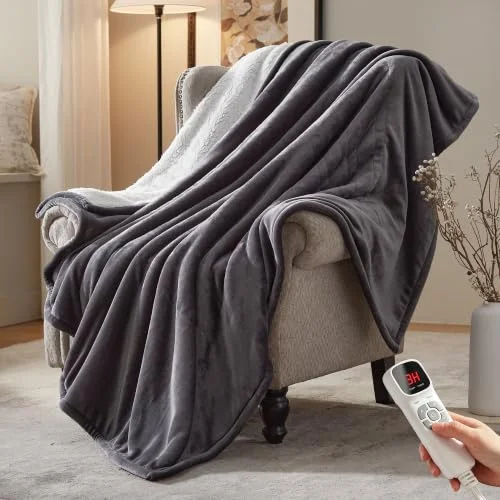
At $29.99, this one ties the BEARKISS for the lowest price of the three. It reverses between a plush face and a sherpa face, which is a fabric choice, not a power one — the footprint is still a 50×60″ throw, so the same running-cost assumption applies here too.

Beautyrest reversible plush sherpa heated throw blanket in grey
$29.99
Throw 50×60″Check price →
03ETL certified

Westinghouse Heated Throw Blanket

The one that names its safety testing on the box
50×60″ throw · charcoal · ETL certified

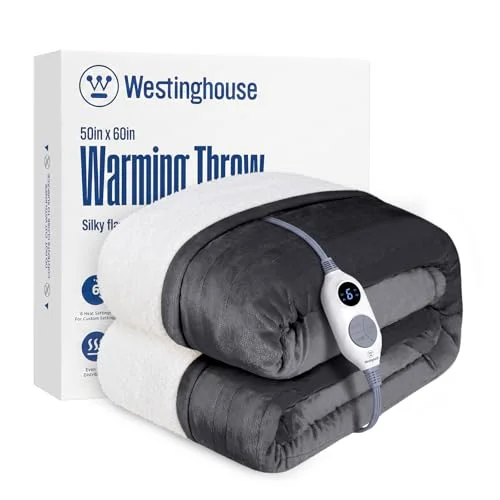
At $32.29, this is the most expensive of the three, and the detail the other two lack is ETL certification — a third-party electrical-safety mark, the kind of specific claim worth repeating because it is printed on the listing, unlike a wattage figure. It is still a 50×60″ throw; the extra $2.30 over the BEARKISS buys the certification and the charcoal finish, not a different electric bill.

Westinghouse heated throw blanket in charcoal, ETL certified
$32.29
Throw 50×60″Check price →
ModelFabricPriceAssumed wattageAssumed cost / evening
BEARKISS FlannelFlannel$27.99~100 W~14¢Price
Beautyrest ReversiblePlush / sherpa$29.99~100 W~14¢Price
Westinghouse CharcoalETL certified$32.29~100 W~14¢Price

For picks organized by which throw suits which use, rather than by this cost comparison, see our best heated throw blankets guide.

How we picked

Three throws, one shared spec gap

We chose the three throws above because they sit at close price points — $29.99, $29.99, and $32.29 — while sharing the same 50×60″ footprint, a clean way to show that price inside this category tracks fabric, finish, and certification, not electricity use. None of them published a wattage, which is the premise of this article rather than an exception we had to work around.

How we compared

Research, not a lab

We're honest about this: we don't physically test these blankets and we don't run a testing lab. The running-cost figures here are an arithmetic model built on a stated assumption, not a measurement on any specific product, and we say so throughout rather than presenting a rounded number as fact. We compare published specifications, stated certifications, live pricing, and general facts about electricity rates and resistive heating, and we do not fabricate wattage, ratings, or review sentiment for products that do not publish them.

FAQ

Common questions

How much does it cost to run a heated blanket overnight?

Using our stated assumption of roughly 100 watts for a throw on a mid setting, eight hours of use, and about 17 cents per kilowatt-hour, the figure comes to around 14 cents. A queen-size bed blanket, covering roughly double the assumed wattage, lands closer to 27 or 28 cents for the same hours. Neither figure is a measurement on a specific product; manufacturers rarely publish wattage, so every number in this category, ours included, rests on a stated assumption you can redo with your own electricity rate.

Why don't heated blanket listings show the wattage?

A heated blanket's heating wire cycles on and off under thermostatic control rather than drawing a constant amount of power, so a single wattage figure on the box would really be an average under some unstated test condition. Shoppers also tend to compare size, heat settings, and auto-off duration rather than running cost at the point of purchase, so there has been little commercial pressure for brands to publish the number. We checked the three throws in this piece and none state a wattage anywhere in their listings.

Is a heated blanket cheaper to run than turning up the thermostat?

By a wide margin for most households. A blanket's assumed 100 watts warms a small area touching one or two people for the hours it is in use. A central heating system has to raise the temperature of entire rooms of air, walls, and furniture, and keep re-heating that volume as it loses warmth, using equipment commonly rated in multiple kilowatts rather than fractions of one. The U.S. Department of Energy estimates each degree a thermostat is raised for an extended period adds roughly one to three percent to heating costs across the whole system, applied for as long as the setting stays changed.

Does a more expensive heated blanket cost more to run?

Not necessarily. Among the three 50×60″ throws we compared, priced from $29.99 to $32.29, the price difference tracks fabric, finish, and stated safety certification rather than a published power draw — none of the three states a wattage, so the same running-cost assumption applies to all three regardless of price. A higher price in this category usually buys materials or certifications, not a documented difference in electricity use.

Keep reading

Related reading