Best Heated Blankets
Roundup · Dual Control Heated Blankets

The Best Dual Control Heated Blankets

One controller and two people is the complaint that comes back, year after year, on every electric blanket that doesn't split the heat. A dual control blanket answers it the obvious way: two wire circuits instead of one, two controllers instead of one, so each side of the bed runs its own temperature. That split has to be paid for somewhere, and it usually isn't paid for in price — it's paid for in the features a single-zone blanket spends its budget on instead.

By Ilane Tall · Updated October 18, 2026 · Research-based.

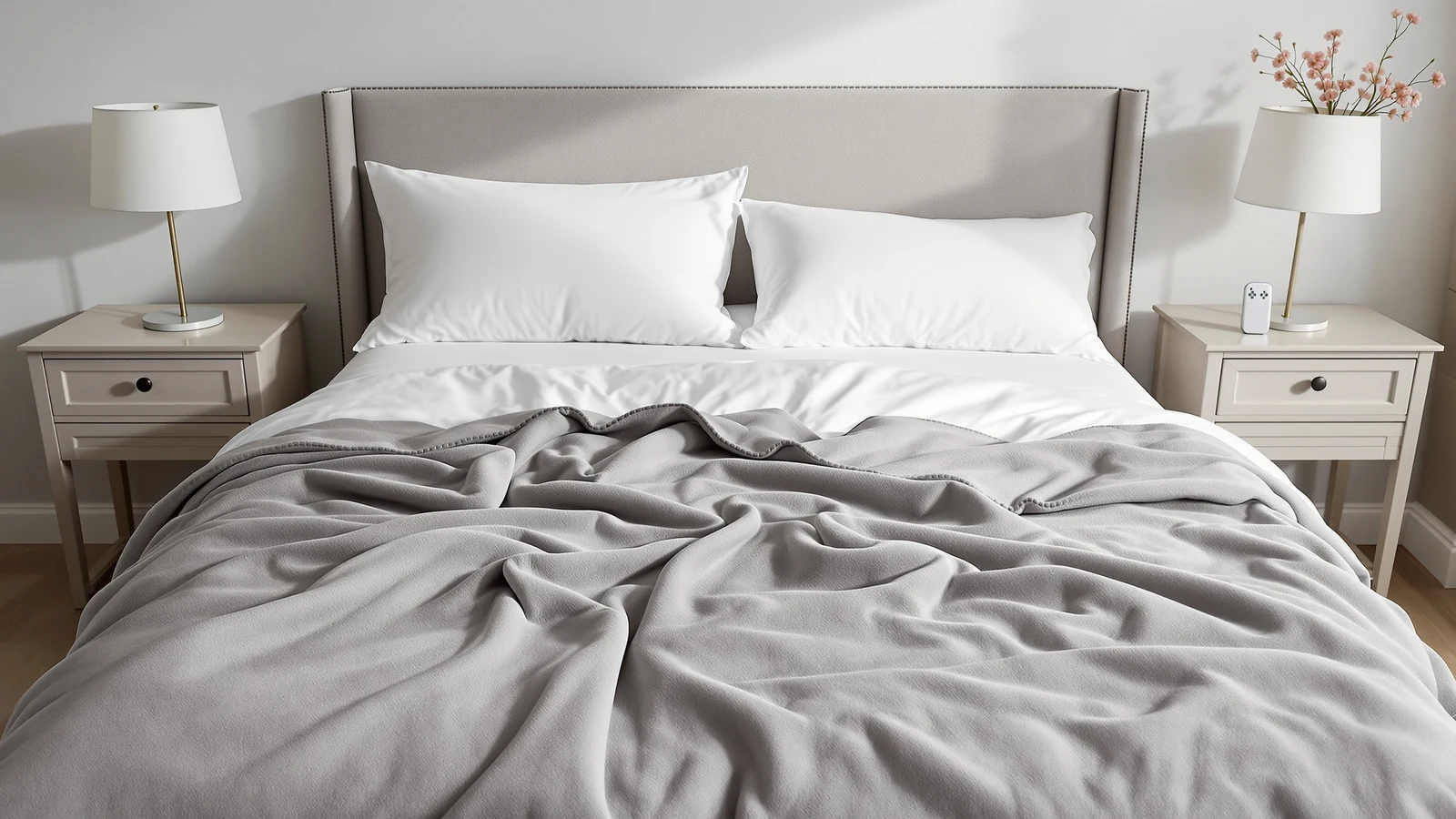
A queen bed with a dual control heated blanket spread over it, two separate controllers resting on each nightstand
Quick answer

One blanket, two thermostats

A dual control — sometimes called dual zone — heated blanket is wired as two separate heating circuits, one for each half, each one running back to its own controller. Of the blankets we could verify against a published spec sheet, the WEOPEN Heated Electric Blanket, Queen Size, Dual Control is the one actually built this way: two zones, two controllers, a single queen-size blanket. It is the pick here if you and whoever shares the bed run genuinely different temperature preferences and neither of you wants to compromise every night.

Below: why a single controller turns into a nightly argument in the first place, what two circuits and two controllers actually mean physically, the feature budget that gets spent on zones instead of displays and settings, whether the midline split lands where you actually sleep, the picks, and the cheaper answer of buying two single-zone blankets instead of one dual-zone one.

Disclosure: this article contains affiliate links. If you buy through one, we may earn a commission at no extra cost to you — see our About page for how we research.

The problem

Why a shared blanket becomes a nightly negotiation

A single-zone electric blanket has exactly one heating circuit and exactly one controller, which is a fine arrangement right up until two people with different temperature preferences get under it. One person runs cold at the extremities and wants the dial up; the other runs warm under a comforter and wants it down, or off entirely by midnight. With one controller between them, there is no setting that satisfies both — there is only a setting one person tolerates and the other quietly resents, and whoever reaches the dial first tends to win that argument more often than is fair.

This isn't a minor comfort gap. Body composition, circulation, metabolism and even which side of the bed is nearer a draft or a window all affect how warm a person runs at night, and none of those differences disappear because two adults happen to share a mattress. A single-zone blanket assumes the two of you want the same thing, and most of the time that assumption is wrong for at least one of you. That mismatch is the entire reason the dual-control category exists: it is a wiring solution to a very ordinary, very recurring household disagreement, not a luxury feature bolted on for its own sake.

It is worth being precise about when this actually matters. On a throw used by one person on a sofa, a single controller is never an issue — there is only one person to please. The negotiation only starts once two people and one controller are under the same blanket, which in practice means a full-size or queen bed blanket shared nightly. If that's not your situation, the rest of this guide may not change what you should buy; our broader roundup of the best heated blankets overall covers single-zone options that do the job for less.

The construction

Two wire circuits, two controllers: what dual zone actually means

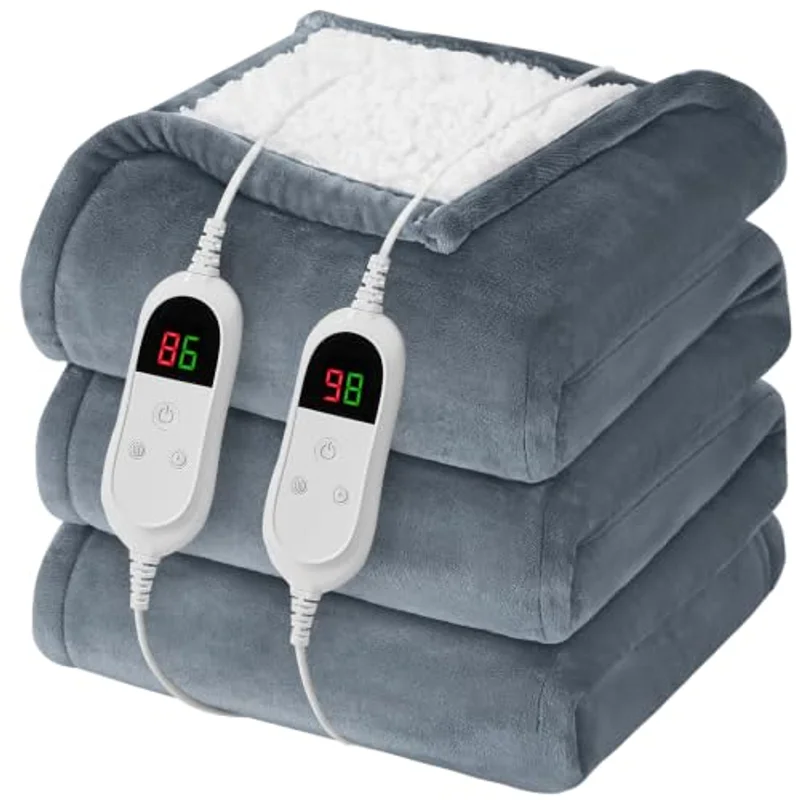
A single-zone blanket runs one continuous heating wire in a grid through the fabric, fed by one power cord and governed by one controller. A dual control blanket is built with two of those grids instead of one, laid out side by side and electrically isolated from each other, each with its own cord running to its own controller. Nothing about the fabric looks different from across the room; the split only shows up in how the blanket is wired underneath it and in the fact that two corded controllers hang off the same blanket instead of one.

The WEOPEN Heated Electric Blanket, Queen Size, Dual Control, at 84×90 inches, is built exactly this way: two independent heating zones running the length of a queen-size blanket, each wired to its own controller, so one side can be switched on, off, or set to a different level without touching anything on the other side. Because the two circuits don't share a controller, there is no shared setting to negotiate — each side of the bed is, electrically, its own blanket that happens to be sewn to the one next to it.

That independence is the whole point, and it's also the reason dual control costs more to manufacture than a single-zone blanket of the same size: two heating grids, two cords, two controllers and the wiring to keep them from interfering with each other is simply more hardware than one grid and one controller. Every dual-zone blanket on the market is paying that manufacturing cost somewhere in its price or in the features it leaves out — which is the subject of the next section.

What you give up

The trade: zones usually replace display and granularity

Every blanket has a feature budget, whether the listing says so or not. A single-zone bed blanket that doesn't need to pay for a second heating circuit and a second controller can spend that budget elsewhere — on a backlit digital display that's readable in a dark room, or on twelve finely spaced heat settings instead of six coarse ones. A dual-zone blanket spent that budget on the zones themselves: two circuits and two controllers instead of one circuit, one controller and a nicer dial.

The WEOPEN Dual Control's own listing describes its controls as programmable rather than naming a specific count of heat settings or a backlit display, which is typical of the category: dual-zone blankets tend to compete on independence, not on the granularity of each zone's own dial. Compare that with a premium single-zone queen blanket built around the opposite trade-off — a backlit controller and a wide, selectable range of heat levels, with no zone split at all, because it only had to engineer one circuit and could spend the rest of its budget on the display and the settings range instead.

Neither trade is objectively better; they are answers to different problems. If what keeps you up is that you can't read the dial at midnight, a zone split does nothing for that and a display-forward single-zone blanket is the better buy. If what keeps you up is that someone always loses the temperature argument, the zone split is the feature that actually fixes it, and a slightly plainer controller on each side is a reasonable price to pay for not having that argument anymore.

Does it land where you sleep

Bed size and whether the split lands where you sleep

A dual-zone blanket's two circuits are built into the fabric at fixed positions, typically split down the lengthwise centerline so each half covers one side of a mattress of a given size. That only works if the blanket's actual width matches the bed it's covering: the WEOPEN Dual Control is sized Queen at 84×90 inches specifically so its midline falls close to the centerline of a 60-inch-wide queen mattress, with each zone sized to reach one sleeper's side plus a reasonable overhang. Put the same blanket on a wider king bed and the midline would land well short of where the second sleeper actually lies — sizing is not a detail to skim past on a dual-zone purchase, because the entire feature depends on the physical split matching the physical bed. Our guide to heated blankets for a queen bed goes further into how a queen blanket's finished dimensions compare with the mattress itself, if queen sizing specifically is what you're trying to confirm.

Single-sleeper sizes don't need this at all, and it's worth saying plainly: a zone split is a two-person feature. The ONDAN Electric Heated Blanket, Full Size, at 72×84 inches, is a single circuit controlled by one dial, and that is the right construction for it — a full-size blanket most often covers one adult, or a bed with only one regular occupant, and there is no second sleeper for a second zone to serve. Buying a dual-control blanket because it sounds like the premium option, when only one person will ever be under it, buys hardware that never gets used.

The practical check before buying any dual-zone blanket: measure your actual mattress width, not just its name, and confirm the blanket's stated size against it. A queen-labeled blanket on a true queen mattress puts the midline roughly where two sleepers' shoulders meet in the middle; the same blanket stretched or bunched to fit a different bed can put that same midline somewhere that doesn't correspond to either side of where people actually lie.

Our picks

The picks

One genuine dual-zone blanket, and two single-zone blankets worth knowing about if you end up going the two-blanket route covered below.

01Best dual-zone

WEOPEN Heated Electric Blanket, Queen Size, Dual Control

For a queen bed shared by two people who disagree on temperature
Queen 84×90″ · two independent heating zones · two controllers · ash gray

This is the one genuinely dual-control blanket in this comparison, and the case for it is narrow and specific: buy it if you and whoever shares the bed consistently want different temperatures, because that's the one problem it's built to solve. Two heating circuits, each wired to its own controller, mean one side of the bed can run a different setting than the other without either of you touching the other person's dial. At 84×90 inches it's sized to put the midline near the center of a true queen mattress, so the split actually falls where two sleepers meet rather than off to one side. At $50.99 it undercuts a display-forward single-zone queen blanket, and that gap is the honest trade described above: this blanket spent its engineering budget on the second zone, not on a backlit display or a long list of finely graded heat settings. If what you need is independence between two sides of the bed rather than more settings on one dial, this is the pick.

WEOPEN dual control heated electric blanket, queen size, ash gray
$50.99
Queen · dual zoneCheck price →
02Best single-zone to pair

ONDAN Electric Heated Blanket, Full Size

A single-circuit blanket sized for one sleeper, and the cheaper half of a two-blanket setup
Full 72×84″ · single heating circuit · one controller · iron grey

The ONDAN is not a dual-zone blanket, and it isn't trying to be — it's a single-circuit, single-controller blanket sized Full at 72×84 inches, built for one person rather than a shared bed. It earns a place in this guide for what it represents rather than what it splits: at $37.99 it's the least expensive of the three products here, which makes it the cheapest building block if you're pricing out the two-separate-blanket alternative covered further down, where each person gets a full-size blanket and a controller entirely to themselves instead of sharing one dual-zone piece. On its own, on a twin or a full bed with one regular occupant, it's a straightforward single-zone blanket with nothing to negotiate over, because there's only one person under it.

ONDAN electric heated blanket, full size, iron grey
$37.99
Full 72×84″Check price →
03Best single-zone with preheat

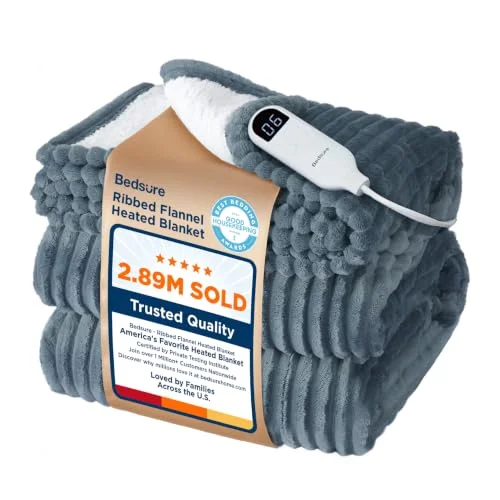
Bedsure Ribbed Electric Blanket, Full, Preheat

A single-circuit blanket with a preheat step, for the person who wants it warm before they get in
Full size · preheat function · ribbed construction · grey

Like the ONDAN, the Bedsure Ribbed is a single-zone, single-controller blanket, sized Full rather than built for two independent sleepers. Its named feature is a preheat function — it runs hot briefly when switched on, then settles to a lower level, so whoever uses it sets it once before getting into bed rather than adjusting a dial afterward. At $62.68 it costs more than the ONDAN and, on its own, more than the dual-zone WEOPEN, which matters directly to the arithmetic in the next section: pairing this with a second single-zone blanket is not automatically the cheaper route, and the preheat feature is the reason this one costs what it does rather than the fact that it covers one side of a bed instead of two.

Bedsure ribbed electric heated blanket, full size, grey, with preheat function
$62.68
Full · preheatCheck price →
ModelBest forSizeZonesPrice
WEOPEN Dual ControlTwo people, different temperaturesQueen 84×90″Two, independent$50.99Price
ONDAN Full SizeOne sleeper, lower priceFull 72×84″Single$37.99Price
Bedsure Ribbed FullOne sleeper, preheatFull sizeSingle$62.68Price
The alternative

The cheaper answer: two throws instead of one dual-zone blanket

There is a simpler way to get two independently controlled zones than buying a blanket engineered to have two of them: buy two ordinary single-zone blankets, give one to each side of the bed, and let each person run their own controller entirely. Two inexpensive 50×60-inch throws, each with its own dial, solve the same problem a dual-control blanket solves — nobody shares a controller — without any of the extra wiring. In the general market this is often the cheaper route, because a basic single-zone throw is a simpler, less expensive product than a blanket engineered with two circuits and two controllers built in.

Worth doing that math honestly rather than assuming it always wins, because with full-size bed blankets rather than compact throws, it doesn't. The ONDAN Full Size at $37.99 and the Bedsure Ribbed Full at $62.68 are both single-zone, single-controller products that could serve this role — one on each side, if your bed and habits can accommodate two separate blankets instead of one shared piece. But two ONDANs comes to $75.98; one ONDAN plus one Bedsure Ribbed comes to $107.98. Both totals beat the $50.99 WEOPEN Dual Control costs as a single purchase. With these specific products, buying two full-size single-zone blankets is the more expensive answer, not the cheaper one, because a full-size bed blanket costs more to build than a compact throw.

The two-blanket route pays off when each single-zone piece is cheap enough on its own — in practice, an actual 50×60-inch throw rather than a 72×84-inch full-size blanket, since a throw uses less fabric and a shorter heating element. Our guide to the best heated throw blankets covers that category directly. And if the mismatch you're solving isn't about zones at all but about a cold mattress rather than a cold person, read our heated throw versus heated mattress pad comparison first, since a mattress pad answers a different problem than any product on this page.

The honest summary: a dual-zone blanket is a convenience purchase as much as a budget one. It's one product to shop for and wash instead of two — and with the specific products researched here, it's also the less expensive one. Two separate blankets only win on price when each is genuinely inexpensive, and lose when either half is a full-size or premium piece in its own right.
How we picked

One true dual-zone blanket, and two single-zone blankets for contrast

We looked for electric blankets that publish a specific, verifiable claim of two independent heating zones with two separate controllers, rather than vague language like "dual heat" used loosely. Only one of the three products in this guide, the WEOPEN Queen Size Dual Control, met that bar with a published spec. We included the ONDAN Full Size and the Bedsure Ribbed Full deliberately as single-zone contrast and as concrete building blocks for the two-separate-blanket alternative, not because either claims a zone split it doesn't have.

How we compared

Research, not a lab

We're honest about this: we don't physically test these blankets and we don't run a testing lab. We compare published specifications, stated construction details, and live pricing, and we anchor every claim in those sources plus general facts about how heating wire and controllers are built. Amazon no longer exposes verified star ratings or review counts through its product API for most listings, so you will not find rating badges, scores, or paraphrased review sentiment anywhere in this guide — we simply do not have that data for these specific products.

FAQ

Common questions

What does "dual control" actually mean on a heated blanket?

It means the blanket is built with two separate heating circuits instead of one, each wired to its own controller, so each side can be set to a different heat level, switched on or off, or run on a different timer without affecting the other side. The WEOPEN Queen Size Dual Control is built this way, with two independent zones running the length of the blanket. It's a wiring difference, not a cosmetic one — the fabric looks the same either way.

Why do dual-zone blankets often have fewer heat settings or no backlit display?

Building two heating circuits and two controllers into one blanket costs more to manufacture than building one of each, and that cost has to come from somewhere. Dual-zone blankets tend to spend their engineering budget on the zone split itself rather than on a backlit display or a long list of finely graded heat settings, which is exactly the trade a premium single-zone blanket makes in the opposite direction.

Is a dual-zone blanket worth it over buying two separate blankets?

It depends entirely on what the two separate blankets would cost. Two basic, inexpensive throws can come in cheaper than one dual-zone bed blanket, because a compact throw uses less fabric and a shorter heating element. But two full-size bed blankets, like the ONDAN and Bedsure Ribbed covered here, can add up to more than a single dual-zone queen blanket costs as one purchase — in that comparison, the one dual-zone blanket is the better value, not the backup plan.

Does the zone split on a dual-control blanket actually match where I sleep?

Only if the blanket's stated size matches your mattress. A queen-labeled dual-zone blanket is built so its midline falls near the center of a true 60-inch-wide queen mattress, putting each zone under one sleeper's side. Put the same blanket on a differently sized bed and the midline can land somewhere that doesn't correspond to either side of where people actually lie, which is why confirming the blanket's finished size against your actual mattress matters more on a dual-zone purchase than on a single-zone one.

Keep reading

Related reading