Best Heated Blankets
Buying Guide · Power Cord Length

Heated Blankets With the Longest Power Cord

Six to eight feet is the quiet default for a heated blanket cord, and nobody tells you that until you have already unwrapped the box and discovered the outlet is on the far wall. A handful of listings publish something longer. Here is what 8.5, 15.1 and 16 feet actually get you, and why that spec rarely makes the front of the listing.

By Ilane Tall · Updated November 11, 2026 · Research-based.

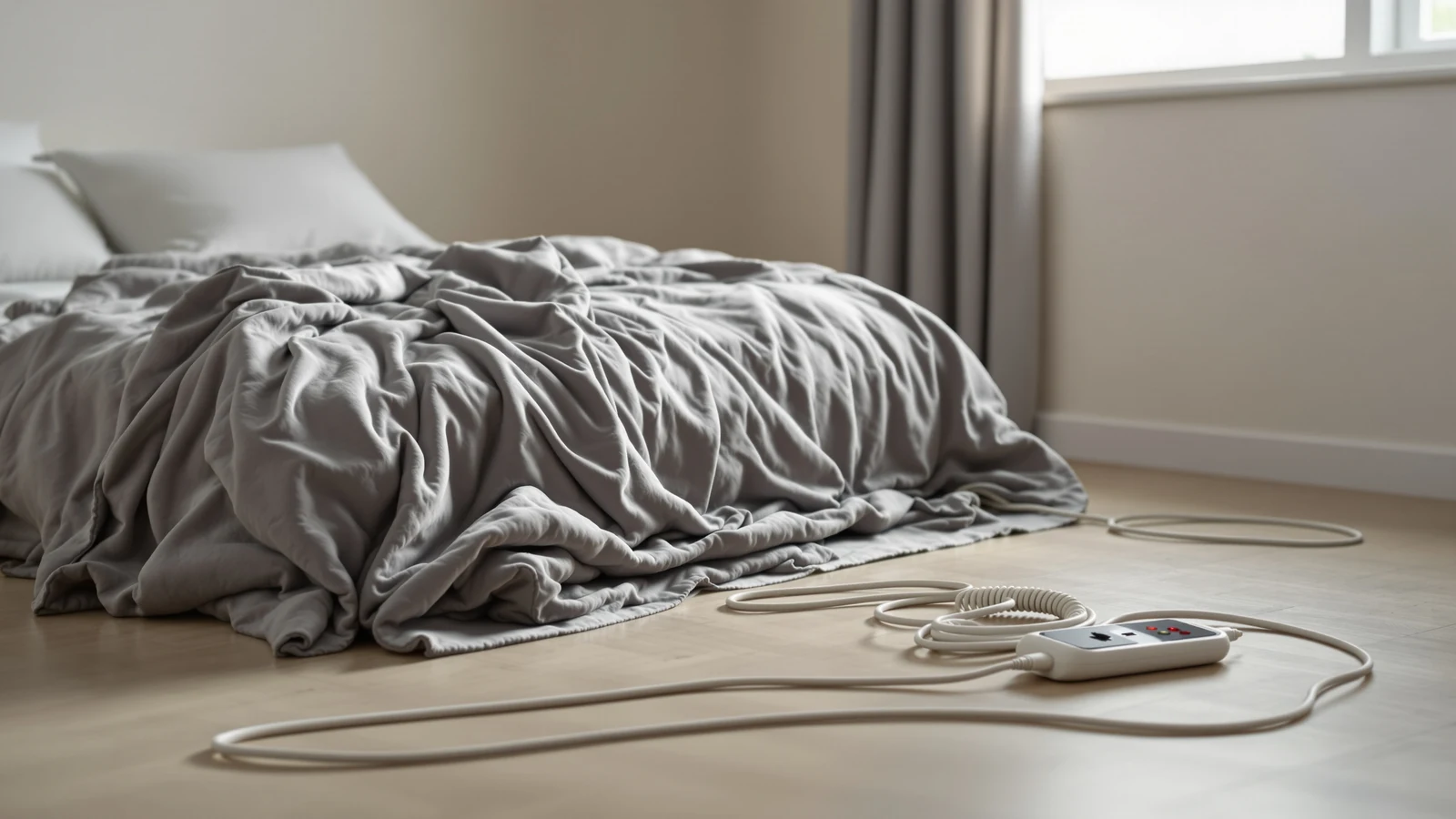
Electric heated blanket power cord with controller running from a wall outlet across a bedroom floor toward a queen bed
Quick answer

Longer than you'd guess from the photos

Cord length is almost never the headline spec on a heated blanket listing, and it's rarely visible in the main product photos, which tend to show the blanket folded, draped, or modeled rather than plugged in. Among the products we've researched for this site, three publish an unusually long figure: an 8.5-foot cord on a 50×60″ throw, a 15.1-foot cord on a queen dual-zone blanket, and a 16-foot cord on a second queen dual-control blanket. The right one depends less on the blanket than on where your outlet actually is — a measurement you can take yourself in thirty seconds, and the step most buyers skip.

This guide covers why the spec hides, what each length realistically reaches, why a queen bed needs more cord than a throw does, how to measure your room before you order, the three picks, and what an extension cord does to a blanket's safety certification.

Disclosure: this article contains affiliate links. If you buy through one, we may earn a commission at no extra cost to you — see our About page for how we research.

The listing itself

Why cord length almost never appears in the main photos

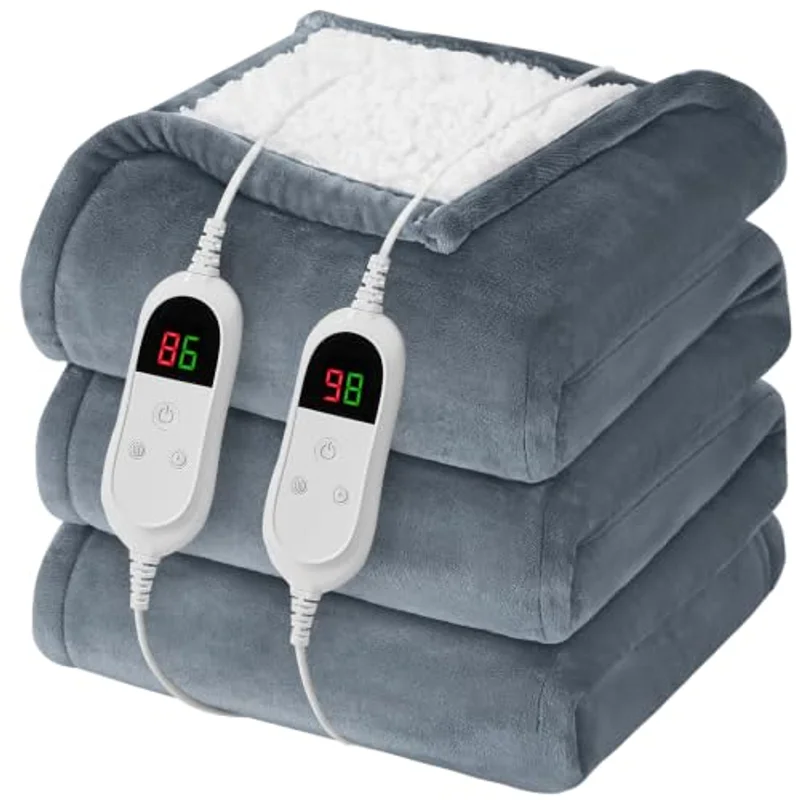
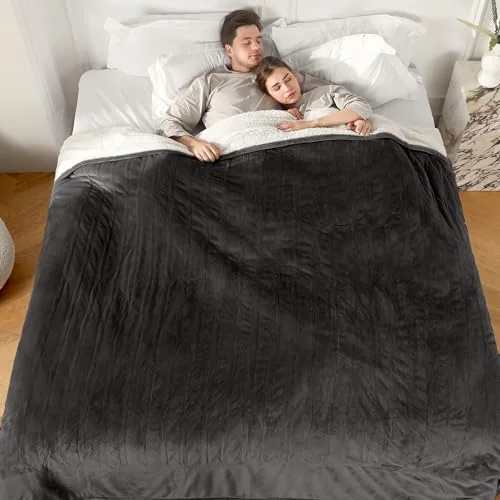
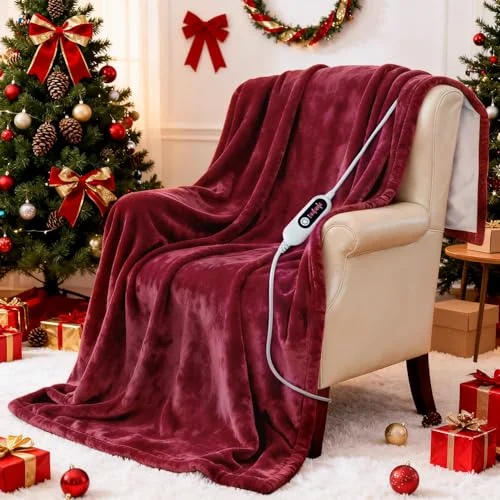
Open any heated blanket listing and the first five images are doing a predictable job: a lifestyle shot of the blanket draped over a sofa or bed, a close-up of the fabric texture, a shot of the controller face, maybe a size chart. None of those images are built to answer "how far does the cord reach," because that is not the question the photography is trying to sell. The blanket is the product being sold; the cord is treated as plumbing — necessary, unglamorous, and easy to leave out of frame.

Where the number does show up is almost always in the bullet-point feature list further down the page, usually the third or fourth bullet, phrased as an aside rather than a headline: "equipped with an 8.5ft extra-long power cord for flexible placement" is a typical example, tucked after sentences about flannel density and one-button controls. It is accurate information, but it is positioned as a minor convenience rather than the spec that decides whether the blanket works in your room at all.

Part of the reason is that most blankets in this category genuinely do ship with a short cord — something in the six-to-eight-foot range is standard, enough to reach a nearby outlet from a sofa arm or a nightstand, and manufacturers have no incentive to draw attention to a number that looks unremarkable next to the competition. The listings that do publish a long cord treat it as a selling point precisely because it is uncommon, which is also part of why you will occasionally see one brand's version of essentially the same blanket show up under more than one storefront listing with a different spec given the headline treatment each time. Don't rely on the hero image or the title to tell you anything about reach; scroll to the full bullet list, and if a cord length isn't stated at all, assume it's on the shorter end.

The arithmetic

What 8.5, 15.1 and 16 feet actually reach from a typical outlet

A number in feet means nothing without a room to put it in, so here is what each published length realistically covers, measured from a wall outlet rather than an idealized straight line — a cord runs along a baseboard or around a nightstand leg, not through open air.

8.5 feet is enough to reach most living-room arrangements: a sofa positioned six feet from the nearest outlet, with a foot or two of slack left over to route the cord along the floor rather than stretch it taut. That is comfortable for the great majority of seating layouts, and it is why this length shows up on a 50×60″ throw rather than a bed blanket — a throw's job is usually confined to one piece of furniture, not a whole room. Where it gets tight is a living room where the only outlet is behind a media console across the room, or an open-plan space where the sofa floats away from any wall.

15.1 feet is built for a different problem: a queen bed with a dual-zone controller on each side, which means the cord has to do two jobs at once — reach the wall, then branch far enough to put a working controller within arm's reach on both nightstands. A queen frame is roughly five feet wide; add the distance from a baseboard outlet to the near corner of the bed, and the far controller's run alone can eat six or seven feet. Fifteen-plus feet gives that routing room without forcing the cord diagonally across open floor — a trip hazard, and the first thing a guest notices.

16 feet is enough, in most primary bedrooms, to reach an outlet on the opposite wall from the bed entirely — useful in rooms where the headboard wall has no outlet at all, common in older housing stock where outlet placement was never planned around furniture layout. It is also enough slack to route a dual-control cord around the foot of a bed frame rather than underneath it, where it would press against wood or metal in a way manufacturers generally advise against. None of these numbers guarantee your specific layout, which is the point of the next section: a published cord length tells you what's possible in a typical room, not what's possible in yours.
Why beds need more than throws

Dual control and cord length: why queens need the longer cord more than throws do

A throw has one job and one likely position: folded over a lap or draped across a sofa back, with a single controller clipped within reach of whoever is sitting under it. One person, one seat, one short run from outlet to blanket — the whole reason a 50×60″ throw can get away with 8.5 feet of cord.

A queen dual-control or dual-zone blanket has a fundamentally different geometry. Two people sleep on opposite sides of a bed roughly five feet wide, and each side needs its own working controller within reach — the entire selling point of dual control, since the alternative is one shared dial and a nightly argument over whose setting wins. The cord isn't running from an outlet to one point; it's running to one side, then branching or continuing to the other, which can easily double the straight-line distance a throw would need for the same room.

The ESTINGO queen blanket covered below states dual control across 5 heating levels with its 16-foot cord, and the WEOPEN queen blanket states two fully independent heating zones — each with its own controller, its own 10-level range, and its own timer — supported by a 15.1-foot cord. In both cases the longer cord is not a luxury add-on; it is close to a functional requirement for the dual-control feature to work as intended. A dual-zone blanket with a short cord forces an awkward choice: route one controller's wire across the width of the bed where a sleeper will kick it, or abandon dual control in practice because only the near-side controller is reachable.

Treat cord length and control layout as one combined spec, not two separate ones, when you're comparing queen-size dual-control blankets against each other. A short-corded dual-zone blanket is a worse buy than a single-zone blanket with an adequate cord — you'd be paying for a second controller the cord won't let you actually reach.

Before you order

Measuring your own room before you trust the spec sheet

A published cord length is a straight-line number; your room isn't. The only reliable way to know whether an 8.5, 15.1, or 16-foot cord will work is to measure the real route it will take, not the shortest distance between two points on a floor plan.

Start at the outlet you intend to use, not the nearest outlet in the room — if the nearest one is behind furniture you cannot move, or already occupied by a lamp charger you aren't giving up, measure from the one you'll actually use. From there, trace the path the cord will physically follow: along the baseboard, around the foot of a bed frame, behind a nightstand leg, not diagonally across open carpet. Add a few inches for every obstacle it has to clear, since a cord pulled taut around a corner uses more length than the same corner measured in a straight line.

For a bed blanket with dual control, measure to both intended controller positions separately, then take the longer route plus the width of the bed if the cord has to cross from one side to the other. For a throw, measure to wherever the controller will actually sit in use — on a cushion or a side table, not the blanket's folded storage spot. The same room-first logic applies to a blanket's footprint, not just its cord; our size-by-size breakdown of one brand's full range walks through that measure-before-you-buy approach for dimensions. Leave at least a foot of slack beyond whatever you measure — a cord pulled to its limit strains the plug at both ends, and a too-short cord that "just barely" reaches today stops reaching the moment you shift the bed six inches during a seasonal cleaning.

The picks

Three with a published cord length worth checking against your room

Ordered by cord length, shortest to longest. Prices move on Amazon — confirm the live price before buying.

01Longest throw cord

Heated Blanket Electric Throw, 50×60″

An 8.5-foot cord on a single-seat throw
50×60″ throw · 5 heat levels · 10 h auto-off · 8.5 ft cord · ETL certified · flannel

At $25.99 this is the least expensive of the three, and the 8.5-foot cord is the longest we have found on a throw this size — most compact throws run shorter. It's built around a one-button control with five temperature levels, a ten-hour automatic shut-off, and overheat protection, with ETL certification stated on the listing. The double-sided flannel construction works as an ordinary throw even unplugged, with the heating element topping up warmth the fabric already holds. The trade-off against the two queen picks below is scope: five heat levels against a ten-level range, and a single controller rather than independent zones — the right amount of control for one person on one piece of furniture, not enough for a shared bed.

Heated blanket electric throw, 50 by 60 inches, flannel, with controller and power cord
$25.99
Throw · 8.5 ft cordCheck price →
02Dual-zone, 15.1 ft

WEOPEN Heated Electric Blanket, Queen

Two independent zones, each reachable without rerouting furniture
Queen 84×90″ · two independent heating zones, 10 levels each (83–113°F) · per-side timers to 8 h · 15.1 ft cord · ash gray

At $50.99, the WEOPEN splits a queen bed into two fully independent heating zones, each with its own LED controller, ten-level range from 83 to 113°F, and selectable timer at one, two, four, six, or eight hours, with an automatic full shut-off as a backstop. The 15.1-foot cord is sized for exactly the scenario described above: a working controller on both sides of a queen bed without forcing one sleeper's wire across the mattress. At 84×90″, it's generous enough that two adults can move around without dragging the blanket off each other. What you give up next to the ESTINGO below is half a foot of cord and its named flannel-and-sherpa face; what you gain is the finer ten-step range on each independent zone.

WEOPEN dual control heated electric blanket, queen size, ash gray, with power cord
$50.99
Queen · 15.1 ft cordCheck price →
03Longest cord, 16 ft

ESTINGO Electric Blanket, Queen

The longest published cord of the three, for the hardest-to-reach outlets
Queen 84×90″ · dual control, 5 heating levels · 10 h auto-off · 16 ft cord · ETL & FCC certified · reversible flannel/sherpa

At $59.99, the ESTINGO pairs a reversible flannel-and-sherpa construction with dual controllers across five heating levels and a ten-hour automatic shut-off, and it publishes the longest cord of the three at 16 feet — the listing describes it as long enough to reach an outlet without rearranging the bedroom. That extra length is the advantage over the WEOPEN above: in a bedroom where the only outlet sits on the wall opposite the headboard, or a dual-control run has to clear the foot of the bed, the extra distance is the difference between a clean installation and one that drapes across open floor. Dual control here means two separate controllers rather than two independently zoned grids, so the temperature range is coarser than the WEOPEN's ten-level zones; it carries both ETL and FCC certification.

ESTINGO electric blanket, queen size, dark gray, dual control with power cord
$59.99
Queen · 16 ft cordCheck price →
ModelBest forSizeCord lengthControlPrice
Heated Blanket Electric ThrowSofa, one outlet nearbyThrow 50×60″8.5 ftSingle, 5 levels$25.99Price
WEOPEN QueenDual-zone queen, mid-length runQueen 84×90″15.1 ftTwo zones, 10 levels each$50.99Price
ESTINGO QueenOutlet across the roomQueen 84×90″16 ftDual, 5 levels$59.99Price
The thing nobody warns you about

What an extension cord does to the safety certification

It is tempting, if even a 16-foot cord still falls short, to simply add an extension cord and call the problem solved. This is where the math stops being about feet and starts being about certification. ETL and UL safety marks certify the product exactly as it ships — the blanket, its controller, and its own attached cord, tested together as one assembly. Introduce a separate extension cord between the wall and the blanket's plug, and you've created a combination that was never part of what any testing lab evaluated.

Heated blankets draw a small but steady current over long, unattended stretches of time — often eight to ten hours overnight — a different load profile than a lamp or phone charger switched on and off. A generic household extension cord, particularly a thin or coiled one, isn't built with that steady low-wattage, long-duration draw specifically in mind, and manufacturer instructions for this category commonly tell you not to use one. Running one anyway moves the device outside the conditions its certification was tested under, which is meaningfully different from simply voiding a warranty.

The better fix, in order: see whether the blanket's own cord makes an extension unnecessary once you measure the real route rather than guessing. If the outlet truly can't be reached, move the furniture closer to it instead. If neither works, that's a signal the specific blanket is the wrong fit for the room — a shorter-cord blanket paired with a nearer outlet is the safer buy than a longer-cord blanket bridging the rest of the way with aftermarket cabling.

How we picked

Three products, chosen for the spec this guide is about

We looked for products in our research set that publish a cord length at all, since most listings in this category omit the figure. Of those, we kept the three with the longest stated lengths and the most complete supporting specification — dimensions, heat settings, auto-off behavior, and a named safety certification — so the comparison rests on published numbers, not a guess.

How we compared

Research, not a lab

We're honest about this: we don't physically test these blankets and we don't run a testing lab. We compare the cord lengths, heat settings, and certifications each listing states, alongside current pricing, and anchor every claim about reach and routing in general facts about outlet placement and furniture geometry. Amazon no longer exposes verified star ratings through its product API, and we don't paraphrase review sentiment as a substitute — you won't find rating badges or "owners say" claims anywhere in this guide.

FAQ

Common questions

Why doesn't the listing show the power cord in the main photos?

Because the photography is built to sell the blanket itself — fabric, folded shape, controller face — not the cord, which gets treated as a minor accessory. The cord length almost always appears instead as a bullet point further down the page, usually the third or fourth one, rather than in the title or the hero image. If a listing doesn't state a cord length anywhere in the bullets, assume it is on the shorter, unremarkable end rather than the longer one.

How do I know if an 8.5-foot cord will reach my outlet?

Measure the actual route the cord will take, not the straight-line distance on a floor plan: from the outlet you intend to use, along the baseboard, around furniture legs, to wherever the controller will sit in use. Add a few inches for every obstacle the cord clears, and leave at least a foot of slack beyond that measurement so the plug isn't under constant strain.

Why do queen dual-control blankets need longer cords than throws?

A throw serves one person in one seat, so the cord only has to make one short run from outlet to controller. A dual-control queen blanket needs a working controller on both sides of a bed roughly five feet wide, which means the cord effectively has to reach one side and then extend or branch to the other — a materially longer real-world distance than a single-seat throw ever needs, even on the same size room.

Can I use an extension cord if the blanket's cord is still too short?

We'd advise against it. Safety certifications like ETL and UL test the blanket, its controller, and its own attached cord as one assembly; adding a separate extension cord creates a combination that was never part of that testing, and manufacturer instructions for this category commonly advise against it. It's safer to measure first and choose a longer-corded model, or move the furniture closer to the outlet, than to bridge the gap with aftermarket cabling.

Keep reading

Related reading